Reply To:
Name - Reply Comment
 The recent decision by the Bar Association of Sri Lanka (BASL) to stage a nationwide boycott of court proceedings following the tragic murder of Attorney-at-Law Buddhika Mallawarachchi and his wife has reignited a crucial debate: Do lawyers have the right to hold the justice system hostage to express their grievances, no matter how legitimate those grievances might be?
The question took a sharply ironic turn at a BASL press conference in Colombo, where a journalist silenced the entire panel with one pointed query: if the gunmen who shot the lawyer are arrested tomorrow, would members of the very same association appear in court to defend them? The BASL president’s uncomfortable moment following this question laid bare the profession’s deep-seated double standard.
While the brutal shooting at a supermarket car park in Akuregoda on Friday was undeniably shocking, particularly given its proximity to the Army Headquarters and the NPP’s Pelawatte office, the collective decision to abandon courts across the country raises serious questions about professional responsibility and the precedence of personal protest over public duty.
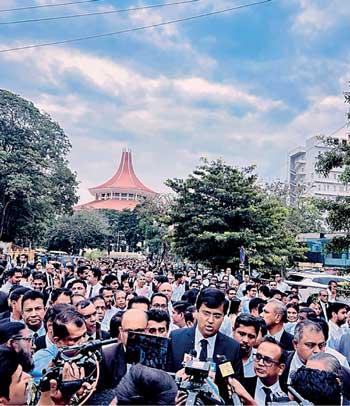 |
| BASL President Rajeev Amarasuriya responding to media |
The Immediate Impact on the Innocent
When BASL President Rajeev Amarasuriya announced that all attorneys-at-law islandwide would refrain from court work, the message was clear: lawyers were prioritising their own security concerns over the rights of thousands of clients awaiting justice. These clients, many of whom have paid substantial fees, found themselves in legal limbo through no fault of their own.
The irony is particularly sharp. Lawyers who regularly defend individuals accused of serious crimes, including murder and narcotics offenses, often earning undeclared income without issuing receipts -- as critics have pointed out -- suddenly find it unacceptable to continue their professional duties when their own community is threatened. This selective application of professional obligation exposes a fundamental hypocrisy in the legal profession’s relationship with society.
National Security Is Not a New Problem
The shooting spree that claimed the lives of the attorney and his wife is part of a broader pattern of underworld violence. Four people were injured in a shooting in Jinthupitiya that left one dead, and another individual was killed in Kalutara. These incidents reveal a deteriorating security situation that affects all citizens, not just members of the legal profession.
The police response to such incidents often involves checking licenses and insurance cards, a superficial reaction that fails to address root causes. With the vehicle used in the Akuregoda shooting burned and authorities scrambling to recover dash cam footage, the investigation has become a wild goose chase. The government’s tendency to attribute these incidents to underworld activity creates a never-ending cycle of violence. Yet this security crisis affects everyone equally. Lawyers are not being specifically targeted because they are lawyers; they are victims of the same criminal networks that threaten all Sri Lankans.
A Repetition of 1958
This is not the first time Sri Lanka’s legal community has threatened to “down tools.” Historical records from Hulftsdorp, the nation’s legal hub named after Dutch General Hulft, reveal a similar confrontation in 1958. Then, lawyers opposed Justice Minister M.W.H. de Silva’s proposal to regulate fee charging, which the minister deemed irrational and arbitrary. The Bar Council passed a resolution condemning the idea and threatened trade union action.
That 1958 dispute centered on protecting professional autonomy against what lawyers called “totalitarian” legislation. Senior counsel C.G. Weeramanthri QC argued that political control would undermine public confidence in the profession. The lawyers claimed they were “the most honorable body of taxpayers in this country” and resisted any external oversight of their fee structures.
The Question of Accountability
The minister in 1958 had raised legitimate concerns about irregularities: lawyers failing to diligently attend cases, misapplying entrusted funds, and misappropriating client money. His proposed legislation aimed to ensure public confidence — the very confidence lawyers claimed would be damaged by regulation.
Senior counsel S. Nadesan made a crucial point: since lawyers were “beings of statute,” they could protest ministerial control but not legislative oversight. Just as the state could regulate wages and prices, it could manage legal fees. This principle extends to professional conduct: lawyers who serve the public cannot arbitrarily withdraw their services.
George Bernard Shaw’s observation that “all professions are conspiracies against the laity” takes on particular resonance here. The legal profession, which positions itself as the guardian of justice and defender of rights, reveals its true priorities when collective action prioritises guild interests over individual client needs.
Lawyers are indeed expected to act with integrity, courtesy, and honesty. They should promote public confidence in the judiciary. But how does abandoning the courts en masse promote such confidence? How does leaving clients stranded demonstrate professional integrity?
A Reasonable Alternative
No one disputes the horror of the Akuregoda murders or questions the legitimate security concerns of Sri Lanka’s legal community. The violence is real, the threat is serious, and the government’s response has been inadequate. These are facts that demand action.
But action need not take the form of collective abandonment of duty. Lawyers could have continued their professional obligations while simultaneously pressing for enhanced security measures. They could have organised demonstrations outside working hours, petitioned parliament, engaged media attention, and lobbied for concrete protective measures, all without leaving their clients in the lurch.
The security crisis affects judges, court staff, witnesses, and litigants as well. Yet these groups continue to fulfill their roles in the justice system. Why should lawyers be exempt from similar professional commitment?
Conclusion
The practice of lawyer strikes, whether protesting murder in 2026 or fee regulation in 1958, represents an unreasonable assertion of professional privilege over public duty. While lawyers rightfully protest against violence and demand better security, they cannot do so by holding the justice system hostage.
If the government continues to pass responsibility for security onto vague “underworld” forces, it perpetuates a cycle of violence that threatens everyone. But lawyers compounding this failure by withdrawing their services only adds another layer of injustice, this time inflicted by those sworn to uphold the law.
The legal profession must recognise that its members are citizens first, subject to the same risks and entitled to the same protections as all Sri Lankans. Their professional status does not grant them the right to suspend justice whenever they feel threatened. In a functioning democracy, no profession, however learned, can claim such extraordinary privilege.
The march from the BASL premises to the Superior Courts complex was meant to signal outrage over the killings. But here is the savage irony that no one in the legal fraternity dares confront: those same black coats that draped themselves in solemnity during that march will, when the murderers are hauled before a court, sweep into the dock to defend them. They will argue technicalities, challenge evidence, and demand bail — for the very men who gunned down their colleague. And when pressed, they will hide behind four words: “The Constitution says so.”