Reply To:
Name - Reply Comment
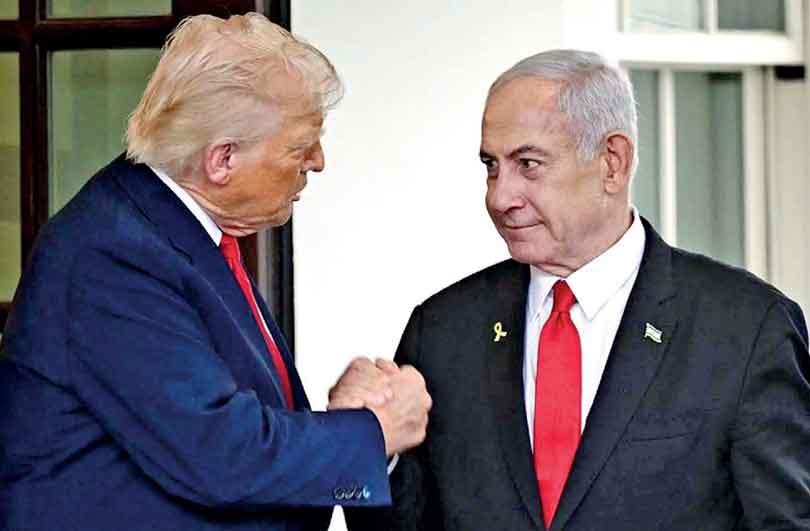
Ironclad ties: US President Donald Trump shakes hands with Israeli Prime Minister Benjamin Netanyahu as Netanyahu departs the White House in Washington, DC, on April 7, 2025. (AFP)
 It is like walking through a minefield. The memorandum of understanding (MoU), signed on June 17 by Iranian President Masoud Pezeshkian and US President Donald Trump, is surviving on a diplomatic shoestring despite a still‑unbridged trust deficit between the belligerents and sinister efforts by Israel to torpedo it.
Israel is not going to give up its efforts to sabotage the deal anytime soon. It knows well that the emerging security architecture of West Asia will not serve its national interest, especially its unlawful drive to annex as much Arab land as it can. Hence, it pays no heed to US calls to end military operations in Lebanon.
Trump seems determined to preserve the hard‑earned MoU, but at the same time he has threatened fresh strikes against Iran, provoking the Islamic Republic, the new superpower of West Asia. The threats nearly killed the talks last Saturday at the Swiss holiday resort of Buergenstock, with Iran announcing that it would close down the Strait of Hormuz again if Israel did not hold fire. The Lebanon ceasefire is clause one of the deal, which also calls on the US to desist from issuing threats.
These threats only prove that Trump is an enigma. On the one hand, he lashes out at Israel for ignoring his advice to cease military operations in Lebanon. On the other, he provokes Iran with rhetoric that pleases Israel and threatens to kill the MoU. It appears he wants both to save and to kill the deal; to attack Israel verbally while also appeasing it.
Given this dilemma, the deal hangs precariously, and much diplomatic effort—especially by mediators Pakistan and Qatar—is still needed to consolidate it. A thaw is vital to save the deal. But it is not an easy task. The US has allowed its Middle East policy sovereignty to be compromised by interference from Israel and the Zionist lobby. The lobby influences presidents and lawmakers through campaign funding and other means.
In return, lawmakers ensure Israel’s interests are protected in US policy decisions. As a result, the US finds itself in a foreign policy quagmire, often abandoning policies that serve exclusively American interests in favour of compromises that accommodate Israel’s. Leaders proudly proclaim the relations between the two nations are ironclad and unshakeable.
However, such compromises have their limits, as seen in successive US presidents’ rejection of Israel’s proposals over the past two decades to launch a joint military attack on Iran. But not Trump; he fell for the Israeli trap.
The last time a US president truly put America first was John F. Kennedy. In the early 1960s, he was determined to chart a foreign policy independent of Israel. Upon learning that Israel was secretly developing a nuclear weapon, he opposed it vehemently and warned of consequences if it did not come clean before his deadline. But before the deadline, Kennedy was assassinated. To date, the assassination remains a mystery, with any independent research linking Israel to the murder dismissed as a conspiracy theory.
In 2018, months before Trump took over, the outgoing president, Barack Obama, diplomatically manoeuvred the UN Security Council to enable passage of a resolution calling on Israel to stop settlement-building activities in occupied Palestine, only to draw a retort from President-elect Trump that he would undo it as soon as he was sworn in. And Trump did more than that. To appease Israel, he not only withdrew the US from the Obama-era foreign policy achievement—the Joint Comprehensive Plan of Action (JCPOA), designed to curtail Iran’s uranium enrichment—but also recognised Jerusalem as the undivided capital of Israel and Syria’s Golan Heights as part of Israeli territory.
Such were his pro-Israel credentials. So much so that he did not hesitate to join Israel when its hawkish prime minister Benjamin Netanyahu broached the idea of bombing Iran, while Pentagon experts are said to have expressed strong reservations. Trump realised his mistake only when Iran ultimately proved to be his Waterloo.
He then went for the next best option—a deal he could sell as a victory. Hardly any American accepts his interpretation. The world knows that Iran won and is getting most of what it wants through the deal. Smarting over his battle wounds, Trump has few options left except for implementing the MoU and working toward a final deal that may grant more concessions to Iran than the JCPOA did.
The military option is definitely out, with Iran—despite enduring more than 3,000 US-Israeli strikes that caused severe damage to its military, nuclear, and civilian infrastructure—demonstrating its military might by controlling the vital Strait of Hormuz. Just yesterday, Iran warned ships they would be attacked if they used routes other than the ones designated by its Revolutionary Guards. The warning underscored Iran’s upper hand in Hormuz affairs. It came after Iran’s top delegation held talks with Oman and US Secretary of State Marco Rubio’s call—during a visit to the region—for toll-free passage. Iran defends the strait like its goalkeeper Alireza Beiranvand saved shot after shot from Belgium in this week’s World Cup game in the US.
Iran is playing 6D chess. Trump has been checkmated. The word ‘checkmate’ has Persian, Sanskrit, and Arabic etymological roots—it derives from the phrase ‘Shah Mat,’ meaning ‘the king is helpless’ (Persian and Sanskrit) or ‘the king is dead’ (Arabic).
Yet despite the checkmate, animosity toward Iran within the Trump administration is so widespread that the survival of the deal remains uncertain.
From War Secretary Pete Hegseth to Secretary of State Rubio, US Ambassador to Israel Mike Huckabee, and Trump’s UN envoy, most of his team consist of staunch Zionists. Trump’s chosen delegate to the Swiss talks—Jared Kushner—is equally a strong Zionist.
Perhaps the outlier is Vice President J.D. Vance. He appears to be the mediators’ preferred choice to lead the US delegation. At Buergenstock, he and the Iranian delegation led by Parliament Speaker Mohammad Bagher Ghalibaf and Foreign Minister Abbas Araghchi were seen in one politically significant picture frame.
Vance has repeatedly berated Israel, asking it to be more grateful for all the favours the US has done for it. The Zionist lobby has already begun working to scuttle his chances as the Republican candidate for the 2028 presidential race.
As the pro‑Israel undercurrents continue within the Trump administration, the White House said nothing about the Pentagon raising alarms to the highest critical level over Israel’s intensifying espionage activities in the US.
See how unresponsive the Trump administration has become when the Israeli prime minister, in defiance of Trump, had the chutzpah to say Trump could do what was right for the US, but Israel would do what was right for Israel? Israel attacks Lebanon. Trump berates Israel and uses profanity, but Washington will not—and cannot—decouple from Israel.
The US–Israeli rift may appear to be real, but not permanent. It’s all part of the game. Needs proof? Decades ago, when Washington arrested high‑profile Israeli spy Jonathan Pollard for espionage, it continued to remain Israel’s all‑weather friend. In similar servility, the US took no action when its warship, the USS Liberty, was attacked by Israel during the 1967 war—even after the captain identified the ship—causing the deaths of more than 30 US sailors. Trump is a bigger Zionist than the presidents who were in office when these incidents occurred.