AI SUMMARY GENERATED ONLY FROM THIS ARTICLE'S TEXT.
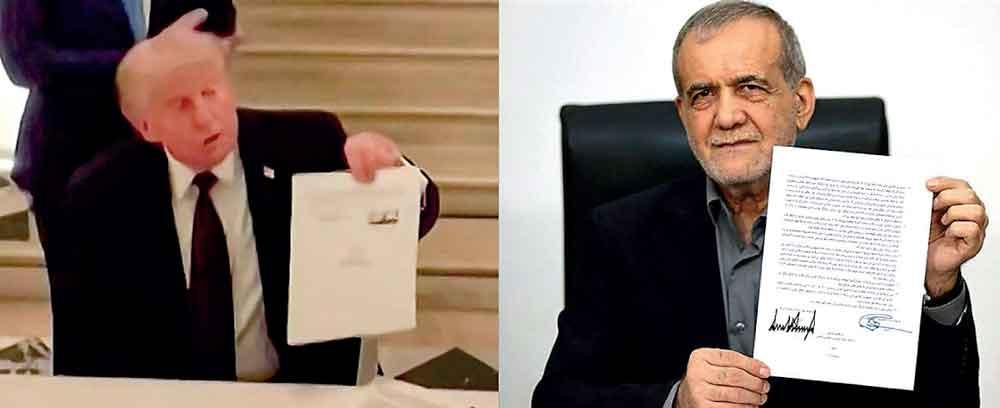
US President Donald Trump and Iran’s President Masoud Pezeshkian holding the memorandum of understanding they signed on Wednesday to end the West Asian war. AFP
Before delving into the 14-point document, the first segment in a two-part process, a word about those who made it possible: “Blessed are the peacemakers.” Mediators Pakistan and Qatar worked tirelessly against unbridgeable odds to secure a working document after months of diplomacy
The long-awaited deal between Iran and the United States is now a reality. Yet the path ahead is paved with uncertainty and geopolitical mines that could shatter the memorandum of understanding or the framework for further talks.
Before delving into the 14-point document, the first segment in a two-part process, a word about those who made it possible: “Blessed are the peacemakers.” Mediators Pakistan and Qatar worked tirelessly against unbridgeable odds to secure a working document after months of diplomacy. Hats off to these nations and others engaged in behind-the-scenes efforts at persuasion to bring peace and hopes of economic revival to West Asia and the wider world. The diplomatic contributions of Saudi Arabia and Turkey cannot be overstated.
Peace requires greater effort than war. Peace also can be a prelude to war. The freer the peace process from secret agendas, the greater its value. We do not yet know how agenda-free the deal is. As events unfold, we shall know whether the agreement signed in Versailles by President Trump after he attended the G7 summit and Iran’s President Masoud Pezeshkian in Tehran is truly peace-centred or strategically loaded for further conflict.
Given the intensity of the hostilities, the deal may signal more of a pause in the conflict than real peace. It is not even called a peace deal. It is also not clear whether a formal ceremony will take place in Bergenstock, the Swiss mountainous resort area. A desperate Trump agreed to terms widely seen as favourable to Iran not out of love for peace but from the realisation that continued conflict could cost the Republican Party electoral defeats — not only in the midterm elections in November but also in the next presidential race.
However, there is no guarantee that a future US government — or even the current one — will not resume hostilities to appease Israel, though at present there are no such signs. US Vice President J.D. Vance has been tasked with selling the deal to hardline and Israeli-friendly segments of the US political scene on both sides of the divide. In a news conference on Thursday, he urged Israel to behave responsibly and not to scuttle the deal.
At present, Iran holds the upper hand. It has demonstrated its ability to leverage the strategic Strait of Hormuz. It has proved both its resilience in the face of relentless US and Israeli attacks and its military capability to inflict pain on its enemies. The US-Israeli war, far from achieving its objective of regime change, pushed the Iranian people — even its critics — to rally behind the theocratic leadership and stabilise the government.
Iran will prevail as long as the strategic importance of the Strait of Hormuz is not undermined by new energy pipelines, which, according to experts, are an expensive alternative. A new Iran-centred security architecture is also emerging in the region, with Gulf nations preferring cooperation to confrontation in dealing with their powerful neighbour.
In peace, there are no losers: only winners. On this score, the US wins. Iran wins. But there is a loser: Israel. In the MoU, there is nothing that pleases Israel — only blows. Much to the chagrin of Israel, the MoU calls for an end to Israeli operations in Lebanon and rejects key Israeli demands that Iran stop supporting Hezbollah and Hamas and reduce its missile range.
Moreover, Israel’s Prime Minister Benjamin Netanyahu has also earned the displeasure of President Trump, whom he often hails as Israel’s greatest ally. Yet Israel will not easily abandon its determination to weaken Iran, the main obstacle to the Zionist regime’s expansionist drive. Israel continues to bomb Lebanon, hoping to provoke an Iranian retaliation that could force the US to side with Israel and derail the peace process. Both the US and Iran are not unaware of Israel’s designs.
Whatever the US rationale for signing the MoU, Trump deserves credit for swallowing his pride and taking the difficult decision to sign the deal with Iran, a nation he had berated as the world’s number one sponsor of terrorism. Backed by Vice President J.D. Vance, he demonstrated political acumen even as detractors slammed the MoU as the worst foreign policy blunder in decades, worse even than President Barack Obama’s 2015 Joint Comprehensive Plan of Action (JCPOA). Trump withdrew from the JCPOA, decrying it as the worst capitulation to Iran and accusing Obama of sending money to Iran, enabling it to build missiles and drones to attack Israel and the US.
Now Trump is offering more concessions to Iran than Obama did, though he insists his deal is better than Obama’s JCPOA. He claims victory, pointing to Iran’s assurance not to pursue a nuclear weapon – a position Iran has always maintained.
It is not easy for Iran to accede to the MoU either. After all, the US has killed Iran’s Supreme Leader Ayatollah Ali Khamenei and key figures over the years – scientists and military commanders. Among them Qassem Soleimani, the celebrated Revolutionary Guard commander. His assassination in 2020 signalled the beginning of the military conflict between Iran and the US. Moreover, some 170 primary school girls and their teachers were killed in a US-Israeli attack on the very first day of the war on February 28.
Here is a summary of the 14‑point deal named the Islamabad Memorandum of Understanding that signals an end to the war that began on February 28:
1.All military operations to end on all fronts, including Lebanon.
2.The parties will respect each other’s sovereignty and territorial integrity and refrain from interfering in each other’s internal affairs.
3.The final deal is to be achieved in 60 days, extendable with mutual consent.
4.The US will remove the naval blockade—a process to be completed within 30 days—and remove its forces from the vicinity of Iran within 30 days.
5.Iran will ensure safe passage of commercial vessels with no charge for 60 days. Demining to begin. Iran will hold talks with Oman and other Gulf states to define the future administration of the strait.
6.The US with regional partners will develop a USD 300 billion plan for the reconstruction and economic development of Iran.
7.The US undertakes to terminate all sanctions against Iran.
8.Iran will not procure or develop nuclear weapons. A mechanism is to be devised to dispose of stockpiled enriched material. Iran’s enrichment needs to be discussed, based on a framework being agreed upon in the final deal.
9.Pending the final deal, Iran will maintain the current status quo of its nuclear programme, and the US will not impose any new sanctions or deploy additional forces in the region.
10.The US Department of Treasury will issue waivers for the export of Iran’s oil and all associated services, including banking transactions, insurance and transportation.
11.The US undertakes to release the frozen funds and assets of Iran.
12.An executive mechanism will be established to monitor the implementation of the MoU and the future compliance of the final deal.
13.After signing the MoU, and subject to the implementation of paragraphs 1, 4, 5, 10 and 11 of the MoU, the two countries will start negotiations regarding the final deal.
14.The final deal will be endorsed by a binding UNSC resolution.
It appears Iran has secured most of what it wanted in the deal, while the US must be satisfied with a sharp drop in oil prices and an assurance from Iran not to pursue a nuclear bomb. The conflict teaches the US a lesson on how not to wage an unwinnable war while underestimating the enemy’s strength, based on the dubious assurances of an opportunistic ally like Israel.
Comments - 0
Comments - Iran-US MoU: Peace or pause?
222
Add comment
Comments will be edited (grammar, spelling and slang) and authorized at the discretion of Daily Mirror online. The website also has the right not to publish selected comments.



 The long-awaited deal between Iran and the United States is now a reality. Yet the path ahead is paved with uncertainty and geopolitical mines that could shatter the memorandum of understanding or the framework for further talks.