Reply To:
Name - Reply Comment
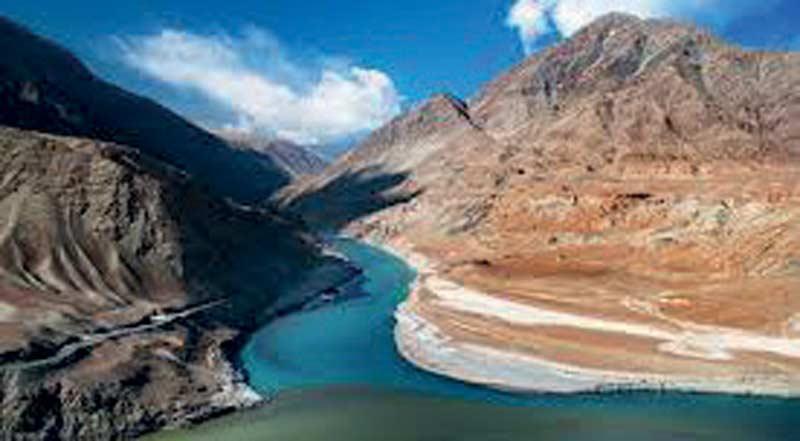
The Zanskar River — in Ladakh, India — is the first major tributary of the Indus River. Water demand in India and Pakistan has intensified since the Indus Waters Treaty was signed in 1960
 Recent events in South Asia offer critical lessons for Sri Lanka as it navigates new energy and infrastructure agreements with India. While relations between India and Sri Lanka have historically been more cordial than the often-hostile India-Pakistan relationship, recent tensions between India and Pakistan illustrate how resource dependency can be weaponised during diplomatic crises, irrespective of existing goodwill.
The immediate context comes from the tragic militant attack in Pahalgam, Indian-administered Kashmir, on April 22, 2025, which claimed the lives of 26 tourists and injured 17 others. The Resistance Front claimed responsibility, igniting a sharp escalation of tensions between India and Pakistan. Prime Minister Narendra Modi’s strong response and Pakistan’s countermeasures—including expelling Indian nationals and halting commercial exchanges—have revived fears of wider conflict.
Perhaps more significant from a strategic perspective is India’s threat to suspend the Indus Waters Treaty (IWT), a landmark 1960 agreement that has survived multiple wars and tensions. Under the IWT, India controls the eastern rivers, while Pakistan holds rights to the western rivers. For decades, this Treaty was hailed as a model of successful transboundary water management, offering a rare example of cooperation between bitter rivals. However, India’s current threats reveal how easily even long-standing agreements can become leverage points during crises.
This backdrop is particularly relevant for Sri Lanka, which recently signed several significant energy-focused memoranda of understanding with India. These agreements include an interconnection of the countries’ power grids, a multi-product petroleum pipeline, and a tripartite agreement with India and the United Arab Emirates to develop Sri Lanka as a regional energy hub. The tripartite agreement is notable not just for its economic ambition but also because its documentation unusually included Hindi and Arabic alongside English—an unprecedented move that some interpret as signaling emerging power dynamics.
Critics argue that Sri Lanka risks creating new vulnerabilities. Unlike Pakistan’s unavoidable dependence on rivers flowing from India due to geography, Sri Lanka has voluntarily entered into these energy partnerships. This distinction suggests that Sri Lanka retains the ability to shape its agreements with stronger safeguards. However, the risks remain real.
Concerns are heightened by the reality that India itself is not energy self-sufficient. It would effectively act as a middleman, importing energy and supplying it to Sri Lanka via the proposed pipeline. Dependence on an external supplier for critical energy needs—even one with historically friendly relations—could become a strategic liability if diplomatic relations sour or if India faces its own energy shortages.
Adding further complexity, Sri Lanka already faces influence from multiple directions. Chinese infrastructure investments have generated accusations of “debt-trap diplomacy,” where the loss of operational control over key assets, such as Hambantota Port, has fueled political controversy. India’s recent push into Sri Lanka’s energy and utility sectors could similarly create operational dependency.
The broader geopolitical trend across South Asia suggests that resource agreements are increasingly becoming tools of leverage rather than solely mechanisms of cooperation. Just as India now considers using the Indus Waters Treaty as a pressure point against Pakistan, analysts point to China’s control of the headwaters of many of India’s rivers in Tibet as a future potential weapon in Sino-Indian conflicts. In this environment, Sri Lanka’s leaders must be acutely aware that today’s friendship does not guarantee tomorrow’s impartiality.
Sri Lanka’s strategic challenge is to harness opportunities for development while safeguarding national autonomy. Its prime location along vital Indian Ocean shipping lanes makes it attractive for major powers seeking influence. Thus, while regional integration offers economic benefits, agreements must be crafted with foresight to avoid inadvertently ceding too much strategic control. These questions of sovereignty and dependency are not new in India-Sri Lanka relations. Since independence, the two countries have experienced periods of tension and reconciliation. In the immediate post-independence period, Sri Lanka viewed India as inheriting the British Empire’s regional ambitions, especially regarding strategic maritime positions like Trincomalee. Sri Lanka’s decision to sign a defense pact with Britain in 1947 instead of India reflected these anxieties.
A major turning point came after India’s withdrawal of the Indian Peace Keeping Force (IPKF) from Sri Lanka in the late 1980s. Thereafter, India pursued a more hands-off approach to Sri Lanka’s ethnic conflict, preferring political solutions over military interventions. This change paved the way for improved relations, culminating in the 1998 Indo-Sri Lanka Free Trade Agreement. Several factors contributed to this shift: India’s banning of the LTTE after Rajiv Gandhi’s assassination, Tamil Nadu’s evolving stance on the conflict, the LTTE’s growing international networks, and changing regional dynamics following the Cold War.
Nevertheless, strategic calculations continued to underlie relations. India’s overriding interest has been Sri Lanka’s stability, viewed as essential for India’s own security. For Sri Lanka, concerns often stemmed from the Sinhalese majority’s perception of being a demographic minority compared to the Tamil population spread across both countries.
Today, echoes of these historical dynamics can be seen in the controversy surrounding the potential sale of a controlling 51% stake in Colombo Dockyard Limited to Mazagon Dock Shipbuilders Limited, an Indian state-owned company. Japanese company Onomichi Dockyard, facing financial difficulties, has announced its intention to divest its stake. However, the Frontline Socialist Party has raised alarms, pointing out that Mazagon primarily manufactures warships and submarines for the Indian military. FSP leaders argue that allowing an Indian defense contractor to control a key Sri Lankan shipyard could have serious strategic implications.
They further stress that under existing agreements with Japan, any sale of this nature requires Sri Lankan government approval—a safeguard that they urge the current administration to invoke. The FSP also calls on the opposition to resist the proposed transaction, viewing it as another step toward eroding Sri Lanka’s strategic autonomy.
Taken together, these developments underline the urgent need for Sri Lanka to carefully balance economic engagement with strategic caution. While closer ties with India offer significant opportunities—particularly at a time of economic hardship—care must be taken to avoid becoming overly reliant on any one partner for critical resources or infrastructure.
The current India-Pakistan crisis over Kashmir—and the potential unraveling of the Indus Waters Treaty—demonstrates how easily vital lifelines can be turned into bargaining chips during times of stress. Sri Lanka would do well to remember that in international relations, friendship and strategic interest are distinct considerations. Agreements must be designed not just for times of harmony but also for times of friction.
As Sri Lanka seeks a path to recovery and growth, it must structure its partnerships to maximize benefits while preserving sovereignty. Otherwise, today’s opportunities could become tomorrow’s vulnerabilities in an increasingly competitive and uncertain regional environment.
Writer can be contacted [email protected]