Reply To:
Name - Reply Comment
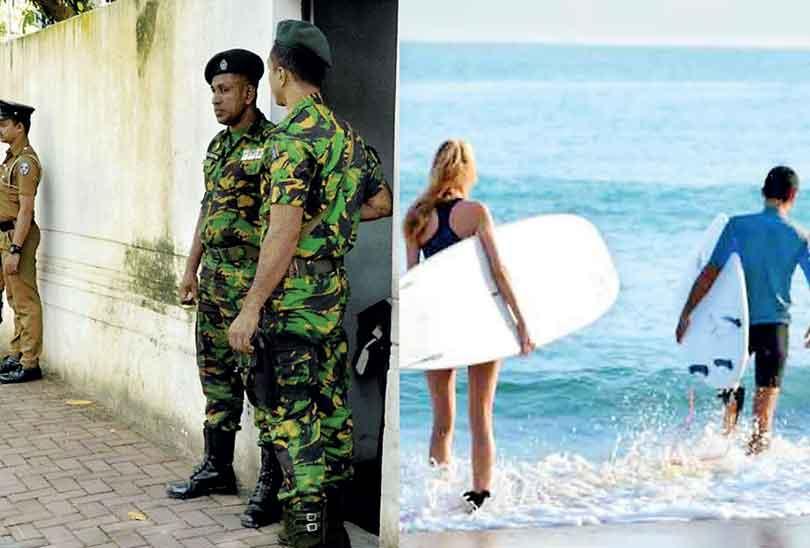
While the move to protect places of worship has been heavily criticised, it is the government’s responsibility to provide security to not just citizens, but even foreigners within our shores. (Left photo pix credit: Pradeep Pathirana, right photo: FILE PHOTO)
Recently, there has been a growing sense of ill will in the local social media posts and newspaper articles towards Israeli tourists in the country. Whether this is a popular sentiment or amplified by a minority is open to question. However, some of the allegations made there are valid, some need government scrutiny, and others are exaggerated.
In a major grievance, it was alleged that Israelis have monopolised Arugambay, displaced locals and turned it into a miniature Zionist colony. This is a highly emotive allegation, but we have been there before. It was not long ago that we were told by the foreign press and self-interested local pundits that Hambantota has been turned into a Chinese colony, which it was not, and that Buddhist temples are colonising the Tamil homeland, which was also not the case. However, these propped-up grievances, including the latest one, serve a different political purpose.
Second, it is alleged, the Israelis, the Russians, and Ukrainians run businesses and eat into the income of local tourist operators. This is a valid grievance, though this is not a problem unique to Sri Lanka. The relevant national and local authorities should address these concerns so that the locals have a level playing field in their business, and tourists who come for holidaying do not engage in business. Shrouded in this controversy is a far more important concern that a vast swathe of the tourism industry, mainly owned by the locals themselves, is operating in a grey economy. The government should bring them to the open, regulate them, and ensure they comply with local labour regulations and pay taxes.
Third, it is commonly alleged in these circles that the Israeli visitors are rude and disrespectful of the local customs, though it is not clear which local customs are being challenged. Some time back, some good fellas wanted to ban the bikinis and regulate clothing in Arugambay and bring a bit of Sharia flavour. The directive was withdrawn after it was highlighted by the media. That is notwithstanding, there will always be the proverbial rude, entitled and boisterous tourist in any community. However, stereotyping a particular community group may betray an ulterior motive or a racial animus.
Fourth is what I find the most disturbing, and it is disturbingly true. Tourists are accused of operating tourist-only bars and cafes, which exclude the locals, effectively creating a mini-sized apartheid in the Down South and the Eastern coast. Some time back, there was the controversy over a White Only Party, which saw the then immigration controller revoking the extended visa-free stay of the Russians and Ukrainians. Probably the problem is a little more complicated than it is portrayed, for some of the most exclusive tourist-only spots are in Mirissa, owned by locals. And the Sri Lankan law prohibits foreigners from owning land in the country. Therefore, any ventures the foreigners maintain are either leased or jointly managed with a local partner. As in the case of Mirrissa and many other newly developed tourist spots in the Down South, locals suddenly found fellow locals not good enough when the influx of tourists began. This is a matter of law enforcement, but it is also a matter of civilisational values. Any self-respecting government must ensure its citizens are not excluded from hotels or nightclubs in their own country for being Sri Lankans. An industrious and forward-looking government should enforce not just a policy of non-discrimination but also the foundational values of society. However, if the enforcement authorities are staffed by individuals who are attitudinally a mirror image of the locals—or foreigners—who refuse to cater to locals, then there is a problem. That, I suppose, is the underlying cause of inaction to an emerging tourist apartheid in the country.
Another concern that was highlighted, among others, in this newspaper was that the ventures owned by Israeli tourists are peddling narcotics. That again is a law-and-order issue, though one could argue that it is not representative of the wider segment of Israeli tourists, nor is it a vice limited to Israeli tourists. The locals are the largest drug traffickers and sellers in the local market, and while the foreigners claim a sizeable share of the haul of drugs intercepted in the airport, the largest share is still seized from fishing trawlers. But you don’t label your neighbourhood fisherman a drug peddler. The problem with most scoops of the kind in this country is that they are not followed up by the reporters or relevant authorities. The ‘gold standard of investigative journalism’ in this country has generally been a politically inspired leak turned into a scoop, followed by nothing.
Another recent concern is over the tourists maintaining their places of worship. Considering that the constitution of this country provides freedom of religion and worship, one cannot find fault with that. Then, some folks criticised when the police provided protection to these places in Colombo, though it is the government’s responsibility to provide security to its citizens and foreigners residing within its shores.
This column should not be misconstrued as a defence of the Israeli conduct in the Gaza war, which is abhorrent and indefensible, though probably the calamity could have been averted had it not been for the October 7 terrorist attacks.
Reading between the lines, one might recognise that much of the local grievances are indeed a facade for those emanating from the post-October 7 period. Sri Lankans have the right to be outraged and a moral duty to condemn the gruesome human toll in Gaza. Though we have fought our own demons to a brutal end, the extent of the carnage in Gaza is beyond any sense of proportionality. However, opposition to war should not take us down the slippery road of anti-Semitism. I have a feeling that some of the anti-Israeli tourist advocacy is venturing out into that territory. That is where the fresh concerns of national security would crop up. Having been taken by surprise by the Easter Sunday attacks, though warning signs had long been there, the last thing the country needs is radicalising agents of yet another foreign grievance. That itself should not preclude local activism against the Gaza war. However, there will always be a fine line to tread on.
Follow @RangaJayasuriya on X