Reply To:
Name - Reply Comment
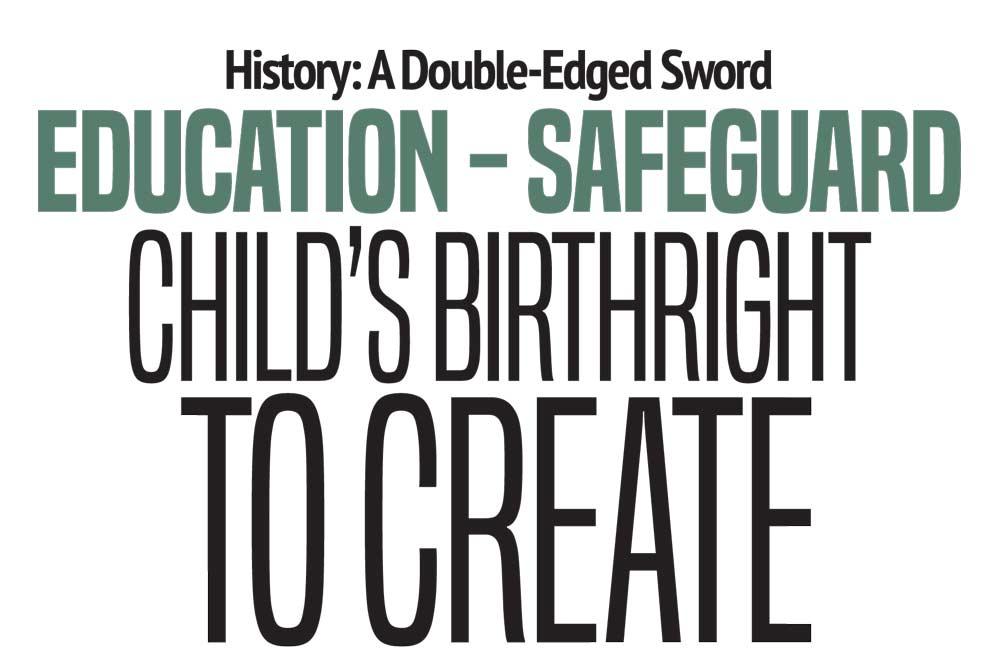
 Every child is born with the same creative power. This is not just a nice idea—it is a fact. All human brains, no matter what race, religion, or class can imagine, invent, and create. The genius we see in great artists and inventors lives inside every child, waiting to grow.
Children are not born divided. They do not enter the world as Buddhists or Hindus, rich or poor—but as natural creators with open minds. It is our job to protect this gift, not destroy it.
Yet sadly, this natural wealth often gets crushed. Not from lack of chances, but from the harmful ideas that society puts into young minds. From an early age, many children learn to see the world not with wonder, but through narrow boxes—their ethnic group, their religion, their caste, their family’s money. These learned divisions do not just split communities; they kill imagination and silence creative voices.
The Problem with How We Teach History
Teaching history is our biggest challenge. History can free minds by teaching critical thinking, or it can trap them with divisive stories that serve politics, not education. In America, where history is compulsory in schools, people teach their 249-year story with no lies and contradictions.
For too long, our classrooms have echoed with tales that, while stirring, have inadvertently planted seeds of separation. The mythologised arrival of Prince Vijaya, the glorified clash between Dutugemunu and Elara—these narratives, however compelling, have become weapons that divide rather than bridges that unite.
The love story of Prince Saliya and Asokamala transcends the artificial boundaries we have constructed. Here was a prince who chose love over prejudice, who saw beyond caste and ethnicity to embrace a woman whose worth lay not in her birth but in her character. Their union was a declaration that love conquers the petty divisions that small minds create.
a short overview of our independence struggle, then study post-independence politics in detail—learning about governance, not nationalist fever. Children learn ethnic labels—”Sinhala” or “Tamil”—before they understand what it means to be human. This early labelling creates artificial boundaries in young minds that should remain open and unlimited. When a five-year-old is taught to identify primarily as belonging to one ethnic group, they begin to see the world through the narrow lens of “us” versus “them” rather than embracing the full spectrum of human experience and connection.
Religious teaching, while intended to provide moral guidance, often stops critical thought by making other traditions seem wrong or inferior. Instead of encouraging children to explore the universal questions that all humans share—about meaning, purpose, and how to live well—rigid religious instruction creates walls between different spiritual paths. Children learn to dismiss wisdom from other traditions simply because it comes from a different source, closing their minds to the rich diversity of human spiritual experience.
The Solution: Creative Education for All
To unlock children’s full potential, we must completely rethink education. First, replace single-religion classes with comparative religious studies. By learning about many faiths, students develop empathy and curiosity, not rigid beliefs. Spirituality becomes personal exploration based on understanding, not something automatically inherited. Religious teaching can still happen at home or in Sunday schools—but schools must be places of open discussion.
Innovation, freed from old prejudices, should be encouraged everywhere. Business education should build partnerships and respect. Most importantly, ideas must be judged on quality, not on who thought of them.
Arts education is crucial. Schools must actively build love for creativity by showing students many cultural forms. Traditional Kandyan dance should be taught alongside modern dance; handmade crafts alongside digital design. Children must see that creativity takes many shapes—but all come from the same human need to express and imagine.
Aesthetic studies build creative talent, making comprehensive arts education essential at all school levels. When children engage with visual arts, music, dance, theater, and literature, they develop neural pathways that enhance creative thinking across subjects. For too long, our classrooms have perpetuated divisive narratives. The mythologised Prince Vijaya, the glorified Dutugemunu-Elara conflict—these tales have become weapons of separation rather than bridges of unity. They promote ethnic superiority and ancient grudges, fostering an “us versus them” mentality that undermines the Sri Lanka we must build together.
But there is another story waiting to be told—one that beats with the rhythm of shared humanity. The love story of Prince Saliya and Asokamala transcends the artificial boundaries we have constructed.
The Cost of Division
When we create division—through race, faith, caste, or class—we do not just break society; we commit creative destruction. Every time a child learns to limit oneself because of identity, we lose a potential artist, thinker, or inventor. The cost cannot be measured.
Research shows that creativity drops sharply during school years, especially between ages five and eighteen—the same time when rigid identities are taught. Every day we wait, we lose more of the brilliance inside the next generation. We must act now to protect every child’s right to create—freely, fully, and fearlessly.
To fix this damage, we need urgent change. Religious teaching in schools must shift from promoting one tradition to offering comparative study. By learning various faiths together, children can appreciate the universal human search for meaning without creating “us versus them” thinking.
Classrooms must become spaces where creativity flourishes, free from inherited bias. A new curriculum would emphasise creative problem-solving that transcends boundaries, with design thinking as a universal tool proving that excellence belongs to no single group. Innovation should be recognised as shared human endeavour, unrestricted by social roles. Business education must prioritise cooperation across differences, while brainstorming sessions should celebrate merit above identity. Students need freedom to think innovatively without old prejudices constraining them, creating safe spaces where ideas matter more than their origin.
This is not just an educational goal—it is a moral duty. Every time we put prejudice into a child’s mind, we commit creative vandalism. We erase future inventions, unsolved problems, and uncreated beauty. Each silenced imagination is a loss not just to that person, but to all humanity.
Children are not born divided. Our job is not to put them into categories, but to protect the creative inheritance they all share.
Now is the time to act. Each day of delay loses a generation’s potential to the poisons of past divisions. To honour our children is to honour their right to be fully creative, freely expressive, and completely human.
“creativity flourishes only in a conflict free mind”