Reply To:
Name - Reply Comment
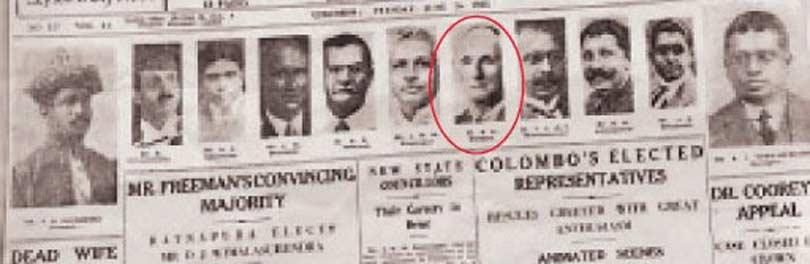
Herbert Rayner Freeman, a British colonial officer, (seventh from left) was able to earn the title “Eajantha Hamuduruwo” during his stay in Sri Lanka
 Herbert Rayner Freeman rose through the Ceylon Civil Service ranks to become Government Agent for North-Central Province
 As Sri Lanka marks its 78th Independence Day today (February 4), the extraordinary story of Herbert Rayner Freeman demonstrates how genuine leadership can transcend race, religion, and nationality.
The year was 1931. In Ceylon’s North-Central Province, where 94% of the population was Sinhala-Buddhist, an extraordinary political drama unfolded. When results for the first State Council elections were announced on June 15, 1931: The British citizen defeated the prominent Sinhala Buddhist lawyer, D.S. Krishnaratne, by a margin of ten to one in a constituency where 94% of voters were Sinhala-Buddhist. Krishnaratne, the sitting member, lost his deposit, a humbling outcome that spoke volumes about the electorate’s political literacy compared to nine decades later.
Nearly a century later, as Sri Lanka marks 78 years of independence from the colonial power Freeman represented, his story deserves resurrection. In an age where identity politics dominates and ethnic divisions are cynically exploited, Freeman’s triumph reminds us that authentic leadership can bridge any divide.
“Ejantha Hamuduruwo”
Freeman’s victory must be understood against Ceylon’s constitutional evolution toward self-governance. The journey began in 1833 when the Colebrooke-Cameron Commission established the Legislative Council with 16 members, including six appointed unofficial representatives from different communities. Meeting in a building on Janadhipathi Mawatha in Colombo Fort—now the Foreign Ministry—this body marked the first tentative step toward representative government, though members could discuss but not initiate legislation.
Progressive reforms followed: the McCallum Reforms of 1910, the Manning Reforms of 1920 and 1923—each expanding membership and introducing elected positions. The transformative moment arrived with the Donoughmore Constitution of 1931, which introduced universal adult suffrage, placing Ceylon ahead of many Western democracies. It was under this revolutionary dispensation that Freeman contested his historic election.
Colonial Officer who refused to leave
Born in England in March 1864, Freeman arrived in Ceylon in 1885 at age 21, appointed to the Colonial Secretariat. Over 34 years, he rose through the Ceylon Civil Service ranks to become Government Agent for the North-Central Province—one of the most senior administrative positions.
When Freeman retired in 1919 at 55, he faced a familiar choice: return to England and draw his pension, or remain in the land that had become home. Freeman chose the latter, spending five years in grassroots social work across the North-Central Province, living among the people he had once governed.
This voluntary service revealed his character. He traveled jungle trails on foot, carrying his iconic umbrella and wearing a tropical hat. He distributed medicines to the sick, provided agricultural equipment to farmers, and became a trusted village figure. Remarkably, he had mastered colloquial Sinhala, not formal official language, but the everyday speech of ordinary people.
He would rest under wayside trees, gathering villagers to hear their grievances and discuss their needs. Despite being European and Christian, he earned the extraordinary title “Ejantha Hamuduruwo”—suggesting respect approaching that accorded to Buddhist monks.
Campaign of the Green Betel Leaf
When Freeman decided to contest the 1931 elections, his campaign was distinctive. The voting system required selecting coloured boxes rather than marking ballots. Freeman chose green and the betel leaf as his symbol, both resonant with rural Sinhalese culture. He toured the province with a green betel leaf pinned to his tropical hat. His message was characteristically straightforward in fluent Sinhala: “I cannot provide transport for you to cast your vote. If you manage to put your vote in my green box, I will win; otherwise, I will sail back to England.”
This honesty was refreshing. While his opponent made grand promises, Freeman asked for trust based on his service record. The electorate responded overwhelmingly. His ten-to-one victory in a 94% Sinhala-Buddhist constituency proved that voters could distinguish genuine commitment from rhetoric, authentic service from political opportunism.
The fearless parliamentarian
Freeman’s tenure in the State Council revealed another dimension of his character. Parliamentary records from the 1930s show a man utterly unafraid of authority or convention when principles were at stake. He didn’t just represent his constituents’ material interests; he actively attended court sessions to advocate for individuals he believed had been unjustly accused in criminal cases; an unusual practice that blurred traditional boundaries between legislative and judicial spheres.
In the legislature itself, Freeman was often a thorn in the side of the establishment. On September 13, 1934, a confrontation recorded in the Hansard illustrated his defiant spirit perfectly. When challenged to withdraw remarks critical of parliamentary conduct, Freeman refused point-blank. Despite interventions from future Prime Minister S.W.R.D. Bandaranaike, D.S. Senanayake and D.B. Jayathilaka, all towering figures of that era—Freeman stood his ground with unwavering determination.
“Send me out. I am prepared to go,” he declared when ordered to withdraw his words. When the Chairman warned that action would be taken, Freeman remained unmoved. “I am not withdrawing anything,” he insisted. Finally suspended for one week, his response was characteristically irreverent: “That is a nice holiday for me.”
This wasn’t the behaviour of a typical colonial administrator or cautious politician. This was a man who had internalised a deeper understanding of representation, that sometimes serving constituents meant defying parliamentary niceties and institutional pressure.
The ultimate vindication came in 1936, when Freeman was returned unopposed from Anuradhapura to the second State Council under the Donoughmore Constitution. For a sitting member to face no opposition was rare; it spoke to the extraordinary bond between Freeman and his constituents. Freeman was truly ‘one of a kind’, and he is sorely missed in circles of politicians who strive for their own agendas rather than the country they are supposed to serve. The world over suffers this loss of pure honesty and leadership, whether temporal or religious. Sri Lanka has no contestants in this league.
As the nation commemorates 78 years since independence from British rule, Freeman’s story poses uncomfortable questions. If a British colonial officer could earn the title “Ejantha Hamuduruwo” through genuine service, what does it say when contemporary leaders fail to inspire basic respect? If an electorate with only 30% literacy could look beyond ethnicity and religion to recognize authentic commitment, what does modern politics that cynically manipulates identity say about our progress?
The images endure: Freeman walking jungle paths, resting under roadside trees speaking fluent Sinhala with farmers, distributing medicine and tools, standing fearlessly in parliament. These paint a portrait of leadership increasingly rare in contemporary Sri Lanka and across the world.
On this Independence Day, perhaps the greatest honor we can pay to hard-won sovereignty is reclaiming the standards Freeman embodied. National renewal may not lie in grandiose schemes or charismatic rhetoric, but in the simple, difficult work of genuine service: listening to concerns, addressing needs, speaking truth to power, putting national welfare above personal ambition.
He chose service when he could have rested, chose principle when silence would have been easier. His adopted home loved him for it. Nearly a century later, his example still lights the way, if we have courage to follow. History whispers across the years: what was once possible still remains possible.