Reply To:
Name - Reply Comment
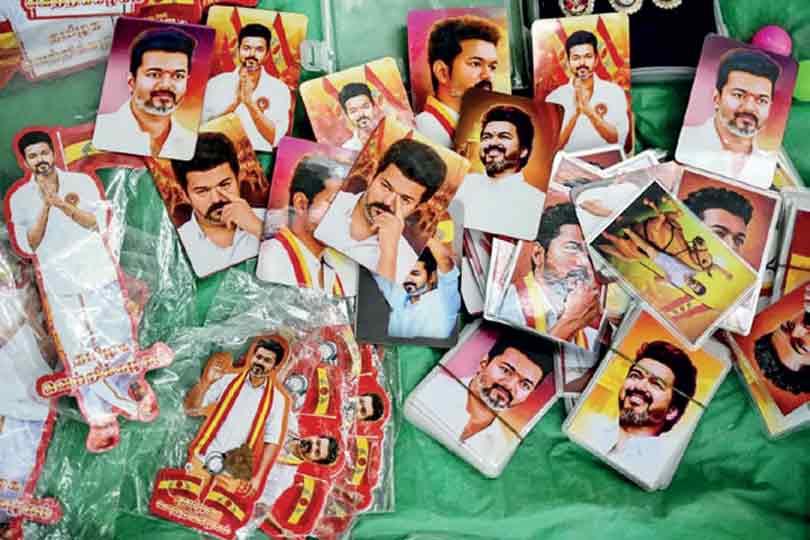
Vijay’s TVK won 108 seats of the 234 up for grabs, but still needing 10 more to form a government
 All pollsters, except Axis India, had given the TVK only double digit numbers at best. Political pundits dismissed him as a mere “spoiler”
It did not matter to the people that Vijay was a political novice and that his party was a fledgling, having been launched only in 2024
 But there was another element -political - that he subtly introduced in a few of his films. The message here was not direct, but rather placed the protagonist (played by him) as the victim of an issue that was the result of the powers-that-be
For all the support, Vijay did not hold a single press conference to elucidate his idea of change. In the few public speeches he made, he played up the harassment of women and the selling of drugs by politically connected hoodlums and the pervasive corruption associated with the DMK’s cadres
 It was a Gen Z- led Tsunami which hit Tamil Nadu’s electoral arena on Monday the fourth of May. The stunning victory of matinee idol Vijay’s Tamilaga Vetri Kazhagam (TVK) in the State Assembly elections was as unexpected and as unsparing as a deluge.
Vijay’s TVK won 108 seats of the 234 up for grabs, but still needing 10 more to form a government. The ruling Dravida Munnetra Kazhagam (DMK), which was seeking a second term, got 73, and the All India Anna Dravida Munnetra Kazhagam (AIADMK) got 53.
The State Chief Minister and DMK supreme M.K. Stalin, was defeated in Kolathur by a TVK candidate. Even Palanivel Thiyagarajan, a top minister, was defeated in his home turf of Madurai.
Pollsters and pundits failed
 All pollsters, except Axis India, had given the TVK only double digit numbers at best. Political pundits dismissed him as a mere “spoiler” attributing whatever he could do to his celluloid image as a dashing hero.
The media failed to correctly assess the groundswell of support among Gen Z for Vijay, for whom he was Thalapathi (Tamil for Commander).
“Most of those who root for him are not old enough to vote,” was a common comment in the intelligentsia. But many also quoted parents as saying that they would vote for Vijay to please their sons and daughters.
Asked by TV channels why they wanted Vijay, youngsters said: “We want change. There should be change!” Few had any clear idea about the kind of change they expected.
”We had the two Dravida parties (DMK and AIADMK) taking turns to rule Tamil Nadu since 1967. Its time, somebody totally new, got a chance,” was a constant refrain.
For all the support, Vijay did not hold a single press conference to elucidate his idea of change. In the few public speeches he made, he played up the harassment of women and the selling of drugs by politically connected hoodlums and the pervasive corruption associated with the DMK’s cadres. It did not matter to the people that Vijay was a political novice and that his party was a fledgling, having been launched only in 2024. Its main purpose was not to spearhead a political or ideological movement but to fight the 2026 Assembly elections-a goal which was seen by many as cinematic rather than practical.
However, Vijay had a vast network of fan clubs which would do some social work, or he himself would give awards to bright students. But he did precious little to politicise them or school them in his political thoughts or ideology. In fact, he had no ideology other than social equality and secularism, which is common to all parties in Tamil Nadu except the BJP.
In contrast to the absence of substance in Vijay’s claims, the DMK had a solid list of achievements to its credit. Chief Minister M.K. Stalin had made Tamil Nadu a top-performing State in India, with enviable social and developmental indices. But Stalin’s claims fell on deaf ears partly because his “development” had not yielded jobs for youngsters coming out of schools and colleges.
In contrast to the centralised development model of the DMK and AIADMK, Vijay’s manifesto promised to set up a government website through which the common man could suggest to legislators schemes and programmes useful to the people. The manifesto promised that these suggestions would be followed up and the progress communicated. To keep up with technological advancements, he proposed to set up an AI university.
Vijay’s success is remarkable also because he came with no political background or experience. Unlike his film star predecessors in politics, he had not held any political office or contested any election. He had fan clubs which were not political clubs at all unlike the fan clubs of M.G.Ramachandran.
Many pooh poohed the TVK for the absence of a leadership structure. The “leadership” of the TVK was but a motely crowd of greenhorns and defectors from other parties. It was therefore easy for political pundits to write off Vijay and concentrate on the prospects of political heavy weights like the DMK, AIADMK, the Congress and the BJP.
The TVK had also surprised observers by opting to enter the electoral fray solo, contesting all the 234 seats up for grabs. This, too, was attributed to political inexperience or the bravado of a novice. But shock was in store for the heavyweights who expected to sail through.
The State Chief Minister and DMK Supremo M.K. Stalin was defeated by the TVK in Kolathur, and the well- spoken and intellectual Palanivel Thiagarajan was trounced by a TVK candidate in his home turf in Madurai, where he was considered unbeatable.
Vijay committed to secularism
Ideologically, Vijay’s ideas were woolly. It was a hodge podge of the Dravidian concept of social justice, anti-caste, equalitarian and secular. Vijay’s secularism was in no doubt. Though a practising Christian (his name being Joseph Vijay Chandrashekhar), he who would visit Hindu temples too.
Observers expect him to be status quoist, following the tried and tested Dravidian policies observed by the DMK and AIADMK. He is expected to be close to Congress, as many Tamil Nadu Congressmen who were yearning for a share of power in the State had pressed for an alliance with Vijay rather than the DMK. Not surprisingly, Rahul Gandhi congratulated him on his victory heartily. Observers say that Vijay would keep a safe distance from the BJP, which he considers an “ideological opponent”.
Transition from films to politics
The 1974- born Vijay comes from a film family, his father, S.A. Chandrasekhar, being a Director, and his mother, Shoba Chandrasekhar, being a playback singer.
Vijay began his career as a child artist. He debuted as a lead actor in “Nalaya Theerpu” which he signed at the age of 18. To date, he has completed 69 films.
But there was another element – political – that he subtly introduced in a few of his films. The message here was not direct, but rather placed the protagonist (played by him) as the victim of an issue that was the result of the powers-that-be.
In “Thamizhan” (2002), where he paired Priyanka Chopra, Vijay played a lawyer called Surya, whose goal in life is one thing: to spread awareness about the law to the common man. Vijay would pull up public servants. In Thalaivaa (2013) drew the ire of the then Tamil Nadu Chief Minister, J. Jayalalitha, who was reportedly irked with the tagline “Time to lead.”
.In “Kaththi” (2014), Vijay showed what he would do for farmers if he came to power. The film showcased the battle between a greedy entrepreneur and a man of the masses. In “Mersal” (2017), Vijay asks why India cannot provide universal health care despite charging a 28% GST, while Singapore, which only charges 7%, could provide free healthcare. This line landed the project in soup post-release, with political parties such as the BJP slamming it.
In “Sarkar” (Government), the story revolves around how a suave entrepreneur’s vote goes missing from the electoral board, and how he decides to make a big deal of it, thus affecting the entire political system of the state.