Reply To:
Name - Reply Comment
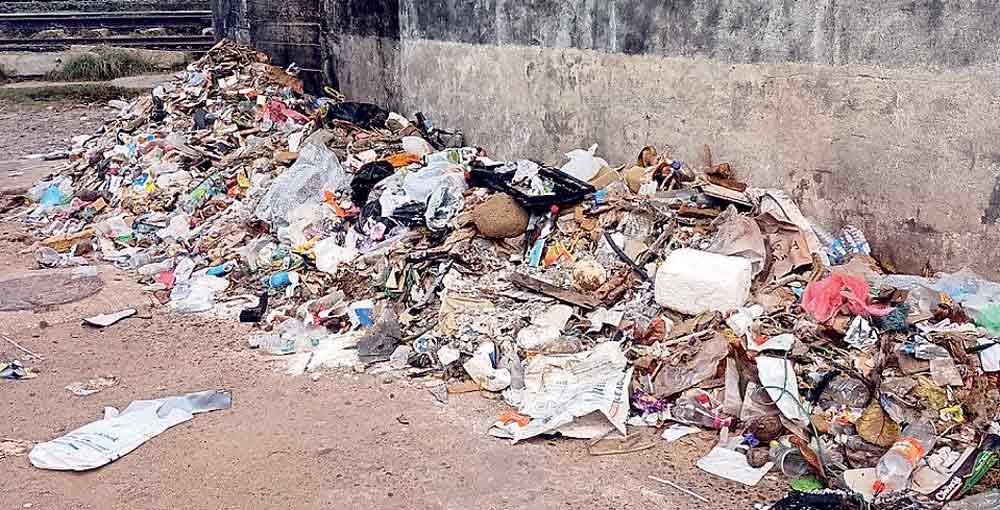
Piles of garbage can be seen in many places despite clean up campaigns
 South Asia suffers from an ungainly reputation for being dirty and messy. That is not always an exaggeration, for the region is overpopulated; its explosive population growth in the past has burdened the states and thinned out per-capita social investment; and local government bodies have often done a sloppy job of keeping their precincts clean and organised.
Sri Lanka, by and large, has been an outlier to this particular South Asian ailment — though the locals have to be reminded of that by visiting Indian tourists — who, with genuine conviction or clickbait shenanigans, post rave social media reviews about how clean this country is. Such compliments ought to be taken with a pinch of salt, for they are often subjective assessments against the innate filth of most South Asian cities, and not global comparisons.
However, Sri Lanka risks losing even these small luxuries. It is a sad indictment for the government’s much hyped Clean Sri Lanka campaign that the garbage keeps piling up along the city streets uncollected for days, basic public amenities such as walking paths and pavements are in disrepair and encroached by the hawkers and shopfronts, and public toilets are as dirty as they were before. In the meantime, well-meaning past programmes such as the relocation of slum dwellers into apartments elsewhere have not only stopped; the process itself seems to have reversed.
Away from its skyscrapers, Colombo’s other business district, the Main Street and Pettah market, which many YouTubers visit to stream the first snapshot of Sri Lankan life, resembles the messiest and most chaotic parts of Dhaka and surely not the best advertisement of Sri Lanka. A stroll in any city street, a little beyond its cosy business hub, would reveal broken pavements. A train ride Down South would expose beaches and beach access roads littered with rubbish dumps and stray plastic and polythene. In most other municipal and urban council areas beyond Western Province, pavements are absent. Where they exist, they are encroached by irregular vendors. Garbage collection is random, and disposal is primitive, contributing to greater pollution. Open garbage trucks jostle with passenger vehicles on busy roads in the morning. Garbage bins rarely exist even in the most congested areas. That might vindicate many Indian online commentators who applaud civic-minded Sri Lankans for the general cleanness of their neighbourhoods. However, no amount of civic sense could supplement the lethargy and indifference of public institutions. The rot will inevitably set in.
Worse still, public institutions, elected or otherwise, are among the main contributors to pollution. Municipalities and urban councils leave their garbage trucks unattended by the roadside or pile garbage on prime state land, creating health hazards to everyone living around. State-of-the-art waste disposal and recycling is not explored not due to the lack of investor interest, but because it would cut off wheeler-dealers long entrenched in the business.
The Railway Department piles up its discarded concrete sleepers along the rail track, causing a public safety hazard and an eyesore. State bus depots are a prime breeding ground for mosquitoes, as recent checks by public health inspectors have revealed.
Clean Sri Lanka has so far failed to produce tangible results, except for news headlines. Sri Lankan cities, towns, and hamlets are dirtier than they were before. Some commonsense initiatives such as relocating hawkers in the city of Kandy are welcomed, but by and large, inefficient local governments and the central government have become the problem, rather than problem solvers.
Garbage dumps, streets encroached by hawkers, broken pavements and slums are proof of governance failure. The current government is not unique in its inability to keep streets clean. Yahapalanaya left the garbage rotting by the roadside uncollected for days, and then a rubbish mountain collapsed in a Colombo suburb, killing scores.
However, if the current lethargy persists, Sri Lankan cities and hamlets would unravel into decay and squalor. Garbage piles up in your neighbourhood for several reasons.
One is political crookedness, which is a historical malady, not unique to this government.
Successive governments have deliberately let the projects undertaken by their predecessors and rivals fall into disrepair as a strategy to politically delegitimise not just their rivals, but also their development initiatives. Yahapalanaya was an extreme example of this case—not only the Port City, the Mattala airport, Floating Market, and many other projects, but also the entire economic momentum that clocked 6.5 per cent annualised growth over the previous decade was discarded simply to delegitimise the Rajapaksas.
Walking paths or hiking trails?
When the Colombo Municipal Council and Urban Development Ministry fail to maintain even the walking paths — which, a satire account on X has renamed as hiking trails — if it is not its inefficiency, it is political crookedness at play.
Second is incompetence. Even a deputy minister in local government was on record as admitting that local government bodies have failed to provide basic services to the public.
This is a side effect when voters mistake grievance-hyping as proof of future administrative competence.
Third, incompetence of elected representatives is magnified by an incompetent bureaucracy at the local government level. That is a major shortfall in Sri Lankan administrative structure, which many advocates of devolution have often overlooked.
Fourth, no one cares. If you have not yet noticed the uncollected garbage in your neighbourhoods and ocean fronts, either you are living in a privileged place, or you simply don’t care.
It takes time for these everyday maladies to show up with their cumulative effect. As Adam Smith once said, it takes a great deal for the ruin of a nation. Nonetheless, the rot sets in, and over time decay eats into the core.
Perhaps, there are a few easy fixes the government could resort to.
Set the basic benchmarks
First, the President can set the basic benchmarks for local government bodies under his Clean Sri Lanka program, one of which should be the provision of basic public services. That is also the model akin to performance-based legitimacy and evaluation, many of its ideological bedfellows, such as the Chinese Communist Party, have resorted to in local governance.
Secondly, it must come to terms with the fact that though most of its mayors, chairmen/ women and elected representatives may be idealistic, they are not equipped for the task they were elected for. Study visits to modern cities in China, East Asia, or Singapore would shed light on how modern cities are governed, which they could emulate back home.
Thirdly, the government should build a competent bureaucracy at the local-government level, which similarly requires foreign training and exposure to the best practices of successful states and city governments.
Fourthly, there is a radical idea, which Sri Lanka can experiment with someday in the future. The voters should be offered a competitive alternative to elected bodies. American-style Freedom cities, tech-driven new cities with private sector administration often set up as incubation hubs for growth, would be an idea worth exploring. Perhaps Hambantota, sparsely populated with large state-owned land, could well be the laboratory for the first such experiment.
Follow @RangaJayasuriya on X.