Reply To:
Name - Reply Comment

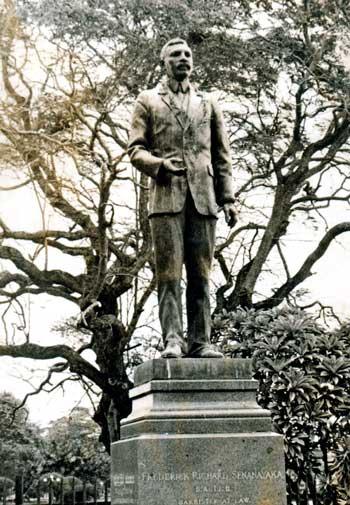 |
| F.R. Senanayake didn’t accumulate wealth like others, he accumulated something far more valuable: the gratitude and loyalty of a nation awakening to itself |
In the pantheon of Sri Lanka’s independence heroes, one name lingers in the shadows of his more celebrated younger brother. Yet Frederick Richard Senanayake’s (FR) story reveals a man who chose principle over prominence, whose strategic vision helped forge the path to freedom.
A fateful birthday
October 20 marked an extraordinary coincidence in the Don Spater Senanayake household. Born on that date in 1882 to Mudaliyar Senanayake, a wealthy graphite magnate, F.R. shared his birthday with his younger brother D.S., born exactly two years later. While D.S. would become independent Ceylon’s first Prime Minister, it was F.R. who first blazed the trail of nationalist resistance that made that achievement possible.
Their family connections read like a blueprint of Ceylon’s political destiny. Elder brother D.C. joined them in their campaigns, while sister Maria Frances married into the Bandaranaike family, linking the Senanayakes to yet another future Prime Minister.
Weapon of temperance
After qualifying as a barrister at Cambridge, F.R. returned home not to build a legal career, but to challenge an empire. In 1912, he launched his most audacious crusade: the temperance movement against the colonial arrack renting system.
The British design was brutally simple. They auctioned liquor licences to tavern owners, filling government coffers while devastating communities through calculated alcoholism. Villages that once centered around temples now faced an epidemic of addiction, deliberately fostered by colonial policy. F.R. and his brothers transformed temperance into a national awakening. Their rallies drew thousands, their message resonating with educated youth who recognised this assault on their culture. What appeared to be a public health campaign was, in essence, an act of rebellion, and the British knew it.
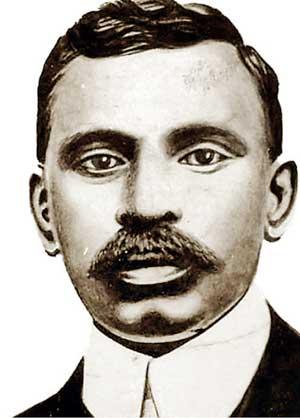 Two years before launching his temperance crusade, F.R. had co-founded the Buddhist Theosophical Society with Colonel Henry Steel Olcott. When he assumed its presidency in 1914, he stood at a dangerous intersection: religious revivalist and political defiant in one.
When World War I erupted, the Senanayake brothers enlisted in the Colombo Town Guard—a calculated display of loyalty. The gesture proved hollow within months.
The Crucible of 1915
During the communal riots that convulsed the island, 32-year-old F.R. walked a perilous line. While Sinhalese mobs rampaged through Colombo targeting Muslim homes and businesses, F.R. moved toward the chaos. His family sheltered Muslims at their Woodlands estate. He patrolled burning streets with other Sinhala leaders, urging rioters to disperse.
The irony was savage. Governor Sir Robert Chalmers viewed F.R.’s temperance movement not as reform, but sedition. These Sinhalese peacemakers, in the governor’s calculus, were insurgents cloaking rebellion in respectability. Arrest warrants followed. F.R. and dozens of leaders faced detention without charge—execution a very real possibility.
For 46 days, F.R. sat in a colonial prison, untried, uncertain. His release came only through desperate diplomatic maneuvering by Sir Ponnambalam Ramanathan and E.W. Perera.
Forged in fire
The ordeal transformed him. F.R. emerged with brutal clarity: social reform alone was worthless against imperial power. The empire responded only to strategic political pressure, carefully applied. The moderate reformer had been forged into something far more dangerous, a tactician who understood that justice under colonialism required not just moral authority, but calculated confrontation.
The man who entered that prison cell was not the man who walked out.
Though qualified for the Legislative Council, F.R. made a calculated choice in 1912: The Colombo Municipal Council, where local governance offered direct impact. But his masterstroke came twelve years later.
King-maker
In 1924, F.R. orchestrated what appeared to be a simple family favour: ensuring his younger brother D.S. won the Negombo Legislative Council seat unopposed. This wasn’t nepotism, it was nation-building. F.R. recognised in D.S. the exact qualities independence required: the patience to navigate colonial bureaucracy, the cunning to dismantle it from within. By securing that uncontested seat, F.R. launched the trajectory that would end at the Prime Minister’s office.
While D.S. climbed, F.R. built the foundation. He formed the Lanka Mahajana Sabha, helped establish the Young Men’s Buddhist Association, and became patron saint to Buddhist institutions across Ceylon. When Sir D.B. Jayatilleke needed land for the Colombo YMBA headquarters at Borella, F.R.’s checkbook opened without hesitation.
House of resolve
At Grassmere, his elegant townhouse on Gregory’s Road, F.R. built more than a home, he created a nerve centre for nationalist planning, where Ceylon’s future was debated and shaped. But Grassmere also witnessed terror. Here, Punjabi soldiers arrived during the 1915 martial law, marching F.R. away from his wife Ellen and six children toward imprisonment and possible execution. That day’s memory, the fear, the uncertainty, the steel resolve, would haunt and inspire the household for generations.
Fortune as weapon
F.R. spent his wealth as deliberately as a general deploys troops: Buddhist schools, cultural associations, educational institutions. Each donation was an investment in national consciousness, each contribution a brick in independence’s foundation.
He chose this path consciously, turning away from the life of luxury his wealth promised. While others accumulated estates and titles, F.R. accumulated something far more valuable: the gratitude and loyalty of a nation awakening to itself.
On January 1, 1926, while on pilgrimage in India, F.R.’s life ended suddenly. He was only 44, an age when most men are just reaching their prime. His work appeared unfinished, his vision incomplete. Yet perhaps that was his final lesson. In 44 years, he had ignited something that could no longer be extinguished. He had planted seeds in a soil he had prepared himself, seeds that would grow into the tree of independence under his brother’s careful tending.
Legacy measured in freedom
Sir D.B. Jayatilleke, first President of the Young Men’s Buddhist Association, captured F.R.’s essence at a commemorative gathering:
“During thirty years, I associated with many national leaders of Sri Lanka, I can state unreservedly that none equaled the late F.R. Senanayake in magnanimity and probity of character. Many projects that are accomplished realities today would never have become what they are without his magnanimous philanthropy and selfless humanity. He was their very foundation, power, and protector. The void created by his departure can never be filled.”
Today, Grassmere stands on R.G. Senanayake Mawatha, honouring both father and son. The house now serves as the Goethe-Institute’s Colombo branch, its walls still echoing with the spirit of the man who built it.
As we mark the centenary of his death, we remember Frederick Richard Senanayake not as footnote to his brother’s glory, but as architect in his own right, a man who understood that true leadership sometimes means working in shadows, that lasting change requires sacrifice, and that a nation’s freedom is built in countless quiet acts of courage and unwavering commitment to something greater than oneself.
His brother D.S. may have declared independence, but F.R. helped make it inevitable.
(The writer can be reached at [email protected] )