 KELUM BANDARA
Reply To:
Name - Reply Comment
Changes are also visible at the same time. For example, in my Ministry, we have started construction of 6,000 houses in the estate sector. In the past, such housing units were constructed for those selected for political reasons. In the districts of Nuwara-Eliya and Badulla, we see such houses distributed not among the needy but among political favourites
We don’t rule out challenges. We have managed to increase our foreign reserves to US $ 6.3 billion by the end of May this year. In another two years’ time, we will be able to attract investments amounting to US $ 4 billion for projects in Hambantota, Trincomalee and Mannar
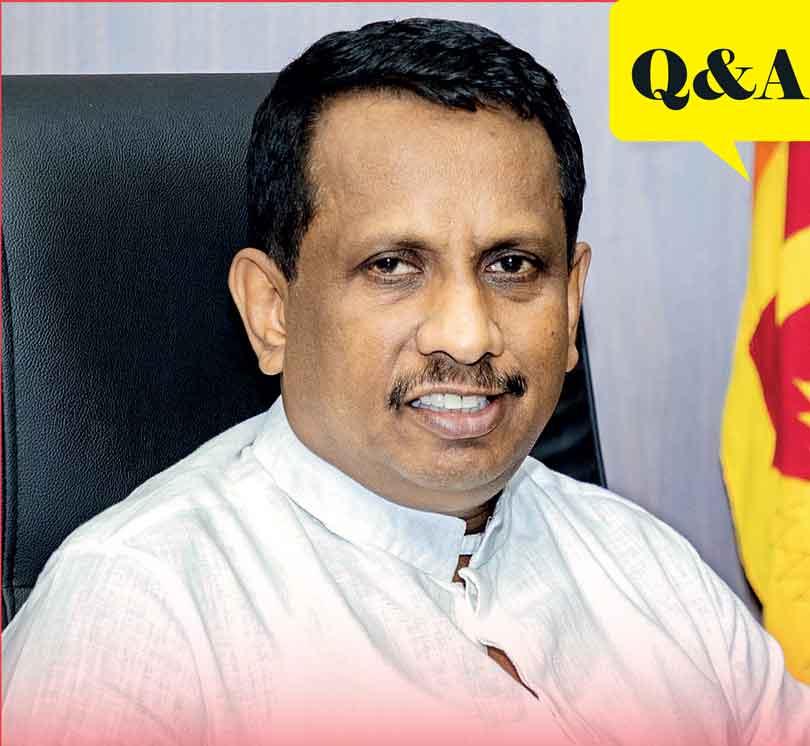
Minister of Plantation and Community Infrastructure Samantha Vidyaratna, in an interview with Daily Mirror, shares views on challenging confronting the National People’s Power (NPP) government and development plans in the pipeline. Excerpts:
Q:How is your experience now governing the country for nearly one year?
If we opted for a traditional style of governance, it would be an easy task. That is because the path had been laid over the decades for it only. It was not otherwise conducive for a novel social, political and economic journey. We are now compelled to create such a new path to forge ahead with governance. In that sense, we are going through a transitional period.
The old ways still stand out during this period of transition. Alongside, signs of transformation we brought about are also seen at times. In the long run, the changes will mend the old ways. There is criticism in society that corruption, fraud and inefficiency – the hallmarks of the old system- are still there. It is correct to a certain extent.
Q:Has the old system gotten in the way of your government with bureaucracy not cooperating fully with you?
We are grappling with a system that has remained entrenched for the past 76 years. We struggle hard to transform it. We need to make a lot of phenomenal changes.
Q:Can you cite some examples where you face difficulties?
First, we introduced the Clean Sri Lanka programme on January 1, 2025. We have to look at its deeper meaning- to create mindsets of people for the desired social transformation. Next, we have to go for digitisation, a step aimed at rooting out corruption and fraud in this technology-driven era. Thirdly, we want to launch a poverty alleviation programme. It is not only economic poverty. We are poor in terms of our social discipline, too. In the event of poverty, there is social degradation, leading to crimes. We will launch our poverty alleviation programme on July 4.
When all these programmes yield, we will be able to find solutions to the concerns you raised.
Q:When you say the old system, does it mean hurdles created by bureaucracy in terms of inefficiency, lethargy, corruption and fraud?
We need changes in three aspects. We want to deviate from the traditional political system. We want to bring about changes in the political culture. We mould our MPs as true people’s representatives. Secondly, we have to transform the economic path. We cannot resort to an economic model that is premised on borrowings and privatisation.
Instead, we want to build the agriculture, industrial sector, fisheries sector, etc. We have started it now. Thirdly, we want to transform society by casting aside racism and religious discrimination, and eradicating the drug menace and organised crimes.
The public service is only a part of this whole system, which we try to change. For example, in Japan, the efficiency of public servants or private sector employees is very high. We cannot expect the same from a public servant in Sri Lanka.
We cannot also expect the same level of discipline in Sri Lanka. In Japan, it has been achieved as the end result of a long journey of transformation. It is the same in Europe. We don’t find fault with our public servants.
In Buddhist literature, we find the Sati Kumbh Jataka. It is a story about two parrots experiencing different environments in their youth despite being brothers. A whirlwind separates the two brothers. One lands in a monastery amidst flowers, while his brother ends up in a village inhabited by thieves. It is not the fault of the parrots concerned.
We are not saying all our public servants or government officials are corrupt and inefficient. Some of them are corrupt, irresponsible and inefficient. There are people with competence, though. We want an honourable, efficient public service to be created.
Q:You promised to create a prosperous Sri Lanka during the election times. Now, you talk about poverty alleviation. For that to be achieved, the economy should expand. The World Bank has said that the economic growth will shrink to 3.5 per cent this year and to 3.1 per cent next year. How can you achieve your targets then?
We don’t rule out challenges. We have managed to increase our foreign reserves to US $ 6.3 billion by the end of May this year. In another two years’ time, we will be able to attract investments amounting to US $ 4 billion for projects in Hambantota, Trincomalee and Mannar.
In addition, we see Colombo Port City as a place with potential for the attraction of another US $ 4 billion. In 2018, we received the highest number of tourists. We received over two million tourists and earned US $ 4 billion. We are planning for three million tourist arrivals this year. Next year, it will improve even more.
President Anura Kumara Dissanayake, in his maiden budget, made the biggest ever allocation in history for capital expenditure. That is for development.
The government has become the biggest investor. We want to allocate even more in the next budget. That is all for economic development, not for doling out inducements to people on political grounds. We, as the government, have planned to perform, going beyond those forecasts.
Q:Investments won’t flow into the country merely because you say the ruling party politicians are not involved in corruption. The investment environment or ease of doing business should be improved instead. After this government came, Adani’s investment project was scrapped. The government secured Sinopec investment of $ $3.7 billion. It is yet to see progress. How can you say investments will come in then?
Some investments which you mentioned had been lined up before we came. We received a fresh mandate from people not to tread along the path chosen by others. We have to act without corruption and fraud. Adani is a world-leading businessman.
There is no question about that. Still, we need to attract investments in a manner that is beneficial to the country. If any investment is not advantageous to the country, we will not approve it. Adani can also invest in Sri Lanka in terms of our government’s transparent criteria. We dealt with Adani in the energy sector. If there are other local, foreign investors who are willing to supply low-cost energy in Sri Lanka, why should we go behind a higher bidder?
Q:Investors complain about the delay in regulatory and approval mechanisms here. How are you going to address it?
That is true. We are stuck because of rules and regulations previously made. Investors feel utterly disgusted when seeking approvals here. At times, they are supposed to secure approvals from 30 different institutions. It is a process that takes years at times. Then, investors are not encouraged to come. We, as the government, are now going to do the needful for them. We are trying to simplify some through digitisation. We will simplify the existing laws through amendments in the future.
Q:In the world, corruption and fraud have been minimised by developing systems with no loopholes for indulgence in such nefarious activities. Punishment of wrongdoers is only one thing. Your government is focused on punishing wrongdoers, not the development of systems. Why is it?
We cannot find fault with the legal system entirely. We have laws with sufficient teeth to deal with corruption and fraud. Many have flouted these laws. That is why they are punished. The enforcement of existing laws is another weak area. We try to enforce it properly. If there are grey areas, we will mend them. In April, we introduced a law that provides for the seizure of proceeds from crimes. In the future, we will introduce new laws.
Q:I meant something different. That is the development of systems creating no room for anyone to indulge in corruption. For example, an investor has to oil the palm of someone to get approval for project implementation. If there is no such requirement for him to proceed with his project, no room will be left for corruption. I meant the development of systems in such a way, for example, only. What is your position?
We aim for what you meant through our digitisation programme. We seek to minimise interactions between public servants and people in person. That is to improve the efficiency of public service. This is a transitional period, as I mentioned earlier. Things will be alright after some time.
Q:How long will it take for people to see the results on the ground?
For some people, changes are already visible. There have been constructive changes right starting from the swearing-in ceremony of the President. There are others who see the results. Yet, they pretend to be ignorant.
We have initiated a number of development projects. Plans are in place to resume work on the Kadawatha-Mirigama stretch of the central expressway. The Cabinet approval has been given for work on the Kurunegala–Dambulla segment of the expressway. The Ruwanpura Expressway is also in the pipeline. Seeds won’t germinate once sown. It takes time. We have to approve financial allocations. It takes time. We strive for achievement. People understand it.
Q:What is your experience in dealing with the execution of mega projects with the involvement of those who served in the past governments?
If we stick to the rules and regulations, we can avoid problems to a great extent. We are encouraging bureaucrats to follow the rules and regulations stipulated. Still, the hallmarks of the past system haunt us.
Changes are also visible at the same time. For example, in my Ministry, we have started construction of 6,000 houses in the estate sector. In the past, such housing units were constructed for those selected for political reasons. In the districts of Nuwara-Eliya and Badulla, we see such houses distributed not among the needy but among political favourites. These houses have been rented out by them now.
This time, we prioritise housing units for those living on lands identified by the National Building Research Organisation (NBRO) as landslides-prone. After necessary approval, the lists of recipients are displayed. People can raise objections within a week. Then, a committee reviews those objections raised. After that, we are able to select the most eligible set of people currently living in line-rooms in the estate sector as beneficiaries of new housing units.
Q:Do you find that bureaucratic inertia is slowing down the pace at which you want to implement your agenda?
That is there. We cannot rule it out. The President can’t move at the pace he desires, and it’s the same in my Ministry. We have to constantly push to get things done. We feel things get pushed, then.
For example, Chilaw Plantation is an estate under my ministry with cashew, coconuts and Rambutan cultivations. Last year, its revenue amounted to Rs.219 million. By May 31, this year, we have earned more than Rs.252 million. Last time, earnings from Rambutan sales were only Rs.900,000. We earned Rs.3 million this time. The cashew cultivation has been leased out for Rs.25 million. We did it for Rs.45 million this time.
The chairmen and board of directors appointed by us work efficiently in this manner. We are in the process of converting loss-making estates into profit-making businesses. We are improving Elkaduwa Plantation and the State Plantation Corporation in this manner.
Q:Do you experience cases where bureaucrats delay approvals, expecting some kickbacks?
Yes. But, they cite various excuses for the delay in granting clearance or approval. There are instances where we removed some officials appointed by us.
We are not ready to name them at the moment. A chairman of a corporation under my Ministry has been removed, for example. There is an audit inquiry against another. We only appointed them. Still, if there are issues, we will sort them out.