Reply To:
Name - Reply Comment
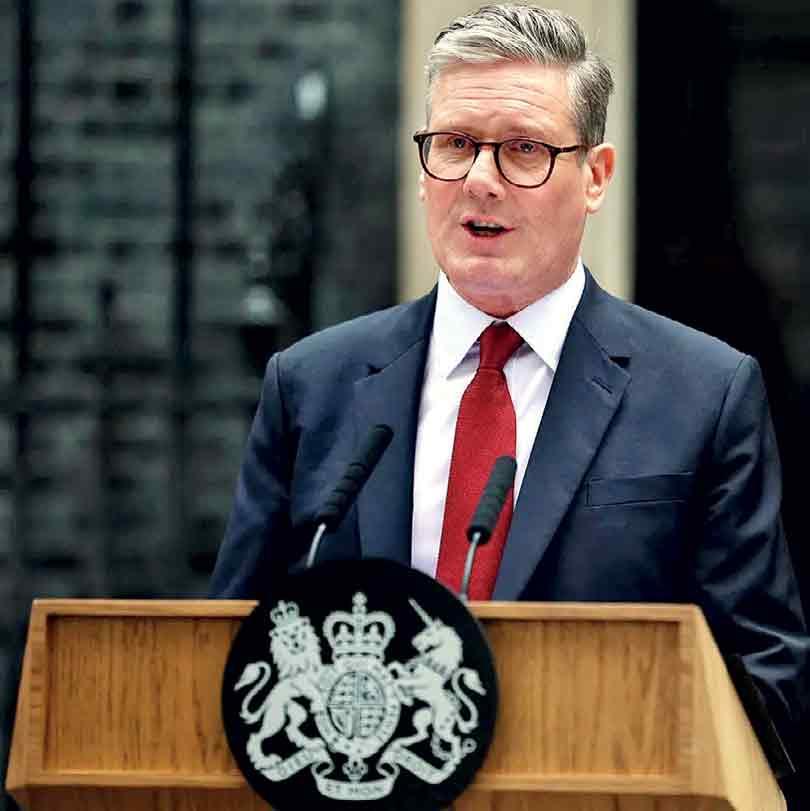
British Prime Minister Keir Starmer resigned due to a Labour Party revolt
 British Prime Minister Keir Starmer announced his resignation on Monday, finally bowing to an internal party mutiny.His resignation automatically triggered a leadership contest and the Labour Party is scheduled to open nominations for the leadership on July 9.
Mr. Starmer would serve as caretaker prime minister until the new leader is elected. Having led the Labour Party, once considered unelectable under Jeremy Corbyn, to a near two-thirds majority in the House of Commons barely two years later, Starmer’s reversal of political fortune is unprecedented and even cruel.
It could only be explained by the political instability and restless electorate born out of the Brexit referendum. The seventh British prime minister to hold office during the last ten years, he did not leave without a fight. He appeared to have survived, skilfully indeed, in the initial party mutiny after the Labour Party suffered heavy losses in the municipal and local government elections in May. Andy Burnham, former Manchester City mayor, who won a by-election of the Labour stronghold of Makerfield last week, is a strong contender. The Labour Party rule book requires any leadership contender to command the support of 20 per cent of Labour Party members of Parliament, which at the current Labour control of 412 seats in the House of Commons would come to around 80 MPs. Given the momentum around Burnham, it would a forceful alternative challenge would be unlikely.
This would leave the Labour party at the mercy of untested Burham at a time the political mainstream faces a severe challenge from Nigel Farage’s right-wing UK Reform Party, which won the most number of seats at May’s local government elections.
Interestingly, the anti-immigrant UK Reform, until recently, had as its chairman Zia Yusuf of Sri Lankan origin. That might be another quirk of minorities who complain about discrimination at every turn back at home, overcompensating to be accepted in their adopted countries, and eventually pulling up the drawbridge from their own kind. At home, though, any member of the minority community who managed to rise above the race is often disowned by the most vocal members of those communities.
The British leadership revolt is destabilising and would potentially play into the hands of the resurgent Right-wing, except that any new leader of the British Labour Party may have three years until the next general election, and claw back popular support.
However, political systems that lack a democratic process of leadership transitions fare far worse over time. Without clear and equitable rules for leadership challenges, they are at the mercy of incompetent party grandees lacking the vision or honesty to fix things right. Such political parties decay quietly and then collapse like rotten tree lines. Take Sri Lanka, for example, though the Congress Party of India could be a case study of the global scale.
Ranil Wickremesinghe had reigned over the UNP since 1995 through a series of electoral defeats. A few could ever recall how many elections he had lost, except for that the Grand Old Party is now a skeleton of its former self and may not have a chance of resurrection. Sajith Premadasa, who led an internal party revolt, understandably so because Mr Wickremesinghe had turned the UNP into his personal fiefdom, had not done better. The Samagi Jana Balawegaya (SJB) was a tragic patricidal offspring of Wickremesinghe’s water-tight hold over the UNP. The split of the UNP has now thrown Sri Lanka’s moderate centrist voters in disarray, leading to state capture by the NPP/JVP.
African dynastic succession
Similarly, SLPP or Pohottuwa, though not a benign force like the UNP/SJB is in political wilderness, as it struggles with a dynastic succession from Mahinda Rajapaksa to presidential scion Namal. The SLPP may not even warrant discussion. It better fits in the template of African political parties of dynastism and personalised power maximalisation than any of the modern Westminster prototypes.
Another political party now in its death throes is the Sri Lanka Freedom Party, which broadly smacks of the collapse of the Indian National Congress. Both parties, though of dynastic orientation, were responsible for far-reaching progressive policy making in the immediate history of their nations and were led by elites who held strong moral convictions. Though their feel-good moral policies failed to generate wealth for their respective population, and created unprecedented economic stagnation for Sri Lanka for the first three decades and India over four decades.
Despite the nostalgia of the past, one might now grudgingly resign oneself to the fact that SLFP itself is beyond resurrection, though the fate might be kinder to its peer across the Palk Straits.
TNA stalwart M.A. Sumanthiran, former MP, goes around forecasting an emerging one-party rule in Sri Lanka under the JVP/NPP rule. Though not a totally unjustified concern given the electoral path of the militant left (or political Islam), which has historically reduced elections into one man, one vote, one time, and effectively dismantled the electoral process, no evidence of such threat exists in Sri Lanka at the moment.
What Mr. Sumanthiran et al have failed to admit is that the pervasive hold of power in traditional political parties in political opposition has turned them less appetising and less electable.
The real prospect of a one-party rule is more likely to emerge from the mainstream opposition political parties’ inability to reform themselves due to the pervading grip of power and resistance to reform by the leadership.
Unlike their British counterparts, who old school Sri Lankan politics modelled themselves after, the political grandees in Sri Lanka have deliberately overlooked the mechanism for internal party democracy. A democratic political process of leadership challenge is non-existent, and the only time such an effort was made was the abortive impeachment motion against Ranasinghe Premadasa in the early 90s. It ended badly and bloodily.
The Sri Lankan political system leaves the party members with no say over who their leader is. Inner Party working committees and delegates are handpicked by the leader, and they stand as a formidable buffer against any meaningful leadership challenge. Instead of a democratic process, the party leaders generally cultivate extensive patronage systems, or party societies, which pave the way for corruption and nepotism. The grassroots is completely cut off from the leadership selection and often a consensus mechanism is opted to elect the leader to serve the perpetuation of patronage systems, which foster a culture of cronyism and sycophancy, and discourage free and fair contest.
The political opposition may be right to be wary about a tilt towards one-party rule. But, perhaps, if it ever materialises, more than anyone else, they are responsible for making it a reality.
They should first strive to ensure internal party democracy. They can borrow from the best practices of the Tories or Labour. What is stopping them is that they simply don’t care.
Follow @RangaJayasuriya on X