 MOHAMED AYUB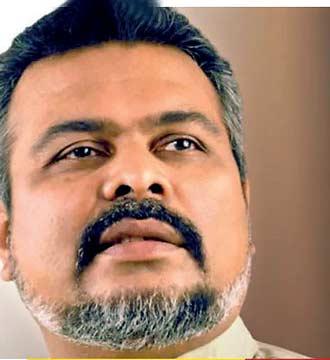
Reply To:
Name - Reply Comment
 The officialdom does not seem to be desiring or strong enough to topple the Government as what Nandana Gunathilake predicted. Nor does the Opposition provide them the necessary outside assistance for the ‘onslaught within.’ Yet, their activities definitely help the Opposition to build up a negative public opinion about the Government
|
The late politician Nandana Gunathilake |
Nandana Gunathilake, who shouldered the rebuilding of the Janatha Vimukthi Peramuna (JVP) after a bloody crackdown of it by the United National Party (UNP) Government in the late eighties passed away on January 18.
However, he quit the JVP in 2008 and later joined the Sri Lanka Freedom Party (SLFP) and the UNP respectively and became a controversial critic of the JVP.
When the JVP-led National People’s Power (NPP) Government announced last August that the pension paid to former Parliamentarians will be scrapped, he said in a Facebook post, “I will die if my pension is touched.” Whatever he meant by that comment, he passed away eleven days after the Bill seeking the repeal of the MP’s pension was presented in Parliament, though accidentally.
This is not an article about Gunathilake, but an important and insightful statement he made on a crucial challenge the NPP Government has been facing from the beginning.
The ministers of the Government since the day they assumed office have been complaining about an unamenable bureaucracy in the country. Against this backdrop, when the former Chairman of the Election Commission Mahinda Deshapriya warned in a Facebook post that what happened to the Governments of Patrice Lumumba of Congo, Sukarno of Indonesia and Salvador Allende of Chile with recur in in Sri Lanka as well if the ‘deep state’ is not contained, Gunathilake explained why the deep state exists in Sri Lanka.
Commenting on Deshapriya’s post he stated, “If power is captured through non-revolutionary means you will have to work within the existing system, and no more than that.
Yet, you have to make revolutionary changes to keep the promises given to the people.
The conflict between these two sides would intensify day in, day out.
The conflict would deepen with the existing system and hinder the efforts to go for revolutionary changes.
Accordingly, the onslaught from within the state would escalate with the assistance from outside.”
Except for Gunathilake’s prediction at the end of his comment, the analytical part of it represents the situation on the ground. The bureaucracy would not play fool with the government leaders who had captured power through an armed revolution or a military coup nor would they sit on the files nor challenge the powers that be lest they would have to pay for it. Even during the ‘white van era’ officials played carefully.
NPP leaders realised the power of the bureaucracy within weeks after they assumed office. Ministers then complained that the officials were not cooperative to the policies and the working style of the new government leaders. Agriculture Minister K.D. Lalkantha made a public statement in December 2024 that the officials accustomed to the old administrative culture obstruct the Government’s efforts to bring the country forward.
He said that these officials who have been hand in glove with the previous corrupt politicians wanted to continue with the way they worked thus far and warned that the next public tsunami would be against them. Industries Minister Sunil Handunnetti also complained then that some government officials were not prepared to change and the Government was compelled to launch a struggle against them.
President Anura Kumara Dissanayake on his part told while addressing a group of officials from the Immigration and Emigration Department, Airport and Aviation Authority and the Sri Lanka Customs in the same month that the time has come for the Customs officials to eschew their negative attitudes. In April he again warned that the Government would have to change the bureaucracy from May, unless they themselves change.
These incidents were an indication of the red tapes in the public sector, in spite of the NPP Government having vowed to bring in an overall system change. Hence it was not surprising that people like Mahinda Deshapriya were fearing repetition of the fates of Lumumba, Sukarno and Allende in Sri Lanka. Lalkantha renewed his complaint about the bureaucratic red tapes at a gathering this week. He stated that the NPP has won only the government and not yet the state. Yes, it is visible. Officials have failed to distribute the initial payments of Rs. 25,000 and Rs. 50,000 to the victims of Cyclone Ditwah, despite President Dissanayake having instructed them to complete the task before December 31. NPP supporters themselves are up in arms against the affairs of the Attorney General’s Department. They seem to deem the AG also as a part of the deep state. The controversy over the education reforms seems to have erupted following a handiwork of certain officials.Sixteen and fourteen months have elapsed respectively since AKD was installed as the President and the NPP swept the electorate at the Parliamentary election. If the government leaders are to grumble still about their failure to wield their power mandated by an unprecedented huge public support over the State machinery, one has to attribute it either to the weakness of the NPP or the fact that how deep seated the deep state is.
Nevertheless, the officialdom does not seem to be desiring or strong enough to topple the Government as what Nandana Gunathilake predicted. Nor does the Opposition provide them the necessary outside assistance for the ‘onslaught within.’ Yet, their activities definitely help the Opposition to build up a negative public opinion about the Government.
Opposition’s campaigns against the Government have not been focused or consistent to mobilise the masses against the Government. They failed to convince the people in their opposition to the Government’s education reforms. They portrayed the reforms as a whole as an attempt to “vulgarisation” of education as Opposition Leader Sajith Premadasa put it. However, when the Government decided to postpone only the reforms for the Year 6, they abandoned their campaign altogether.
They earlier had announced a no-confidence motion against Prime Minister Dr. Harini Amarasuriya, who is also the Education Minister, over these reforms while demanding a Parliamentary debate on those reforms. Ironically, government ministers are now scornfully questioning them when they want to debate the no-faith motion and education reforms, as they seem to have backtracked from both. They have thus far frustrated Nandana Gunathilake who predicted and hoped that an “onslaught from within the state would escalate with the assistance from outside” resulting in the collapse of the government.