 MOHAMED AYUB
Reply To:
Name - Reply Comment
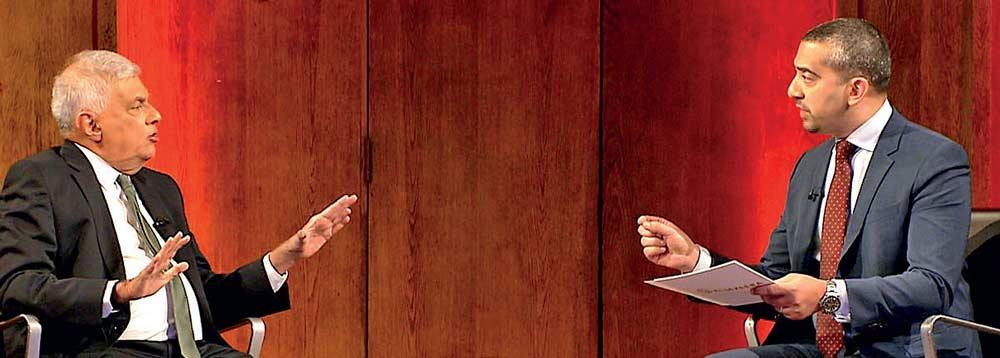
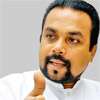
Former President Ranil Wickremesinghe (left) during the Head to Head programme on Al Jazeera, hosted by Mehdi Hasan (right)
Why on earth did former President Ranil Wickremesinghe agree to be interviewed by Mehdi Hasan in the latter’s Head to Head programme on Doha-based Al Jazeera television, if he knew the nature of the interview? It was a disaster for him.
Although belatedly, we raise this question for two reasons, firstly, the interrogating style of the programme which is conducted with no holds barred, aggressively and without caring who the interviewee is, seemed to be too much for Wickremesinghe. Secondly, he is one of the Sri Lankan politicians with skeletons in the cupboard as clearly evident at the interview.
The interview conducted in London some weeks ago before an audience visibly hostile to Wickremesinghe was aired on March 6. It was so damaging to the former President that he convened a media conference here in Colombo soon after it was aired, to do some damage control. He told the journalists that Al Jazeera did not telecast the full interview but an edited version of it, leaving out some of the “good parts” from it.
It became a disaster for Wickremesinghe not only because of Hasan’s aggressive interviewing style and the atmosphere that was seemingly hostile to him but also for his inability to successfully face some of the important questions put to him. He also seemed to have aggravated the situation by provoking the interviewer who seemed not to be intimidated or bullied.
Clashes with journalists are not something new to Wickremesinghe. In most cases when critical or difficult questions are posed to him, he either attempts to scorn or embarrass the journalist. When Deutsche Welle (DW) journalist Martin Gak questioned about suggestions to hold an international investigation over the claims made by the Britain’s Channel 4 Television on Easter Sunday terrorist attacks during an interview in Berlin on October 2, 2023, he pounced on the man reminding his national origin. “Why is it for Sri Lankans and Asians? You think we are second class? Take this Western attitude out. You are talking nonsense” he said angrily.
It is not clear as to what provoked the then President to drag the “West” into the argument. The question had nothing to do with the West or Asia. Even a Japanese journalist would have asked him the same question in that context. However, at a later stage of the discussion he gave a strong logical answer to the question.
Similarly, during an interview in Sri Lanka, a female journalist asked for his comments on allegations that he was not so attached to the local culture. He shot back with a question asking whether she knew about King Manawamma, with which the journalist seemed so nonplused that she did not ask him what her knowledge about Manawamma got to do with her question.
One would hardly contest the fact that Mehdi Hasan does not allow his interviewees to drag on their answers. Sometimes this prevents the interviewee from giving a complete answer, which we witnessed during the interview with Wickremesinghe. Similarly, this also prevents the crafty interviewees to distract from the question.
Even the heads of state, retired or sitting, are not placed in an exalted position during these interviews. Not a single time did Hasan address Wickremesinghe by other than his name. Sarcasm was met with sarcasm. When the septuagenarian former President said “I was in politics before you were born,” Hasan was heard saying amidst laughter in the audience, “Some may say that is part of the problem.”
In fact, should one expect Wickremesinghe to admit the existence of the Batalanda torture chamber and his involvement in it as cited in the Batalanda Commission report? When he was questioned about it, he from the beginning attempted to technically, but childishly evade.
First, he questioned “where is the report,” whereas soft copies, of it both in English as well as Sinhala, have been shared among tens of thousands of people locally and internationally. He challengingly asked Hasan to quote from the report, apparently believing that the latter did not have a copy of the report. When Frances Harrison, the former BBC correspondent in Sri Lanka showed a copy of it, he said it has not been presented in Parliament, as if contents of the report are valid only if it is tabled in the House.
Ranil Wickremesinghe was elected President by Parliament with the support of 134 members - a large majority of whom were members of the SLPP still backing Rajapaksas. Yet, he, during the interview attempted to deny that Rajapaksas supported him, despite the public knowledge that it was the Rajapaksas who supported all his Bills and motions in Parliament, before he was unseated as President. Hasan might have failed to prove Wickemesinghe’s involvement in Batalanda torture chamber and Rajapaksas’ support to him, but nobody would have accepted what Wickremesinghe said about those issues either.
The main point we can gather from this interview is that no Sri Lankan leader should participate in such programmes with a hope to save his skin, as almost all have skeletons in their cupboards. Can Mahinda Rajapaksa convince such an audience about what happened to Lasanatha Wickrematunga, Keith Noyahr and Thajudeen? Or what happened to the 19,000 persons whom the Paranagama Commission has listed as missing persons? Or why he appointed so many commissions to look into human rights issues and what happened to those commission reports? The list goes on.
How is Maithripala Sirisena, if he is interviewed, going to justify the exclusion of his Prime Minister from the Security Council before the Easter Sunday Attacks? How can he convince as the President and the Minister of Defence that he did not have prior knowledge about those attacks? Why did he backtrack from creating an accountability mechanism after giving an undertaking to the UNHRC by co-sponsoring its resolutions?
Gotabaya Rajapaksa was questioned during a press briefing as to where those thousands of people who surrendered to the army during the last days of the war are. ‘Ask the army commander,’ was his response. Can he do the same at a ‘Head to Head’ interview? Anura Kumara Dissanayake might be the leader who would be roasted least in that sense.
These leaders can bluff when they are questioned about these and similar issues within the country by local journalists who have so many limitations including safety, but not by foreign journalists, especially outside the borders of the country.