Reply To:
Name - Reply Comment
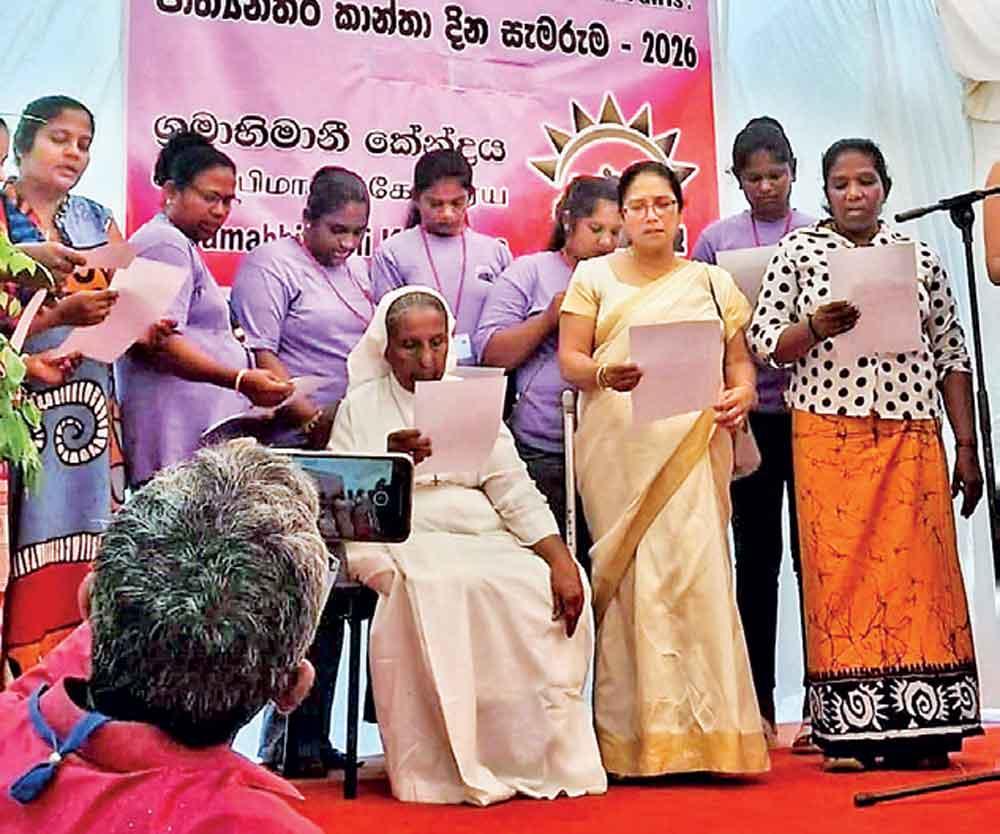
Women workers with Rev. Sr. Noel Christine Fernando pledge that they will continue their struggle
|
Rev. Fr. Sarath Iddamalgoda addresses the gathering |
Women workers gathered recently at the Shramabimani Centre in Seeduwa to mark the World Women’s Day, demanding a living wage that matches the rising cost of living, decent working conditions, safety of workers, better healthcare facilities and limiting the extensive working hours from the government and employers.
Free Trade Zone (FTZ) workers urged lawmakers and their employers to understand the silent tears shed amidst the sound of machines.
“We face frequent humiliation and insults within and outside work which a woman cannot bear, but we go through them to feed our children, parents and other dependents in our homes,” said Shriani Fernando, an employee of a garment factory at the Katunauake FTZ.
Many such sad stories were narrated on the appalling living and working conditions of female workers who have left behind their families, kith and kin to keep the wolf from the door.
“There is no privacy in a ten by ten room shared with other workers who have to walk back to their rooms late at night through lonely streets,” said Indrani Weerasinghe, a mother who has to feed five mouths with the little wage she earns as a factory employee.
Female workers who are compelled to leave the safety of their homes at a very tender age to support the family fall prey to predatory men seeking opportunities to satisfy their carnal desires.
The predator could either be the employer, landlord, a friend, the partner or a sympathiser with ulterior motives.
“While we are walking back to our rooms, men ask us whether they could give us a lift. When we refuse the offer, they make disgusting remarks,” a young worker said.
Speech and hearing impaired workers said that they too, are able to work as well as those not impaired.
They said: “ we have eyes, a good brain, hands and feet to work. We need to be treated like all others instead of verbal sympathies.”
Behind the horrific ordeals is the unseen force that makes workers immune to the injustices at the workplace. Many workers who are victims of sexual exploitation and harassment keep silent to safeguard their jobs.
“We know the outcome if we speak against unfair treatment by our bosses. If we lose our jobs, who will feed our children,” said Susumali Dissanayake, a mother of four, employed at a garment factory in Gampaha.
What is saddening and gruesome is that workers try and make up for low wages or incomes by offering themselves to fulfill the sexual desires of certain men.
Women garment workers in FTZs face severe exploitation, including 16-hour workdays, unachievable production targets, sexual harassment, and hazardous work conditions. Many endure poverty, wage theft, and lack of basic facilities, often resulting in Urinary Tract Infections (UTIs) due to poor sanitation and limited bathroom access.
Landless female workers in the Gampaha District urged the present authorities to bring an end to their homeless condition by taking steps to fulfill their fundamental right to live in a house of their own.
“The manner in which we are treated sometimes by our landlords is similar to being a slave. Shifting houses each year or two is nothing short of being refugees who have no status and dignity,” said A.Shridevi from Walana, Katunayake.
“We have been living like gypsies moving from one house to another without a permanent address for a long time. What we ask from the government is to give us the title deeds to the houses we are in now, so that we have some status and respect,” said Shandani Fernado, a member of the Association of Homeless Families in Gampaha.
“When we fail to pay the rent by one day, we hear such unpleasant language from the landlords; and some of us have broken family relations due to misunderstanding while sharing the same house with our siblings,” she said.
Sister Noel Christine Fernando, a prominent rights activist who leads the Sramabimani Kendraya (or Shramabimani Centre) in Seeduwa, a rights group focusing on worker solidarity, particularly within the free trade zones said the battle to secure the rights of workers will go on whichever government is in power.
“It was never a matter of smooth sailing for the Sharmabimani centre since its start in 1994. However, it waded through high tides, and rough waters and stood through thick and thin to be what it is today, branching out for every worker to take rest and shelter,” Sister Fernando said.
She said it is these worker’s toil and tears that bring much needed foreign exchange to the country. “We believe this government that came to power through the ballot of landless people will heed to their cry and provide them a permanent house,” she added.
Rev. Fr. Sarath Iddamalgoda, core founder and director of Shramaabimani Centre, said under whatever condition, we musn’t forget the vision and the mission that we are called upon to ensure justice for the oppressed and the marginalised.
He said the condition of the landless community in the Gampaha district and in the rest of the country is similar to the estate community who have been living for over 200 years without proper status, which reveals the extent of social inequality and discrimination in a nation that is signatory to many UN conventions on the right to life and decent living.
“A bottom-top discussion and collaboration with a people-friendly and people-centred administrative mechanism is critical to address the persisting issue of the ‘unknown poor’ in the country whose call for a permanent house has gone unheeded for many decades,” he said.
According to the UN, an increasing number of people are driven from their homes by crises such as conflict, political instability, climate change, and economic hardship. A record number of people are forcibly displaced and in an increasingly urbanizing world -- displacement is becoming an urban phenomenon.
Meanwhile, poverty in Sri Lanka has been rising since the economic crisis in 2022 where many households in the ‘middle income’ bracket have been pushed down to the ‘poor’ segment.
According to the World Bank poverty continued to increase in 2021, and doubled between 2021 and 2022, from 13.1 to 25.0 percent ($3.65 per capita, 2017 PPP) adding 2.5 million people into poverty in 2022.
Eradicating extreme poverty for all people everywhere by 2030 is a pivotal goal of the 2030 Agenda for Sustainable Development.
Blurb: What is saddening and gruesome is that workers try and make up for low wages or incomes by offering themselves to fulfill the sexual desires of certain men