Reply To:
Name - Reply Comment
 In a fluid international system of power transition, strained geopolitical alliances in Trump’s second term and fickle domestic politics under Gen Z fervour, Asanga Abeyagoonasekera’s aptly titled book ‘Winds of Change’ is an eye opener.
Abeyagoonasekera, a geopolitical analyst and former head of two foreign policy and security think tanks in Sri Lanka, covers a gamut of issues, each with its own complexity and contradictions. They range from the geopolitics of China’s Belt and Road initiative, Indo-China rivalry, America’s Indo-Pacific strategy, evolving alignments, cautious hedging strategies by wary states and domestic politics of individual states in South Asia and beyond.
One fundamental problem of most geopolitical analyses of this kind is that they tend to read too much, and too prematurely, into geopolitics, effectively turning nation-states into black boxes and the analyses themselves into echo chambers.
Abeyagoonasekera avoids that pitfall. In most measures, he strives to offer a holistic and nuanced picture and strays clear of partisan rhetoric of either side of the geopolitical divide. He discusses systemic forces. i.e. great powers and shifting power configurations, but also domestic systems of regional states, which is important , as neo-classical realists would argue, or any cursory observer in international politics would casually note, domestic choices and preferences have far-reaching influence in the foreign policy choices of states, more so during times of low systemic pressure.
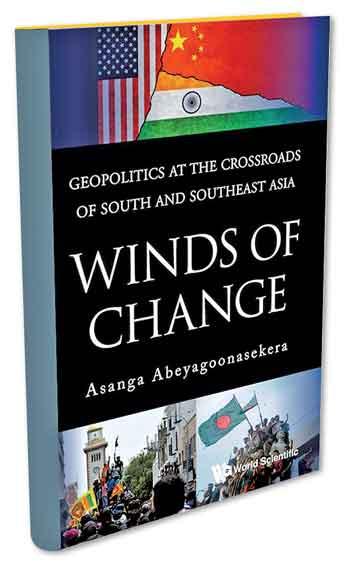 |
| Winds of Change covers a gamut of socio-political issues |
 |
| Asanga Abeyagoonasekera |
Abeyagoonasekera draws extensively from first-hand experience, regional travels, interviews, anecdotes, and theory and practice of foreign policy and international politics.
Some of the insights are interesting – and one reference probably overshadowed the depth and breadth of the rest of the analysis.
Abygoonesekara quotes Gotabaya Rajapaksa, the ex-president, as alleging that the CIA had orchestrated his ouster through popular protests -- a preposterous charge, indeed, though conspiracy theories sell.
Abeyagoonasekera quotes the Bangladeshi observers, and some Indians, saying the same about the ouster of Sheikh Hasina, through similar mass protests, which turned bloody – unlike in Sri Lanka– when the regime turned its guns on student protestors. In the same pages, certain Russians were also heard referring to coloured revolutions.
Abygoonesekara makes no effort to negate or substantiate these claims; he records them.
Elsewhere, he is more outspoken. He observes that relations with semi-autocratic regimes entailed a substantial reputational cost for China. He refers to Gotabaya Rajapaksa’s administration, especially, though the sentiment is valid across Asia, Africa and Latin America. He places blame for the vanity projects of BRI (Belt and Road Initiative) on borrowing nations, which often overlook long-term financial viability and environmental concerns of such projects, driven by domestic elitist and political considerations.
One of the main drawbacks of unchecked dalliance with autocratic regimes is that such bilateral relations, no matter how deep-rooted, tend to be identified with the regime, effectively making them disproportionately susceptible to the mood shifts associated with domestic political changes. Abeyagoonasekera rightly points out that this is not uniquely a Chinese predicament, as India’s strained relations with post-Hasina Bangladesh and brewing anti-Indian sentiments in the streets of Dhaka would reveal.
But, concerning China, this presents a curious paradox. China’s foreign policy approach of non-interference in the internal affairs of other states itself prompts Beijing to work with any government in power, though the same policy returns favour through the adherence to the One China policy and disavowal of any Western censure of China’s human rights.
Despite these drawbacks, Abeyagoonasekera defends, rightly so, the colossal importance of China’s BRI as a lender to the global South. He takes a holistic view. He argues that developing nations are borrowing from China, not simply because of what was erroneously called no-strings-attached loans. Instead, he details how Chinese loans had addressed a key lending gap in global infrastructure financing (developing nations face an infrastructure finance deficit of US$ 3.7 trillion to 43 trillion annually.) China provides loans at scale and expediently, and at lending rates, though, may not be in line with the ODA definition of aid, are still more conciliatory than commercial borrowings.
Abeyagoonasekera goes on to argue that the BRI is a global civilisational initiative and a counter-hegemonic force. He borrows from the Gramscian concept of cultural hegemony, i.e. power is maintained not through force, but by shaping society’s beliefs, values, and norms and normalising the dominant ideology through institutions like media, education, and religion.
Abeygoonesekera draws a parallel: China’s foreign-facing civil society groups and think tanks are increasingly dedicated to promoting a China-centric harmonious culture, while the Chinese state attempts to create a new world order, where its cultural, intellectual and moral leadership take the central role. And BRI brings China’s cultural hegemony into global economic and infrastructure realms, he observes.
Spiral of security competition
He observes US-led balance of power initiatives such as QUAD, AUKUS and overall US Indo-Pacific strategy in response to the rising economic and military power of China. He envisages, rightly so, that China would view such mechanisms as a threat, leading to a spiral of security competition.
One of the lacunae in the book is its expansive area of discourse itself, which precludes the author from extensively dwelling on each topic. Abeyagoonasekera himself provides an overdose of information, but not much analysis. A reader might find it difficult to digest so much information, unless he is offered an analytical framework to store it. Instead, Abeyagoonasekera prescribes policy recommendations for states navigating the geopolitical minefields, some of which would be useful for policymakers.
One of them might interest the NPP government. He recommends the new administration in Colombo to take lessons from the Gramscian experience. Citing Gramsci’s transformismo (transformation), he observes that the ruling class maintains its dominance not by force, but by consent, by integrating opposing elements of society into its system, creating a semblance of reform while avoiding profound and destabilising systemic changes.
That is advice worth listening to.
Winds of Change: Geopolitics at the Crossroads of South And South East Asia, (World Scientific) by Asanga Abeyagoonasekera is now available at Sarasavi Bookshop