Reply To:
Name - Reply Comment
 Dr. Kulasinghe was a pioneer who sought new paths to solve problems others deemed unthinkable
He demonstrated that foreign contractors were not essential for national infrastructure
His crowning achievement was leading the Accelerated Mahaweli Development Project from 1977
By Sugath Priya Kulathunga Arachchi
|
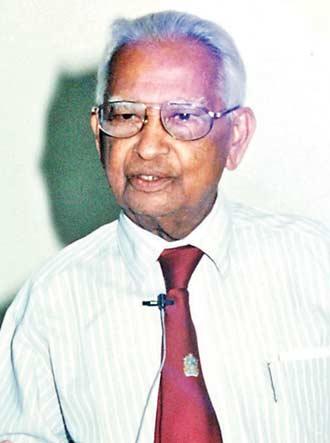
The picture shows Dr. A.N.S.Kulasinghe delivering a Technical presentation at the Sri Lanka Branch of The Institute of Marine Engineers on October 18, 2000 |
|
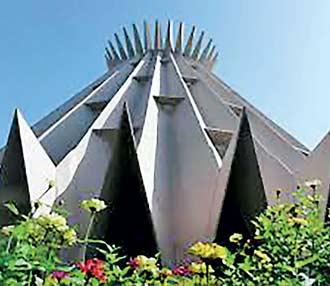
Among his architectural marvels are the Colombo Planetarium, designed like a blooming lotus and seating 500 people |
|
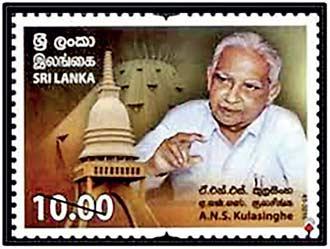
The Philatelic Bureau of the Department of Posts issued a new postage stamp in the denomination of Rs.10.00 26th October, 2016 to commemorate Dr. A. N. S. Kulasinghe |
Sri Lanka once had a remarkable inventor who proved that poverty could be overcome not through borrowed development models, but by harnessing indigenous knowledge and innovation. That man was the late Dr. Arumadura Nandasena Silva Kulasinghe—a globally acclaimed Sri Lankan engineer whose extraordinary creations continue to inspire the world.
Dr. Kulasinghe was a pioneer who sought new paths to solve problems others deemed unthinkable. He was celebrated not only for his contributions to engineering research and development, but also for applying locally grounded solutions to national development. His guiding principle was simple yet profound: “We must develop construction policies that use our own resources, suit our climate, minimize costs, and do no harm to the environment.”
He demonstrated that foreign contractors were not essential for national infrastructure. His work earned admiration from global figures, including Sir Arthur C. Clarke, who once said that post-independence Sri Lanka produced only a handful of brilliant scientists—and Kulasinghe stood out among them.
Global recognition, local genius
Kulasinghe’s engineering brilliance earned him advisory roles in Malaysia, Indonesia, Singapore, the Philippines, and Thailand. His name became synonymous with innovations like precast concrete technology, concrete boats, silos, and window frames. The iconic Colombo Planetarium and the monumental works of the Accelerated Mahaweli Development Project are testaments to his genius.
Born in 1919 in Udammita, Ja-Ela, Kulasinghe was educated at Wadduwa English Boys’ College, Maris Stella College, and St. Benedict’s College. He studied engineering at Ceylon Technical College under the University of London and won the prestigious Sri Chandrasekera Scholarship.
His patented precast concrete technology earned him the nickname “Concrete Kulasinghe.” He also invented the FS 77 Fuel Saver, which reduced fuel consumption by over 25% and was successfully tested in the UK and Scotland. He developed efficient tea leaf dryers and small generators.
Despite his global acclaim, Sri Lanka often failed to fully utilise his talents. A famous anecdote recounts how a Sri Lankan minister sought low-cost housing advice in Malaysia, only to be told that Malaysia had learned from Sri Lanka—specifically from Kulasinghe.
In the 1960s, Prime Minister R. Premadasa challenged him to build housing on a marsh in Maligawatte. Kulasinghe accepted and successfully constructed four-story flats there, followed by similar projects in Narahenpita.
His crowning achievement was leading the Accelerated Mahaweli Development Project from 1977, completing a 30-year plan in just five years. He oversaw the construction of major reservoirs including Victoria, Kotmale, Maduru Oya, Randenigala and Rantambe.
He championed cost-effective technologies like concrete roads, concrete sleepers for railways, and ferrocement boats. His innovations saved up to 25% in railway costs and empowered local engineers.
Kulasinghe often clashed with foreign consultants, notably during the Maduru Oya project, where foreign intervention quadrupled costs and eliminated a planned 6MW power station from the local design.
Architectural wonders
Among his architectural marvels are the Colombo Planetarium, designed like a blooming lotus and seating 500 people, and the Kalutara Chaitya—Sri Lanka’s largest hollow stupa. Despite opposition, he built it with a hollow interior to prevent collapse near the river mouth.
He also designed the Sambodhi Chaitya at the Colombo Port and the Mahaweli Maha Seya near the Kotmale Reservoir, commemorating submerged temples. The latter is Sri Lanka’s second tallest stupa after Ruwanweliseya.
His legacy includes restoring the Maligavila Buddha statue, building the Puttalam Cement Factory, and leading projects for the State Engineering Corporation, National Science Foundation, Lanka Leyland, and Lanka Steel Corporation.
A Lasting Tribute
Dr. Kulasinghe passed away on February 14, 2006, at age 86. In honour of his service to the Mahaweli Project, the recently built Moragahakanda Reservoir was named the “Kulasinghe Reservoir.”