Reply To:
Name - Reply Comment
 An estimated 1288 Bharata are currently living in Sri Lanka, although they are a slowly vanishing group
Fernando is the most common Bharata surname. The Fernandos hailing from the parish of Vembar in South East India, were the converts of the Jesuits in the 16th century whose faith was enkindled by St. Francis Xavier
Sri Lankan culture has been greatly influenced by India, owing to the geographical proximity of the two countries. The narrowest distance between the two is a strip of 50 kilo metres between Dhanushkodi in India and Thalaimannar in Sri Lanka, which was believed once to be connected by a stone bridge that the great Indian epic ‘Ramayana’ claims was built by monkeys. Aerial mapping has confirmed the existence of the Rama’s Bridge or Rama Setu. The close connection led to many exchanges between the two countries—people arriving on each shore over the years, and the merging of cultures.
 A small community of predominantly Catholic people of Indian origin occupy the western coastal belt from Mannar to Chilaw and Negombo to Colombo. They are believed to be descendants of Tamil-speaking Paravar people of Southern India who had once been Hindus. An estimated 1288 Bharata are currently living in Sri Lanka, although they are a slowly vanishing group, who were only recognised as a unique ethnic group in 2001.
Pearl diving is where the connection of the Bharatas to the Island begins. Legend has it that in 1415, they came from Mohenjo-daro led by Aryan warriors and 16 lieutenants to drive away the ‘Mukkuvas’ or Arab horse traders, ensconced in Puttalam, who were monopolising the very valuable pearl trade. Incensed by an encroachment on what they considered to be their domain, the Bharatas, using their sea-faring skills, sailed across the Indian Ocean to make regular forays into this monopoly. Over time, they completely displaced the Arabs, and as a reward, the King of Sri Lanka at that time, King Parakramabahu VI of Kotte welcomed them as his subjects. Integrating very well with the local communities, they initially settled down on the coast at Mannar where many of the descendants of the original families still remain.
Fernando is the most common Bharata surname. The Fernandos hailing from the parish of Vembar in South East India, were the converts of the Jesuits in the 16th century whose faith was enkindled by St. Francis Xavier. Through thick and thin, they cherished their faith even as they spread their wings to distant shores, to reach Mannar, Negombo, and Colombo and beyond.
Coonghe, Pinghe, Moraes, Croos, Dabrera, Soza, some Fernandos, some Rodrigos, Paldano, also Feldano, Figurado, Mirando, Paiva, Victoria and Raj Chandra - all these names that may sound familiar to Sri Lankans are rooted in the Bharatha community. Their names also link them immediately to the Portuguese and Catholicism. Though their ancestors were Hindus, they were compelled to convert to Catholicism when Portuguese colonial missionaries came to Ceylon, and were bestowed Portuguese names. Vestiges of Hindu culture still remain, for families still tie the thali around the bride’s neck during the marriage ceremony. The older generations speak mostly Tamil. There are four family names of non-Christian origin still in common use, these being Kalingarayan, Villavarayan, Poobalarayan and Rayan. These names are thought possibly to have their origin in Arayan, which was used by Tamil fishing groups.
In Negombo, I met an elderly gentleman who has a different story to relate. Alensis Brendan Sosa claims “the Bharatas or Bharatakula as a relatively prosperous merchant group from India that settled amongst the Sinhalese in the Negombo area”. They came from Tuticorin, a port city in Tamil Nadu presently known as Thoothukudi.
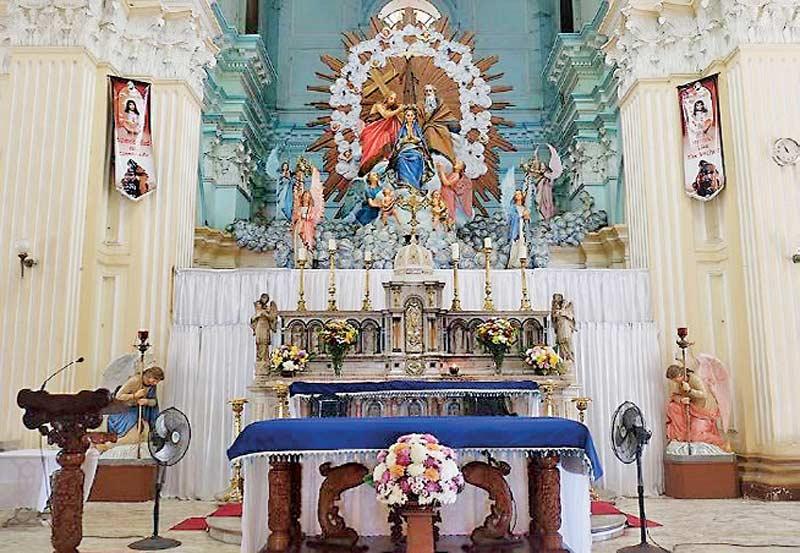
According to Sosa, his ancestor Gabriel de Croos arrived in Negombo and set up a business in the 1800s. His son, John Leo de Croos, married Nita Coonghe and they had two daughters Rosa Isabelle de Croos and Mary Christina de Croos. Soon after giving birth to Mary, Nita died and Clara, Sosa’s grandmother cared for her. The two sisters were boarded at the Kandy convent where they received an education. John Leo was a landowner, a very wealthy man. Apart from setting aside inheritance for his two daughters, he left a large portion of his wealth to the poor. One story relates, that a thousand acres of coconut land was entrusted in the care of the parish priest of St Mary’s church to be given as dowries to poor women and land to widows. Sosa said that we should go there and see the beautiful marble Altar made in memory of John de Croos and his wife in 1922.
Donating land to Marist Brothers
The two daughters themselves, devout Catholics dedicated their lives to serving the community. They donated a 10-acre land at the Copra junction (the place where Copra was collected to be transported to Colombo) in Negombo to the Marist Brothers to build a secondary school for boys. The school that began in 1921 as part of St Mary’s College was renamed Maris Stella College in 1924. To match the school’s new name ‘Maris Stella’ which means ‘the star of the sea’ the college crest was designed to depict a sailing ship with a star at the top, with the motto “Ite Para Tutum” meaning “show us the way”. The two letters “A” and “M” stands for Ave Maria the first two words in Latin of the Catholic prayer Hail Mary. Today, Maris Stella is a leading boys’ school in the Western Province.
Sosa recollects the generosity of his ancestors “Bharatas in Negombo built a cemetery and an elder’s home using their own wealth. Next to the elder’s home is the community hall where people of our community meet regularly”.
The Baharata cemetery is a place of tranquility and reverence with a small chapel located at the center. Neat rows of graves line the pathway. Elaborate gravestones in marble indicated familiar Bharata surnames like Croos, Coonghe, Moraes and Dabrera. This land has been a donation by N E de Croos and his son, Canisius de Croos, a retired government servant was taking care of the plots until he died.
According to Sosa, the Bharatas later moved away from their traditional sea-faring roots into commerce. The first prominent Colombo trader was S. Miguel Fernando, a Milliner and Draper who specialised in gents’ outfitting. His business was located at 106, Main Street in Pettah, now the commercial and trade hub of the city, This was soon followed by what became iconic merchant icons like M.P Gomez, J.L. Carwallio and F.X Pereira’s—the first departmental store in Ceylon, which stood at 144 Main Street, Pettah. Many stories abound of Christmas shopping not being complete without a visit to buy crackers, cake ingredients and of course, liquor.
The Bharatas also left a legacy which became historical in Sri Lanka—the kerosene bullock cart. Starting from importing onions from India, they acquired the agency to distribute petroleum products and even exported kerosene to India. There were over 50 “Rising Sun” petrol and oil depots throughout the island, all of them run by Bharata business owners. This trading success encouraged the Bharatas to venture into other commercial ventures and soon they were into Coconut farming, Land ownership and Arrack licensing moving on the coast from Mannar to Panadura and inland into Kandy and Kurunegala.
Bhatata families get together to celebrate occasions such as Christmas. Even those who are living overseas come back to Sri Lanka to be reunited with their families. Sosa’s daughter Diordre says “We cook black pork curry with lots of pepper - a must for any festive occasion”. The black pork curry is so-called because of the spices and curry power used for the marinade. Tamarind is used to add distinct sour notes to curry, and even a hint of sweet and fruity taste. Explaining the recipes handed down from her grandmother, she says they also have a special ‘moju’ rice-puller (a pickle) made of prawns or dried fish. “Unlike other communities we use equal quantities of onion and maldive fish in our seeni sambol to make it really crunchy,” she adds.
Crab curry is another specialty at Bharata family get-togethers, especially on Sundays. This dish goes all the way back to their roots in fishing, where the mud crabs abundant in lagoons were brought home live with their pinchers tied up with strings, to be boiled and cooked.
The two main Bharata communities in Negombo and Colombo have established their own associations to preserve the unique culture. The Negombo Bharata Association was started in 1937. Nicholas Emmanuel De Croos the only son of John Leo de Croos Sosa’s ancestor became the first president. The following year the Baharatas in Kotahena also established their own Association through which they organized various social and religious programs during the year to keep the community united and also to keep the present generation aware of the history and traditions of Bharatas.
The connection between the two countries has been strong for many centuries. I. X. Pereira built a Rest Home in Tuticorin for the benefit of Bharathas who came from Ceylon or the outlying villages. It is known today as the Bharatha Home. The first Bharatha Conference was held in Tuticorin in December 1915. In January 1938, the 9th Bharatha Conference was held in Colombo, under the presidency of Mr A.L.J. Croos Dabrera. “The good thing about belonging to a small community is that everybody is known to each other. We have always been living harmoniously with everyone” concludes Sosa. Sosa himself, a retired Air Force officer of high rank is proud to have served the country during the civil war for 30 years. The Bharatas proved their success by both integrating into the local communities they settled in, and yet retaining their own unique identity and culture.