Reply To:
Name - Reply Comment
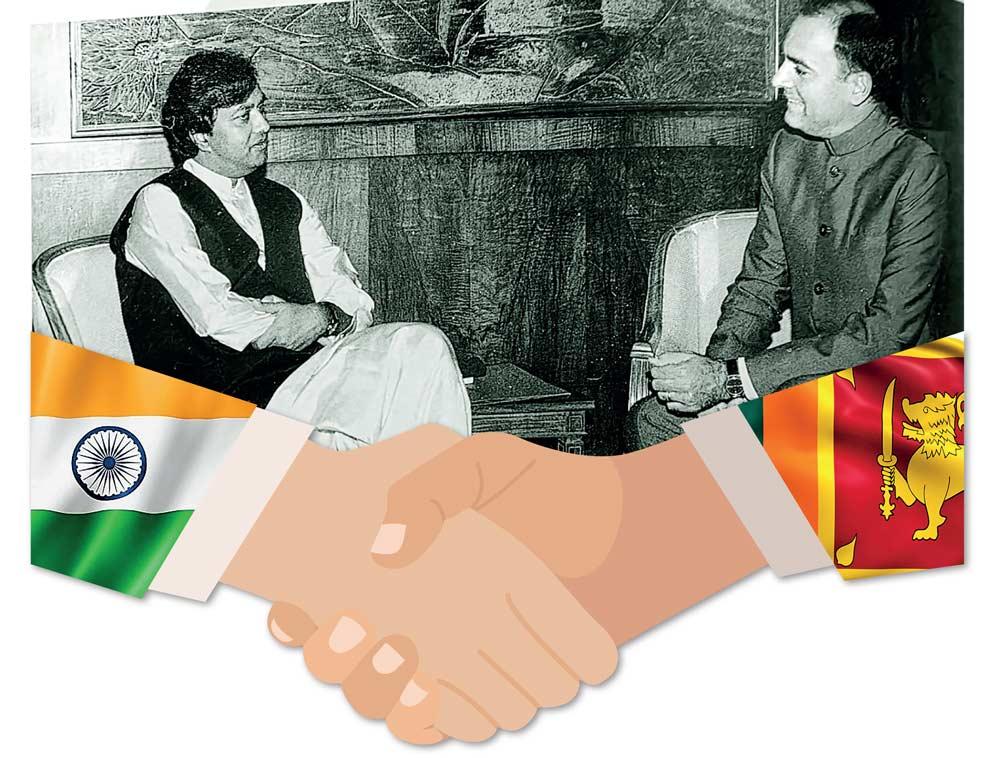
Gamini Dissanayake in conversation with Indian Premier Rajiv Gandhi
 “The accord changed the direction and scope of relations between the two countries, turning hostility into fragile friendship.”
“My father might have lived longer had he not been drawn into the accord’s political storm.”
“The agreement failed to bring peace but laid the foundation for a new understanding between India and Sri Lanka.”
“A window of opportunity arose, but its price was written in blood, grief, and irreversible change.”
 The 1987 Indo-Lanka Accord marked a defining moment in Sri Lanka’s modern history, altering its relations with India and redrawing the island’s political landscape. Written from a deeply personal lens, Navin Dissanayake revisits the turbulent events that led to the agreement, its aftermath of violence, and its enduring legacy of cooperation amid sacrifice and loss.
|
Navin Dissanayake |
It’s been 38 years since the Indo-Lanka accord of 1987 was signed between Prime Minister Rajiv Gandhi of India and President JR Jayawardene of Sri Lanka. I had a ringside view of what happened leading up to it. I am penning these words on the occasion of my father’s 31st death anniversary, and there is a spasm of trepidation in my heart as I know that he might have lived longer and not been assassinated on that night of October 24 had he not got involved in the Accord.
As I am also researching a book I am writing, the events so long ago that may have been erased by time. Indeed, the generation after 2000 should be given an account of those events for posterity. The Indo-Lanka Accord of 1987 changed the direction and scope of relations between the two countries. Two countries on a hostile trajectory were placed on a more friendly footing. What was the cost that entailed? Indeed, the short-term costs were immense, but do the long-term benefits outweigh the short-term pain and cost?
The background to this accord between the two countries was Sri Lanka’s foreign policy in the 1980s and the rise of militant separatist activity, also during that time. President Jayawardene made an error in judgment by having a lukewarm attitude towards Indira Gandhi, the Prime Minister of India at that time. This was exasperated by the defeat of Mrs Bandaranaike in 1977 and President Jayawardene’s action against her, namely the deprivation of her civic rights. Mrs Gandhi did not take to this kindly.
JRJ’s pro-Western ideological and economic policies were frowned upon in New Delhi. The situation was complicated by the rise of extremism in the Northern and Eastern Provinces. Alfred Dorriapah, the SLFP mayor of Jaffna, was shot by Prabhakaran in 1976. By the beginning of the 1980s, there were several separatist groups active in the North/East, and most of them were guided by an ethno-nationalist doctrine of Tamil nationalism, which would lead to a separate state. In 1983, the July riots happened. These riots targeted Tamil civilians who lost life, limb and property and had become forever a black mark in Sri-Lanka’s history.
Although the UNP government kept a tremendous pace on economic development, tremendous fissures had come about on the social and political fronts. The postponement of the general election by a referendum and the deprivation of Mrs Bandaranaike’s civic rights caused much disenchantment in society.
As the Tamil groups struck into the Sinhalese homeland in Anuradhapura, the need for a political solution to the Ethnic issue was getting louder. Although a separate ministry of National Security was created under the dynamic leadership of the Late Minister Lalith Athulathmudali, there was an increasing sense of frustration in Colombo as a conventional army was finding it challenging to counter the hit-and-run tactics of the guerrilla groups. It was an open secret that New Delhi assisted these groups in many forms and ways. Mrs Gandhi was assassinated in 1984, and her son Rajiv wanted to normalise relations with Sri Lanka, and my father played a crucial role in this aspect.
At the beginning of 1987, my father was extremely popular in the country. He was seen as a dynamic young leader of the UNP, one among the many who had been groomed by President Jayawardene for the next level of leadership. His primary responsibility was the Mahaweli development project, which built several dams for irrigation and power generation. Hydropower from these reservoirs still powers Sri-Lanka’s electricity supply to the tune of 25-30%. These majestic reservoirs and the Mahaweli project testify to Sri Lanka’s ability in engineering, hydro-irrigation technology, and human discipline, which are needed for giant strides in development.
He was also credited with Sri Lanka obtaining test status in cricket, which still stands as one of the few sports in which Sri Lanka has excelled.
At the beginning of 1987, he was only 45 years old, full of ideas and vision for Sri-lanka. Intelligent, articulate in both Sinhala and English, a superb political organiser and operator, he was one of the few who knew grassroots politics and also had an idea of where to take Sri-Lanka. Micro and Macro, the small and the big, Colombo and the village, he has mastered it all.
Sri-Lanka was also heading for a presidential election in 1988. President Jayawardene was 81 years old at that time, and there was a legal view that, as he had only contested once, he could contest again.
Prime Minister Premadasa was clearly the frontrunner, but those closest to my father felt he should not do anything to lower his popularity among the masses.
At the beginning of 1987, it was thought that the war was unwinnable and impacted the economy. On the 4th of June 1987, India undertook a food drop from its Air Force. The famous “Parippu Drop’ was a gross violation of Sri-Lanka’s sovereignty and territorial integrity.
It was conducted to give food relief to the displaced people of the North-East as a result of Operation Liberation, the retaking of the Vadamaracchi area by the security forces. As a result of this, there was an anti-India wave in Sri-lanka. The Sri-Lankan government hyped up these feelings among the population. The political leadership was all about how bad India was to Sri-lanka. The question is how, in merely eight weeks, the situation was reversed entirely for the signing of the Indo-Lanka accord of 1987.
As a young 18-year-old and from the limited knowledge of politics I had, I advised my father not to get involved in this because of the anti-India feeling prevalent at that time. He took it upon himself to initiate a dialogue with K.P. Salve, Chairman of the Indian Cricket Board, who was close to the Gandhi Family.
These discussions also expanded to Romesh Bhandhari, the Foreign Secretary, and KC Pant, the Indian Defence Minister. These discussions occurred at the end of June 1987.PM Gandhi and President Jayawardene were very much involved and gave the green light for these discussions. By the middle of July, there was a working draft of an agreement. The Indians wanted a devolution model based on the federal model. They also wanted security guarantees in the form that Sri-Lankan soil would not be used for anti-Indian purposes. Sri-Lanka wanted India’s unconditional support to maintain its sovereignty and territorial integrity.
If India maintained close links with the separatists and provided them training, there was a great possibility of a break-up of Sri-Lanka. India’s support was crucial to neutralize the militant groups, especially the LTTE.
For Sri Lanka to change its constitution through an amendment, Sri Lanka was expecting India’s unconditional support to quell the Tamil militancy.
Given the time factor and realistic political environment, we were questioning my father whether this was practically possible, both within the government and the country.
President Jayawardene had three detractors for the accord within his own circle —Prime Minister Premadasa, National Security Minister Lalith Athulathmudali and his son Ravi Jayawardene. By the 20th of July, there was widespread speculation that an agreement would be signed. Pro-Nationalist Tamil and Sinhala groups became aggressively active. The SLFP of Mrs Bandaranaike openly came out against it.
The JVP, through its Militant arm, the Deshavimukthi Janatha Viyaparaya (DJV), organised a brutal and violent response by targeting all opposition and government supporters who aligned with the accord.
It has to be mentioned here that Actor turned politician Vijaya Kumaratunge and his wife Chandrika supported the accord on a matter of principle as they felt that devolution of power was necessary as a solution to the grievances of the Tamil people. The mayhem had started, and what happened thereafter was the darkest period in political violence in Sri Lankan history.
The anti-accord argument’s core was that Sri-lanka would no longer be a unitary state. The accord recognised that the north-east was a historical homeland of the Tamil people. Recognised Tamil as an official language and, for the first time, provided extensive power devolution as a political solution to the ethnic problem.
For the Sri-Lankan side, in one stroke, President Jayawardene got India’s solid support and assistance to neutralise and mitigate the growing militancy engulfing the island. The accord also provided for demilitarising the militants and an Indian peacekeeping force to enforce the provisions.
While Finance Minister Ronnie De Mel and the rest of the cabinet supported the accord, it was my father who stuck his neck out and came out openly supporting it.
The Maha Sangha, which formed his core support, admonished him for it. On July 29, when Rajeev Gandhi landed in Colombo, Colombo was under curfew, and there was thick smoke covering it.PM Premadasa and Minister Athulathmudali boycotted the signing ceremony.PM Gandhi was nearly killed when a sailor in the guard in his honour assaulted him with his rifle. There was a massive protest everywhere. The feelings of the people were definitely anti-accord, and it was palpably felt in the streets of Colombo and several main cities in Sri-Lanka.
The characters involved were strong-willed people who would not back away from that path once a course of action was planned and agreed upon.PM Gandhi was a young and charismatic leader who wanted to correct his mother’s wrong policy on Sri-Lanka.
He genuinely wanted something positive to come out of the accord. Given the ground situation and growing dissent among the population, President Jayawardene had a reasonable excuse to delay the signing ceremony.
I don’t think the intelligence services gave proper guidance and assessments to both leaders.PM Gandhi was told that Prabhakaran would acquiesce to the accord, and if not, the Indian army could handle the situation, and President Jayawardene was not informed about the brutality that the JVP/DJV could unleash.
The resultant loss of life was terrible. The DJV killed nearly 15,000 UNP and SLFP supporters, and the security forces, in the form of Para forces, killed an equal number of DJV activists. The entire JVP leadership was wiped out.
Minister Athulathmudali barely survived a hand bomb that was thrown inside the parliament building. Vijaya Kumeratunge was assassinated and nearly 30 actors, writers and intellectuals paid with their life.
Maybe President Jayawardene, my father, and the cabinet would not have supported the accord if they knew about the impending severity of the violence. The agreement failed in its basic premise of getting peace in Sri-Lanka. India could not implement the provisions of disarming the LTTE. They got involved in a local war, like Vietnam, that took the lives of 1200 Indian soldiers.
While for Sri Lankans, the death and resultant chaos from 1987-89 was excruciating. I am sure when Prabhakaran planned the assassination of Rajeev and my father, their role in the Accord would have been foremost in his mind. The silver lining is the long-term thinking and the principles ingrained in the accord, which embolden a positive future for both countries working together on matters of shared interest. The accord rewrote the fledgling Indo-Lanka relations in a new light.
A window of opportunity arose, and it was taken; the question is whether the resultant loss of life and property was worth it for Sri-Lanka. Would President Jayawardene have taken the final plunge if he knew there would be such a massive loss of life? I don’t think so. India is clearly an emerging economic power.
Its 1.4 trillion-dollar economy is now the fifth largest and will be the third soon.
The Sri-Lankan political leadership has to work out new deals with Indian entities for inward Indian investments and opening up the Indian market for Sri-Lankan exporters.
The potential is enormous. The signing of the accord and resultant violence took the lives of many, but it also paved the way for a stronger Sri Lanka-India relationship. The key is to work for a better future, learning from past mistakes.
The writer is the current vice-chairman of the UNP is an attorney-at-law and Barrister-at-law