Reply To:
Name - Reply Comment
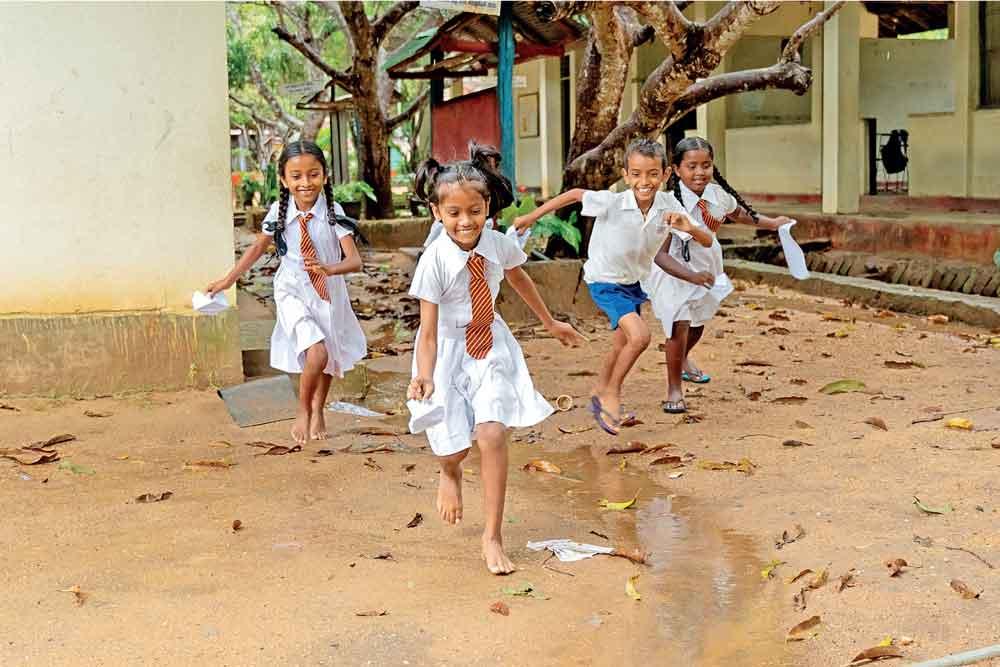
 Around the world, this is a genuinely difficult time to be a child.
Climate shocks, economic disruption, and the enduring shadow of learning loss have placed extraordinary pressure on children and the services meant to support them. Education systems are stretched. Health and nutrition challenges are evolving faster than policy can keep pace. And families are navigating uncertainty with fewer resources than before.
Sri Lanka is no exception. The country’s children have absorbed the consequences of the economic crisis; in classrooms, in homes, in the food on their plates. Around one in four Sri Lankans still live below the poverty line, a legacy that reversed more than a decade of hard-won progress. Recovery is real but uneven, and the pressures on the next generation remains significant.
Yet this is also a moment where small but meaningful steps are being taken. And in the work of improving children’s lives, those steps matter.
Take early childhood education. The rollout of a revised preschool curriculum framework marks a quiet but important shift in how Sri Lanka approaches the foundational years of a child’s development. The global evidence is clear: the experiences a child has before the age of six shapes their learning, their relationships, and their health for decades to come. For a preschool child in Sri Lanka today, this means something tangible - a classroom environment better designed for learning through play, teachers supported with clearer guidance, and an approach that recognises the whole child, not just early academic readiness. It means a child who arrives at school curious and leaves still curious, whose early experience of learning is one of discovery rather than anxiety.
These are precisely the conditions from which lasting change grows.
Progress in the school environment extends well beyond the classroom. Years of advocacy by health authorities, educators, and partners are now translating into policy. The Ministry of Health’s recent guidelines banning high-sugar, high-fat, and ultra-processed foods from school canteens reflects a clear-eyed response to a concerning trend: more than 40 percent of schoolchildren regularly consume food high in sugar, and rates of childhood overweight and obesity are rising. Sri Lanka faces a dual nutrition burden; undernutrition persists in the most vulnerable communities, while diet-related non-communicable diseases are increasing. Reshaping the school food environment is a meaningful intervention in that context, and one long in the making.
Progress in classrooms is also about how children feel when they are there. The recent ministerial circular reinforcing zero tolerance for corporal punishment is a significant signal. Alongside it, ongoing discussions with the teaching profession on how to guide and manage children in ways that support rather than diminish their confidence represent exactly the kind of systemic shift that does not make headlines but matters enormously. A child who feels safe and respected in a classroom learns differently, and better, than one who does not. They ask questions. They take risks. They begin to understand that school is a place that is on their side.
And when disruption comes, the quality of the response matters. Sri Lanka’s learning recovery plan following Cyclone Ditwah showed what joined-up thinking looks like in practice, covering the full continuum from preschool through to TVET in a single, coherent framework, the first time a recovery plan in Sri Lanka had been designed with such a comprehensive scope.
None of these steps will make the front page. There is no single announcement, no ribbon-cutting moment that captures these steps. What is happening is quieter and, in many ways, more important than that.
It is a child sitting down to a lunch that will not harm her long-term health. It is a four-year-old in a preschool where the teacher has been trained to listen as well as instruct. It is a student who raises her hand without fear of what happens if she gets the answer wrong. These moments are invisible in the aggregate. They do not show up in headline growth figures or political speeches. But they accumulate, in children’s bodies, in their confidence, in their sense of what the world expects of them and what they can expect of the world. This is what child-centred reform looks like in practice; a gradual shift in what children experience every day, in the places where they spend most of their time.
For those who care about children - parents, teachers, advocates, policymakers - this is a moment to feel genuinely encouraged. Not complacent, because the work is far from done, implementation challenges are real, and many children in Sri Lanka remain far from where they need to be. But I believe it is possible to recognise progress in the form of these small steps and still press for more.
Countries that invest consistently in children - even imperfectly, even incrementally- tend over time to raise healthier, more resilient, better-educated generations. Sri Lanka has the foundations, the institutions, and the commitment to do exactly that. These steps, modest as they may seem, are how that future is built - one classroom, one canteen, one child at a time.
Pictures courtesy UNICEF