
Reply To:
Name - Reply Comment
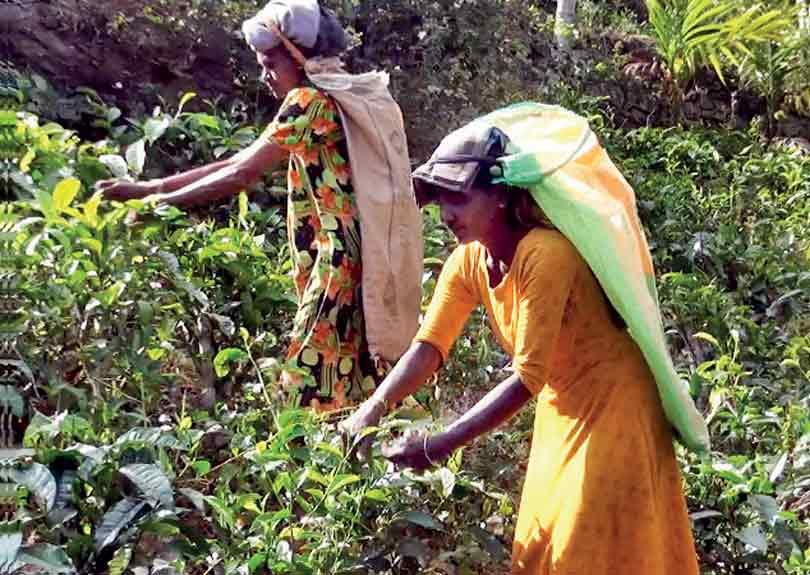
Tea smallholders maintain that their businesses are running at a loss owing to the sharp drop of prices in raw leaves and the increasing cost of labour and fertilizer
 The tea smallholders complain that their request to the successive governments for a fertilizer subsidy has fallen on deaf ears
Tea smallholders pointed out that the price of raw leaves has dropped from Rs.210 per kilo to the range of Rs. 150-140
By Palitha Ariyawansa
|
Dulith Asoka |
More than 30,000 tea smallholders in the Badulla district have been in a predicament for want of a remunerative market for their raw tea leaves. They maintain that the tea smallholdings are running at a loss owing to the sharp drop of prices in raw leaves and the increasing cost of labour and fertilizer prices.
The tea smallholders pointed out that their request to the successive governments since long including the present government for a fertilizer subsidy has fallen on deaf ears.
A tea smallholder of Pugahakumbura, Anura Jayawardene said that the families that depend on the income from cultivating a few acres of tea have lost their livelihood. It is their main livelihood.
“The cost of labour has shot up to Rs.1600 per day with meals for a tea plucker. Added to it is the increasing price of fertilizer. The price of a bag of fertilizer has shot up to Rs.15000. We are paid about Rs.150 per kilo of raw leaves which is insufficient to meet the cost. I have two acres of tea and I spend about Rs. 150,000 for fertilizer alone. It is unbearable. Tea smallholdings are running at heavy losses.
Another tea smallholder of Ambagamuwa in Ella, M.D.Karunawathie blamed the authorities for ignoring the issues affecting tea smallholders. “We are now sick of this trade due to the losses. The cost of maintaining tea smallholdings have been increasing in leaps and bounds while the price paid for raw leaves has declined. We are not entitled to any subsidy scheme with regard to fertilizer compared to coconut cultivation. We are now compelled to abandon tea cultivation” she said.
A tea smallholder in Badulla, D.M.Karunapala, pointed out that the price of raw leaves had been Rs.210 kilo, but it has now reduced to Rs.140.
“During the previous government, we received a fertilizer subsidy which has now been suspended. The price of fertilizer has increased in alarming proportions when compared to the previous year. We will be compelled to leave the tea smallholdings to the mercy of the jungle,” said.
Another aggrieved tea smallholder, Singaram Nadarajah of Ballaketuwa, blamed the system of purchasing raw leaves using scales that are manipulated to indicate a lesser weight at the factories.
“I have two acres of tea, but I am disgusted of tea cultivation owing to the losses incurred by us. The failure to apply fertilizer at regular intervals results in a poor yield. The price paid for raw leaves has dropped from Rs.250 to Rs.150, hence we incur heavy losses. Added to our woes are the frauds that occur at the factories during the purchase stage using weighing equipment. The scales are adjusted to show a lesser weight when selling our raw leaves,” Nadarajah said.
Meanwhile Dulith Asoka, who is the Asst. Director of Weights and Measures Standardizing Service Department in the Badulla District, said that several individuals who were involved in purchasing raw leaves using fraudulent scales were presented in court and fined. He also urged farmers to alert him if they come to know of fraudsters who cheat on tea leaf sellers.
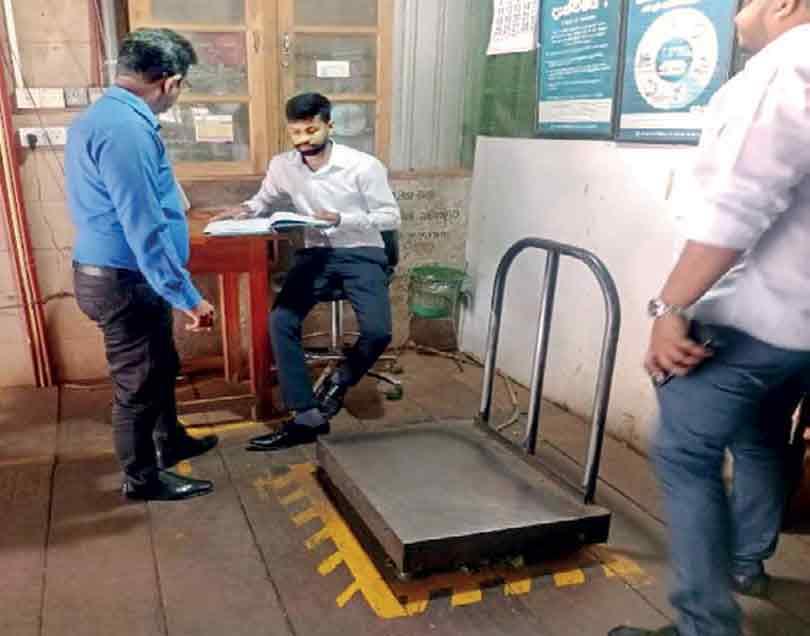 An occasion when a scale adjusted to weigh tea leaves at a lower weight was detected
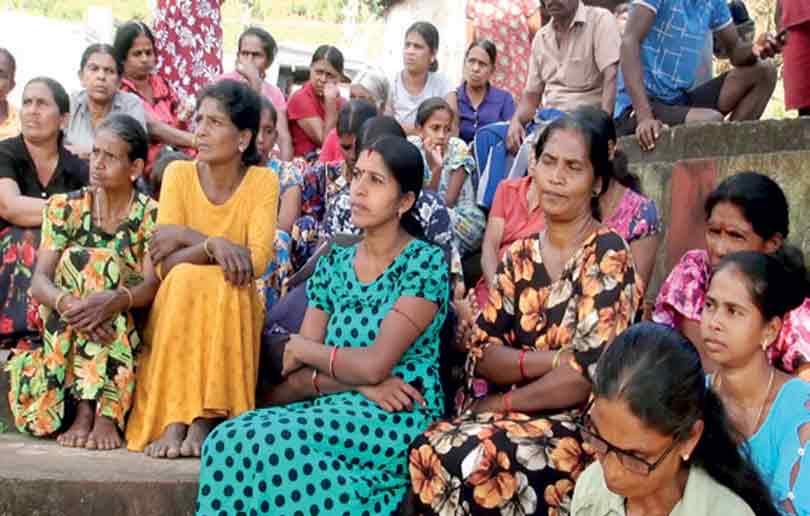 A group of tea smallholders in Ballaketuwa