 KELUM BANDARA
Reply To:
Name - Reply Comment
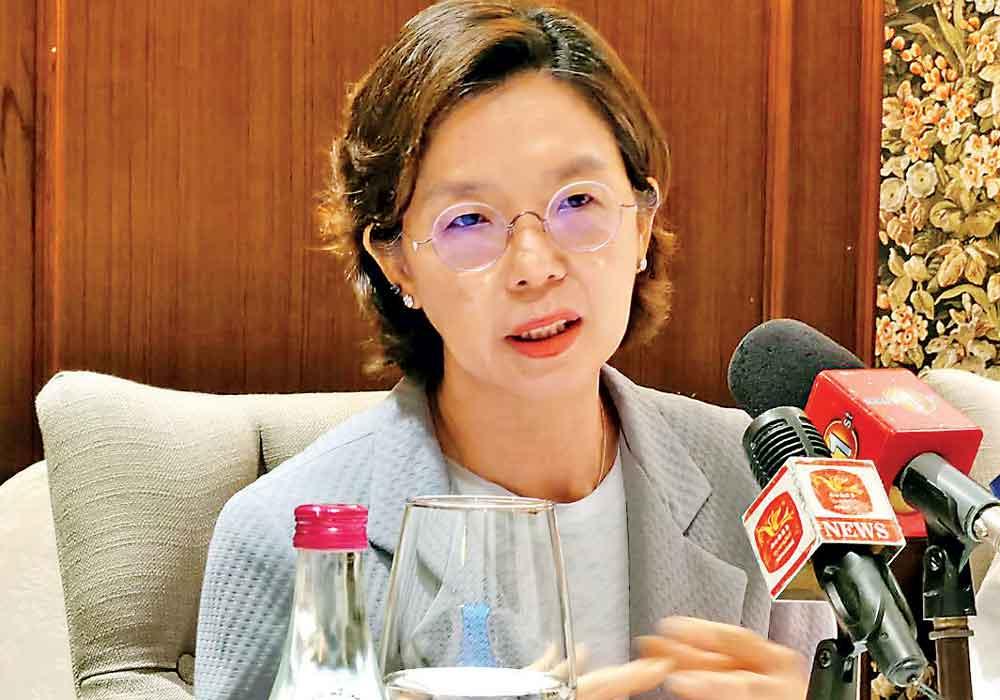
South Korean Ambassador speaks during Pathfinder Foundation’s roundtable discussion
- South Korea’s success did not happen overnight. It was the result of a long-term process
- From a war-ravaged and impoverished country in the 1950s, it emerged as a leading economic and cultural power through long-term planning and adaptability during crises
- Three dimensions—democracy, economic transformation and global integration—formed the pillars of Korea’s unique development story
In the 1950s, Sri Lanka was regarded as the “Star of the East,” boasting a strong plantation economy and a literacy rate that was the envy of Asia. Its per capita income—US $ 200—was triple that of South Korea. In fact, South Korea was poorer at that time than most African countries.
However, given the divergent paths undertaken, Sri Lanka, which even defaulted on its sovereign debt payments, is now trying to recover from an economic crisis, whereas South Korea has emerged as a global economic powerhouse with a per capita income of around US $ 36,000.
South Korea’s success did not happen overnight. It was the result of a long-term process. During a roundtable discussion organised by the Pathfinder Foundation, South Korean Ambassador Miyon Lee said this achievement—often described as the “Miracle on the Han River”—was the outcome of sustained policies pursued over decades.
“Whether or not there was a consistent grand strategy, I can’t really say, but it was the result of sustained policies and the hard work of the Korean people to build a free and transparent democratic society, an economic powerhouse driven by market-oriented industrial planning, and a responsible global soft power rooted in collective peace and shared prosperity,” she said.
According to her, three dimensions—democracy, economic transformation and global integration—formed the pillars of Korea’s unique development story, which eventually became the foundation for the global K-culture phenomenon.
South Korea’s path was not always smooth in terms of democratisation, she said.
“The devastation of the 1950 Korean War and the subsequent division and confrontation between North and South under the Cold War provided a pretext for authoritarian rule. This is not to say that there were no efforts to seek peaceful solutions for coexistence and unification, nor that the North Korean threat could indefinitely suppress the people’s aspirations for democracy. Through the determined efforts of citizens, workers, academics, and religious leaders, Korea achieved a democratic transition in 1987, introducing direct presidential elections and national elections. This transition was more than a political shift,” she said.
Describing democracy as an economic catalyst, she said it ensured greater civil participation, transparency, the rule of law, and fair competition—all of which are essential conditions for innovation and creativity.
Speaking on South Korea’s economic transformation, she said that, beginning in the 1960s, the country introduced a series of five-year economic development plans aimed at building infrastructure, supporting industries, promoting exports, and guiding technological advancement.
The trajectory unfolded in three phases. The first focused on light industries such as textiles, wigs, and footwear, mainly for export earnings and foreign exchange generation. South Korea then moved into heavy and chemical industries, including steel, petrochemicals, shipbuilding, and automobiles.
Despite initial international scepticism, this transition eventually helped the country move into a third phase centred on high-tech industries, including semiconductors and information technology.
In each phase, the Government laid the groundwork through policy and infrastructure, while private companies drove innovation and execution, the Ambassador said.
This rapid growth model faced a severe setback during the 1997 Asian financial crisis. South Korea was compelled to negotiate a debt restructuring package with the International Monetary Fund (IMF), open market access to major creditors, and restructure industries to address the overexpansion of its large conglomerates, known as chaebols, through mergers and acquisitions.
Calling the 1997 financial crisis “a blessing in disguise” in many ways, the Ambassador said it produced three significant outcomes.
Politically, opposition candidate President Kim Dae-jung won the presidential election, ushering in a genuine transfer of democratic power. Economically, the crisis forced painful yet necessary industrial restructuring, accelerating South Korea’s transition towards higher-value industries, she said.
South Korea’s integration into the global economic order did not come without resistance. Joining the WTO triggered significant protests by farmers.
“On the other hand, the 2008 global financial crisis gave Korea the opportunity to enter the G20. The Government pursued an aggressive Free Trade Agreement (FTA) strategy after the crisis to expand export markets globally. Today, our trade network covers approximately 80 percent of the global economy,” she said.
“Of course, there was significant domestic resistance to free trade agreements, but the Government persuaded the public that FTAs were the way to expand our economic territory. This integration was not simply about market access; it was also about adopting global standards and ensuring that South Korean companies could compete and succeed on the world stage. To overcome geopolitical isolation and manage regional rivalries such as the formation of the EU and NAFTA, South Korea also played an active role in the establishment of APEC, which held its inaugural leaders’ meeting in 1993,” she said.
According to her, this regional engagement complemented Korea’s multilateral and bilateral trade diplomacy and reinforced its identity as a constructive middle economic power in the Asia-Pacific region.
In South Korea, the cultural industry was identified as a new engine of growth that not only reflected the maturity of existing industries but also enabled the country to move further into higher-value sectors.
South Korea’s journey through democratisation, market reform and global integration created the conditions necessary for the flowering of its cultural industries.
The Ambassador said the democratic transition after 1987 dismantled the walls of censorship. Subjects that had long been taboo—political corruption, nepotism, human rights abuses, North Korean issues, as well as social concerns such as an ageing society, class hierarchy, education-based discrimination and school bullying—found new voices. Fiction, faction, and fantasy were freely employed to explore universal human values while maintaining commercial appeal, creating a creative ecosystem of extraordinary depth and diversity.
A 1994 Presidential Advisory Committee report had already recognised the cultural industry as a strategic national sector, noting that the revenue generated by a single Hollywood film such as Jurassic Park could equal the export earnings of hundreds of Hyundai automobiles. The former censorship-oriented regulatory regime was later replaced by the Motion Picture Promotion Act, opening the door for private sector investment.
“Well, there was controversy over the screen quota system at that time, but ultimately it was not protectionism that saved the film industry. Compelling storytelling and investment achieved what protectionism could not. The 1997 financial crisis gave the Government’s cultural policy a new urgency. Within two years, the new administration introduced the Framework Act on Cultural Industry Promotion, which classified the cultural industry as a high-value strategic sector and established the legal and financial foundations for systematic support across all areas of cultural content,” she said.
She also referred to ‘Shiri’ as the first Korean blockbuster, saying it attracted audiences in numbers previously considered impossible for a domestic production.
“It proved that Korean storytelling could compete with Hollywood on its own terms. The film’s success achieved two things,” she said.
South Korea’s experience shows that economic transformation is not achieved overnight, but through sustained policies, political reforms, investment in industries and integration with the global economy.
From a war-ravaged and impoverished country in the 1950s, it emerged as a leading economic and cultural power through long-term planning and adaptability during crises. For Sri Lanka, which is still struggling to recover from its economic collapse, the South Korean story offers lessons on the importance of policy consistency, export-oriented growth, democratic institutions and investment in innovation and human capital and economic reforms.