

Reply To:
Name - Reply Comment

 Though the Govt. initiated a programme to do a census of animals there appears to be no effort to verify the data
It raises the possibility that this census was based on assumptions rather than actual data
Critics point out that this census was not conducted according to internationally accepted standards
An animal census requires a study of animal behaviour, training for officials, and a consistent timeframe
By Sudharika Gurusingha
|
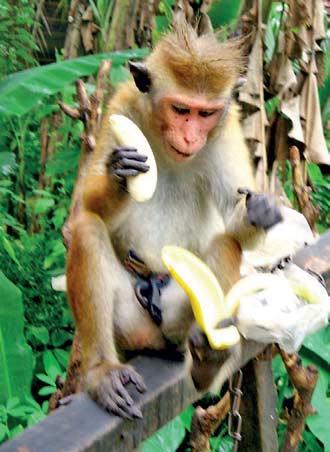
Torque monkey |
|
K.B Gunartne |
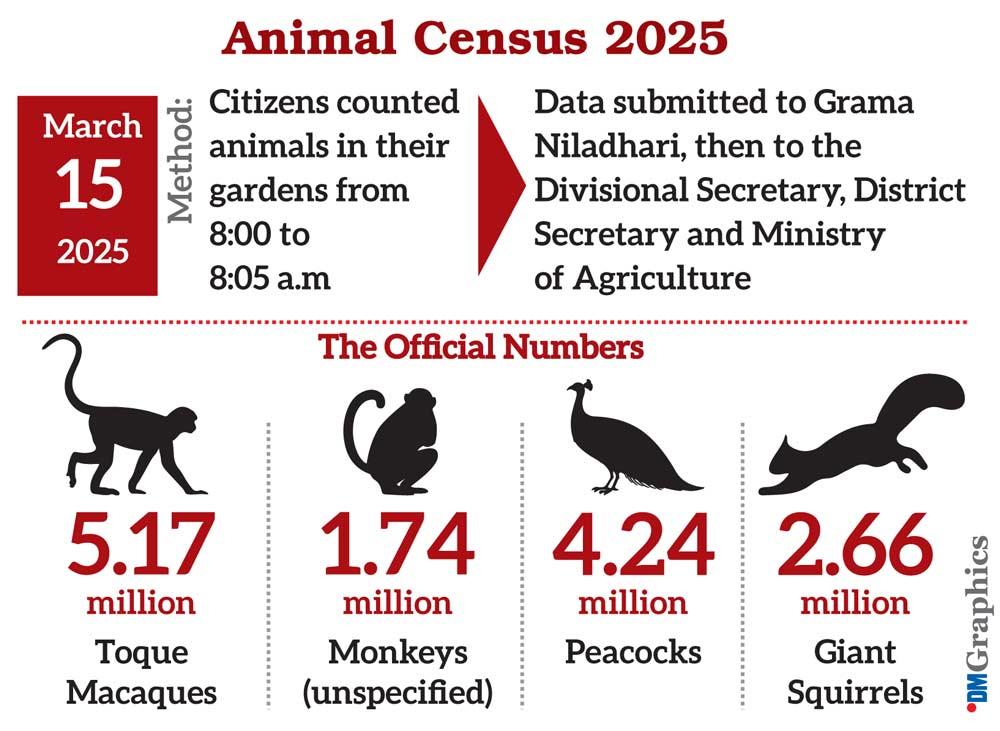
A census of animals is a rare occurrence in Sri Lanka. Recently, such a census was conducted on March 15. The method used involved counting the number of animals that appeared in one’s garden within a five-minute window from 8:00 to 8:05 a.m, recording the numbers on a form provided by the government and submitting it to the Grama Niladhari. The data was handed over by the Grama Niladhari to the Divisional Secretary, then to the District Secretary, and finally to the Ministry of Agriculture. Our resource person for this article is K.B.Guneratne, Former Director of Agriculture.
Based on this process, the government assumes the census to be complete and accurate.However, the government seems to have no understanding of what actually took place, and there appears to be no effort to verify the data either. The results, which were initially promised within three days, were later said to be released after a week. If the data from across the country had truly been collected, the results could have been published within that time frame. In reality, it took three months for the results to be made public. What exactly did the Ministry of Agriculture do with the results during that time? Why was there such a delay? It raises the possibility that this census was based on assumptions rather than actual data.
The delay itself casts serious doubt. Minister of Agriculture, Livestock, Land and Irrigation, K.D. Lalkantha, recently stated that public institutions are “dens of thieves.” He emphasised that his experience was based on the Ministry of Agriculture. If that is the case, can this animal census be trusted as anything other than the product of a corrupt system? Is such a process acceptable? This is a valid and pressing question for the public. A statement made publicly by the minister himself cannot simply be dismissed.
The silence of the 1.4 million public employees raises serious concerns—does it mean they are part of a group of thieves or frauds? It remains unclear whether ministry secretaries, district secretaries, and all-island service officers remained silent because they knew the truth, or simply lacked the courage to speak out. Either way, the situation casts suspicions that some form of malpractice has taken place.
This census was not conducted according to internationally accepted standards. An animal census requires a study of animal behaviour, training for officials, and a consistent timeframe. It cannot be completed within a single day. In this case, the responsibility was handed over to the public and Grama Niladharis, but the public showed little interest.
Many simply filled in arbitrary numbers on the forms. As a result, government statistics are unreliable. Conducting a valid census requires trained personnel. On the day of the census, a Deputy Minister from Polonnaruwa publicly stated that Grama Niladharis were not taking the process seriously and said he would raise the matter with the District Secretary. This writer personally witnessed forms being carelessly discarded, and the Grama Niladharis failing to distribute them properly.
Shortcomings and flaws
Instead of delivering the forms individually, they handed them over in bundles to a few selected people, leaving many without access. This was particularly evident among female Grama Niladharis, who also failed to manage the distribution effectively. As a result of these shortcomings, the data collected was incomplete, the sample was flawed, and since the sample was not properly obtained, the final result is inaccurate.
When the results were released, one official stated that although the forms might still be in people’s homes, the data was nonetheless valid. Critics point out that he cannot make such a claim, as it is merely his personal belief that the data is accurate. But this does not reflect the true overall result of the survey done in this country. In fact, such a statement shows that the committee appointed for the task is publicly admitting that the data is not reliable.
Moreover, how can the overall results be considered accurate simply by recording the number of monkeys, giant squirrels, and peacocks seen in home gardens? Who will count the animals living in the forests? This raises serious questions about whether the public is being misled.
No one truly knows the number of these animals in the country’s forests. This process is nothing but a deception. The Ministry of Agriculture has become a source of mockery. This so-called census is another example of that. The data is entirely unacceptable, as the process was unscientific and failed to account for the entire country.
According to the results recently announced, Sri Lanka supposedly has 5.17 million toque macaques, 1.74 million monkeys, 4.24 million peacocks, and 2.66 million giant squirrels. These numbers are immediately suspect. Anyone traveling across the island can observe that such large populations of these animals are not evident.
This result raises doubts about a possible politicization. There is suspicion as to whether the census was completed solely through the participation of political supporters, who may have filled out the relevant forms—truthfully or not. This doubt arises especially because it was claimed that the highest number of toque macaques was recorded in the Kandy District. Kandy, being a highly urbanized area, has very limited forest cover.
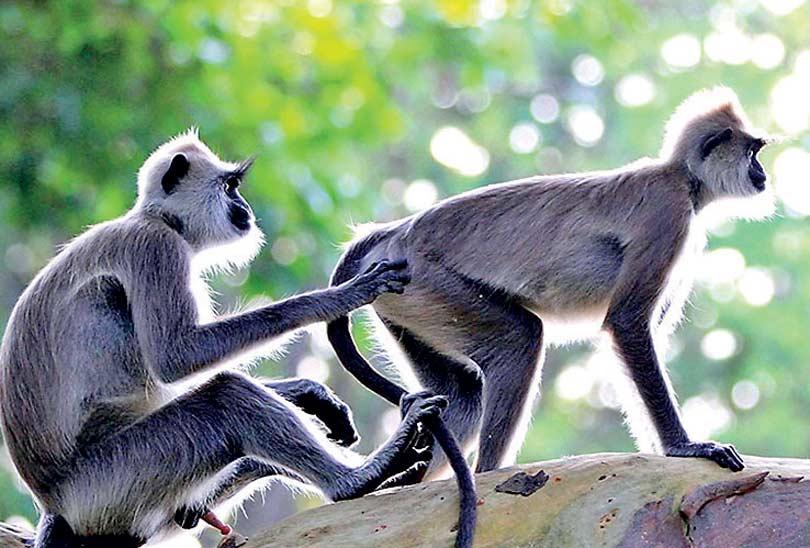
How can the overall results of the survey be considered accurate simply by recording the number of giant squirrels, peacocks and monkeys (in picture) seen in home gardens?
Accordingly, the public questions whether the claim that there are over 600,000 toque macaques in this district was a deliberate act by corrupt officials aiming to score political points for the district represented by the minister. According to the committee garbage is being piled up in areas like Gampola and Nawalapitiya within Kandy city, but there is no large-scale waste problem across the entire district. While there are some minor export crops, there is no widespread fruit cultivation. There is nothing in particular within this district that would attract a toque macaque population. Previously, a British national conducted a three-year study on toque macaques in the Polonnaruwa District.
He reported a population of around 300,000 toque macaques there. Additionally, according to research by a Tamil environmentalist, the total toque macaque population in Sri Lanka is around 3.3 million. The current officials have neither the knowledge nor the experience of these studies. This census should be redone, taking into account those past findings and following scientific methods used in other countries around the world.
A scientifically conducted survey in India
According to a scientifically conducted survey in India, the toque macaque population there is estimated at 50 million. India is now planning to conduct its next census using artificial intelligence. Not only that, they are also exploring new methods to control the toque macaque population. So where does our country stand? Our officials show neither interest nor willingness about these approaches.
They simply present some numbers and release a result. In Sri Lanka, most data is unreliable. As a result, plans based on such data inevitably fail. That is the true state of affairs here. Controlling the toque macaque population does not require statistics—it requires a proper methodology. A census should not be conducted to suit the political authority’s agenda and turn the country into a laughingstock.
False data must not be published. Officials should also remember that this is exactly why even the minister has publicly referred to them as thieves. As a supposed solution, the government announced that toque macaques would be herded to an island in the Randenigala area and that food would be transported daily from Kandy—80 kilometres away—in several vehicles. The operation would be handed over to the Sri Lanka Navy. But placing hundreds of thousands of toque macaques on an island would create extreme population pressure.
They will be at risk of dying. Food will become scarce. The toque macaque is an intelligent animal. They too can suffer from physical and mental exhaustion, ultimately leading to death. This is nothing short of a mass killing of animals—without actually killing them. I personally expressed my opposition to this plan. You can imagine the enormous cost of transporting food daily from Kandy to the island using multiple vehicles for an indefinite period. This is not a solution to the problem, but rather an ill-considered idea expressed without any scientific basis.
To this day, not a single toque macaque has been successfully relocated to a forest, nor has any effective solution been provided for the issue. The committee appointed on the matter recently suggested solutions such as waste management, forming crop protection committees, and sterilization. None of these can solve the problem.
Sterilization is not easily carried out. There are no trained officers for such work. Even universities lack sufficient staff to support such a process. It is simply not feasible. Pradeshiya Sabhas show no real interest in waste management. The level of waste management currently practiced is already adequate but cannot address the toque macaque issue. A crop protection committee cannot achieve anything either.
This entire process appears to be an attempt by the government to shift the burden onto the people, knowing that these recommendations are impractical. If the people are expected to resolve the problem on their own, then what is the point of appointing a government? This, survey, quite clearly, is a fraud. In reality, it is a staged drama surrounding the toque macaque issue.
This writer concludes this article by summarizing the sentiments by critics which put in a capsule would say “government clearly lacks the strength to implement any plan, policy, or practical course of action”.
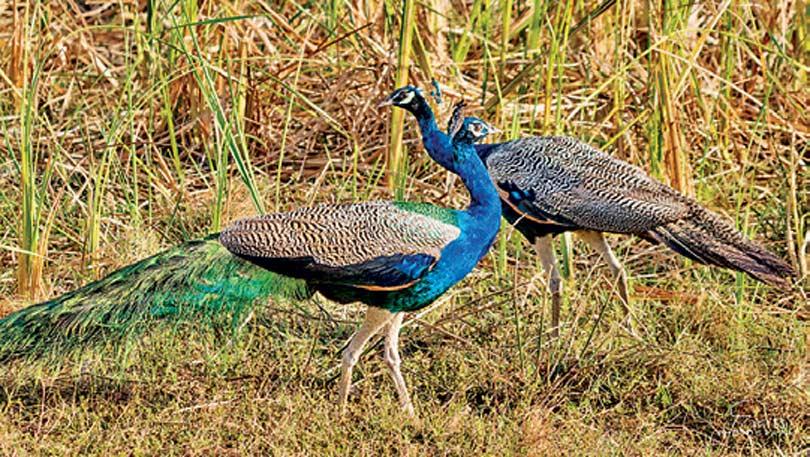
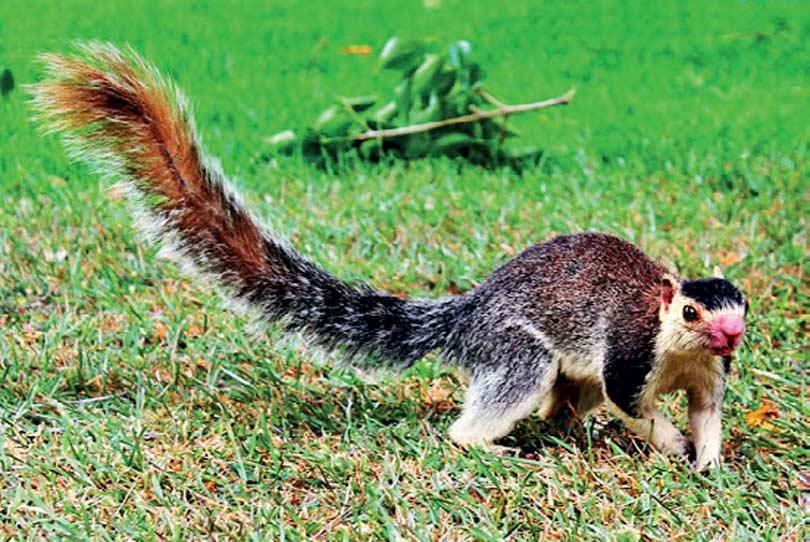
Giant squirrel