Reply To:
Name - Reply Comment
Each year, the Sri Dalada Maligawa distributes ‘new’ rice to the Raja Maha Viharayas to have their own ‘Alut Sahal’ Mangallaya on Duruthu Poya Day (festivity connected with the harvest). According to the chief incumbent of the Sagama Raja Maha Viharaya Ven. Ampitiya Dharmapala Thera, during ancient times the rice distributed by the Maligawa was brought in procession to the respective Raja Maha Viharayas. But today, the ‘Alut Sal” is brought in a vehicle
 While the veneration of the Sacred Tooth Relic was happening in Kandy, another ancient ritual was enacted 17 kilometers away, presumed to be from the time of King Bhuveneka Bahu. This was at Sagama Raja Maha Viharaya..
The ancient monarchs believed the village to be the primary base of any society and that a village would prosper if its people were united through activities centered around the Temple.
Certain rites and rituals observed from the time of the ancient kings is connected with important festivals like Avurudu (Sinhala-Tamil New Year), and these are still very much alive in four villages in the Kandyan region. There were six such villages, but in the course of time two lost their ritualistic aspects. But these four are keeping these traditions alive in the Hewaheta electorate.
Seventeen km from Kandy, one comes to the Sagama Raja Maha Viharaya dating back to the period of the third century BC, or the reign of King Devanampiyatissa (Senanayake, 2018), who planted one of the eight Bo-saplings taken from the Bo-tree that was brought to Sri Lanka by Sanghamittha Therani. But some believe that this temple was established during the reign of King Buvanekabahu V of Gampola (1372-1408). A.D.
The name of this temple is mentioned in Nampota, an ancient Sinhalese text considered to have been compiled after the 14th century A.D. The old image house and the Sanghawasa (monks’ dwelling) building are considered ancient monuments of this temple with archaeological significance (Rajapakse, 2016). The architecture as well as the paintings and sculptures of the image house display features of the Gampola and Kandyan Periods.
Each year, the Sri Dalada Maligawa distributes ‘new’ rice to the Raja Maha Viharayas to have their own ‘Alut Sahal’ Mangallaya on Duruthu Poya Day (festivity connected with the harvest). According to the chief incumbent of the Sagama Raja Maha Viharaya Ven. Ampitiya Dharmapala Thera, during ancient times the rice distributed by the Maligawa was brought in procession to the respective Raja Maha Viharayas. But today, the ‘Alut Sal” is brought in a vehicle.
About three days after the Sinhala New Year, the villages of Godamunne and Kapuliyadde get busy with rituals connected with the Sagama Raja Maha Vihare. The rituals start off with bringing about half the quantity of rice that has now been distributed from the Sri Dalada Maligawa to the Sagama Raja Maha Viharaya, and then distributed to the respective villages.
The villagers who have just concluded reaping a harvest, will cook this rice brought from the Raja Maha Viharaya and offer it to both Lord Buddha and god Saman in the temple. It is not known why god Saman, usually associated with the Sabaragamuwa Province, is also a deity at Sagama Raja Maha Viharaya, which is in the Central Province.
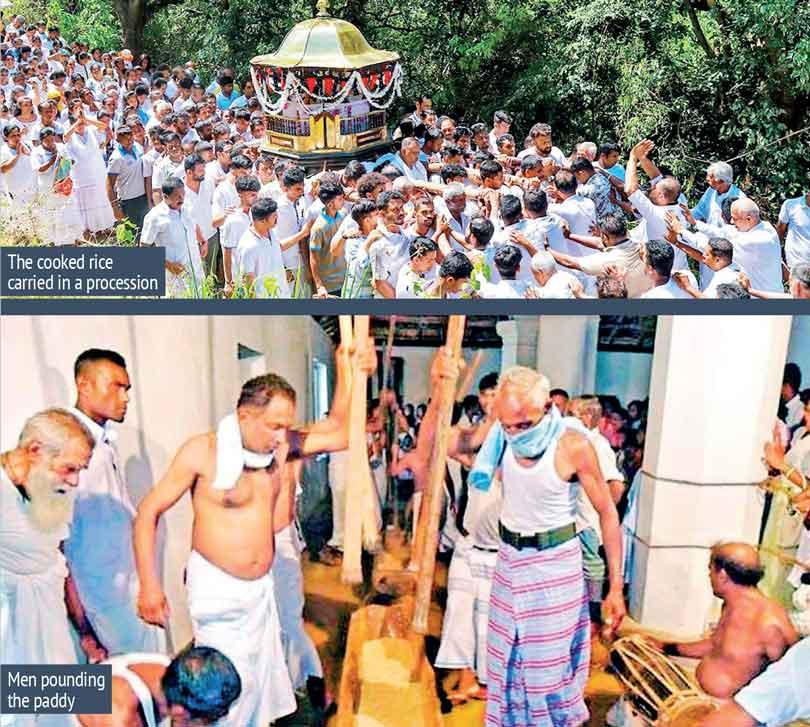
Once the rice is cooked it is taken in a procession called “Mal Perahera” to the temple. In addition to these two villages, two others – at Bootawatta and Nugaliyada -- also carry out this ritual in procession to make their offering to the Sagama Raja Maha Vihare. On the sixth day, all the villagers gather at the Preaching Hall or Bana Maduwa of the temple and pound paddy. Only men take part in this ritual known as “Hamba Ketuma”.
The pounding of paddy is done in a special wooden boat-like contraption by a group of about five or six men. The same night the villagers, once again men only, start cooking food items, to be offered to the Bo-tree and the Buddha statue at the ancient temple.
The following day, they fill the cooked rice and other food items into two large bowls which are taken to the temple and offered to Lord Buddha and god Saman. This whole process is divided among the four villages, with two villages doing it for one week and the other two continuing the process the following week. This ceremony would have been practised in most villages in the Kandyan Kingdom, but only these four villages have continued with the tradition.
On the last day the cooked rice is taken in two large bowls carried by men on a trestle, one from the Godamunne preching hall and the other from the Hapuliyadde preaching hall with, everyone clamouring to take part in the procession.
For nearly three kilometers from the Godamunne temple to Sagama Raja Maha Viharaya, this procession wends it ways to offer the cooked rice from Godamunne to the Bo tree and from Happulyadde temple preching hall to the main shrine of Buddha, also an archeological monument.
Concurrently with the veneration of the Sacred Tooth Relic was in Kandy, the offering was made on Sunday April 27th at the Sagama Raja Maha Vihary in keeping with the ancient tradition.