 Kamanthi Wickramasinghe
 Reply To:
Name - Reply Comment
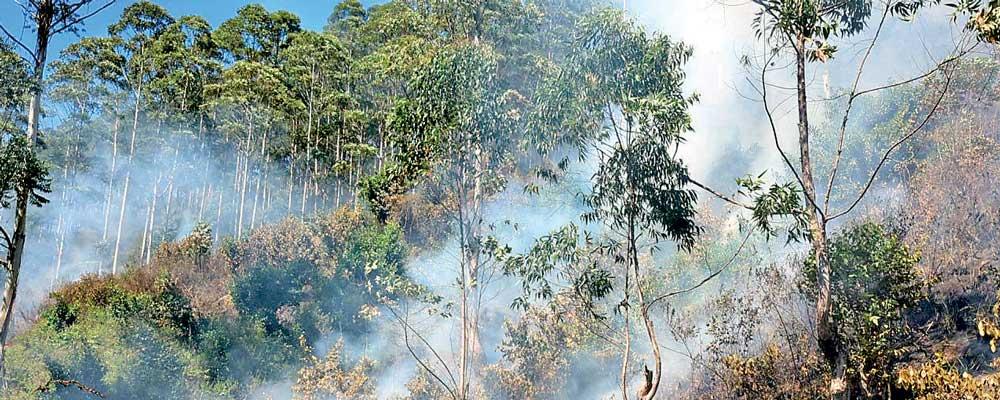
Fire in the Samanala Nature Reserve has destroyed over 30 acres of land
(PIC BY RANJITH RAJAPAKSA)
As many as 40 small scale and large scale forest fires have occurred throughout the country as of February 24, 2025. According to the Disaster Management Centre, forest fires have been reported in several districts including Kandy, Nuwara Eliya, Badulla and Moneragala. The recent forest fire at the Ravana Ella sanctuary had reportedly destroyed over 600 acres of the forest area which is home to an abundance of flora and fauna. Apart from two incidents in Kandy and one each in Nuwara Eliya, Badulla and Moneragala over the past few days, another incident of a forest fire was reported from Hamilton Estate, Maskeliya on February 24.
DRY CONDITIONS, MAIN CAUSE FOR FOREST FIRES
Ferocious wildfires tore through Los Angeles in January this year, destroying over 14,000 acres of land, killing at least 29 people, displacing thousands of other people and animals. Powerful winds and dry conditions have been identified as the main causes for this disaster. According to the H. G. Wasantha, Conservator of Forests, Biodiversity and Watershed Conservation at the Forest Conservation Department, this year, the dry season started earlier in Sri Lanka, than during previous years. “Usually when there’s dry weather people set fire to forest areas. In tropical countries such as Sri Lanka, forest fires occur due to manmade activities. The new grass that comes after a forest fire is an excellent fodder for animals. Setting fire to forests makes poaching easier. People engaged in chena cultivations set fire to forests and even plantation companies engage in such activities. There are instances when forest fires occur as a result of unfinished cigarette butts that were thrown into a dry forest area out of habit,” he added.
According to the Forest Conservation Ordinance, entry into a designated forest area is prohibited without a permit. Apart from unauthorised entry, other prohibited activities include feeling trees, removing t imber, hunting, grazing livestock a n d damaging flora and fauna within the forest boundaries.
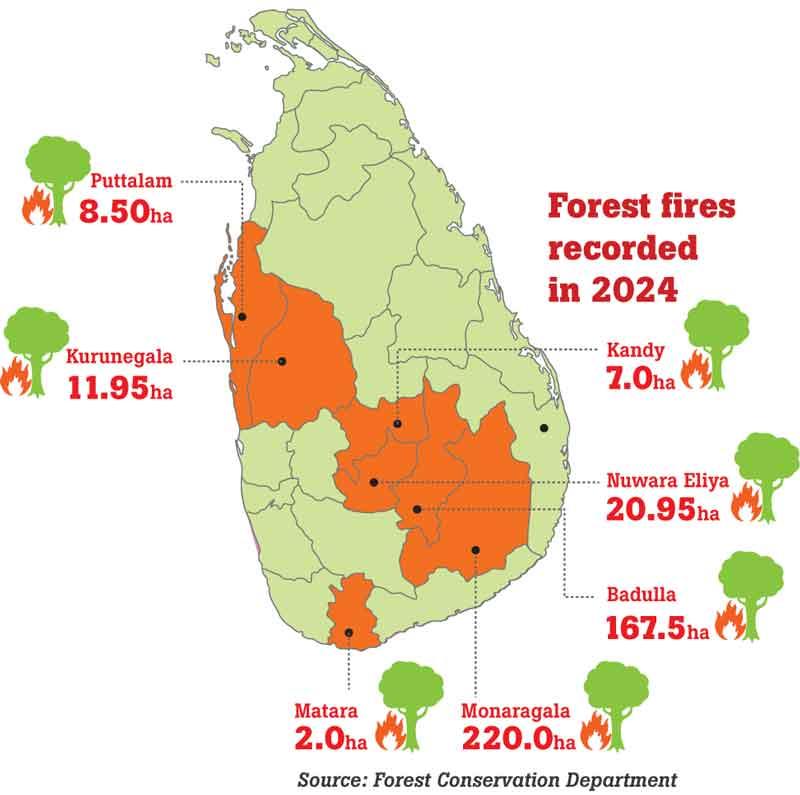
Fores t fires have been a regular occurrence in Sri Lanka, especially during the dry season. In areas such as Polonnaruwa, Anuradhapura and Hambantota, farmers are in the habit of setting fire to forests because they can supply fodder to their cattle. The damage caused by forest fires during 2024 is estimated at 438 hectares, which according to Wasantha, is less when compared to the damage caused during other years. “There have been instances when over 2000 hectares of forests were destroyed due to fires,” he added.
Wasantha further said that there are lesser chances of a fire to spread within a natural forest. “Usually it spreads when there’s grass in the undergrowth. In pine plantations there’s hardly any undergrowth. But pine leaves that fall onto the ground remain as layers and once a fire had been ignited, it would spread horizontally. There are seldom forest fire incidents reported from Galle, Matara and other areas in the wet zone. These days forest fires are frequently being reported from Kandy, Nuwara Eliya and Badulla districts,” he said.
FIRE BELTS – A SUCCESSFUL PREVENTION STRATEGY
The Department of Biodiversity and Watershed Conservation at the Forest Conservation Department is tasked with mitigating and controlling forest fires. Last year, a sum of Rs. 10 million was allocated for this purpose and during the first four months of this year a sum of Rs. 5 million had been allocated through the interim budget. “As a prevention strategy we create a fire belt in areas that are vulnerable to frequent forest fires. A fire belt is created by clearing an area which is 10 metres wide from the boundary of the forest. This would in turn prevent the fire from spreading into the forest except in instances where there are heavy winds. This is a successful method to prevent forest fires and we usually plant gliricidia and other plants along this belt,” he added. The belt is maintained frequently every year. In addition fire security officers are being appointed to keep track of any suspicious activities in forest areas. Awareness programmes are also being conducted to keep people informed about the bigger impact of forest fires. “Most people think that forest officers would have the biggest impact from forest fires. But the greater impact is always on people, environment and the world,” Wasantha further said.
In addition, a steering committee has also been appointed specifically to prevent forest fires which has allocated specific tasks to divisional secretaries, forest department officials and other representatives. “There’s a criteria to announce a forest fire prevention week. This year it falls from February 24 to March 2. During this week we accelerate prevention programmes and have requested support from stakeholder institutions, the Defence ministry, Ministry of Mass Media and environmental organisations,” he added. When asked about the allocations, Wasantha said that allocations are not sufficient when compared to the amount of work that needs to be completed. “We usually have an opportunity to request for more funds. There’s also a reward fund from which we cover some expenses. Forest officers need to pump fuel and then we have rural communities, police, divisional secretariat officers whom we need to look after. The DMC, DS, police, TRI forces, community and environmental organizations help us a lot. There are some mountainous places such as Maragala in the Knuckles region which we cannot reach. So we need assistance from these stakeholders,” he said.
IMPACT ON BIODIVERSITY AND FOREST COVER
A forest fire usually disrupts habitats of endemic flora and fauna. It not only displace animal populations, but also disrupts the growth of endemic plants. According to Wasantha, there are seedlings of endemic plant species which are at risk of being destroyed even though there isn’t a huge impact on large trees. As a result we would only be able to find plant species which are more adaptable to forest fires. Therefore trees such as Bulu, Nelli, Maila would survive. A forest fire would also impact small animals such as reptiles and amphibians,” he added.
Responding to a query on forest cover, Wasantha said that a forest cover assessment is done every five years using satellite images. “We have done assessments for 2010, 2015 and 2020. There are many definitions to a forest. According to FAO, a forest is a land spanning over 0.5 hectares with trees higher than 5 metres and a canopy cover of more than 10%. There shouldn’t be other activities happening in this area such as agriculture or urban land use. In 2010 we had a forest cover of 29.7%, in 2015 it was 29.2% and in 2020 it was 29.1%. From 2010 to 2015 the forest cover had been reduced by about 0.5%. This is around 32,000 hectares and from 2015-2020 around 6000 hectares have declined. This shows that the rate of reduction has reduced. Therefore we believe that existing forest policies and our conservation efforts have some impact. We have also made a commitment to the Paris Agreement to increase our forest cover to 32% by 2030. To achieve this target, we are carrying out many forest restoration programmes on degraded lands,” Wasantha said.

 As a prevention strategy we create a fire belt in areas that are vulnerable to frequent forest fires. A fire belt is created by clearing an area which is 10 metres wide from the boundary of the forest. This would in turn prevent the fire from spreading into the forest except in instances where there are heavy winds. This is a successful method to prevent forest fires -
H. G Wasantha, Conservator of Forests, Biodiversity and Watershed Conservation at the Forest Conservation Department
Global warming is on the rise and this is due to carbon dioxide emissions. Therefore it has been observed that people will have to opt for alternative sources of income as they cannot engage in agriculture, while some endemic flora and fauna species would become extinct. “Trees are the best source to absorb carbon dioxide emissions and a forest is like an air conditioner. In fact we are digging our own grave by setting fire to forests. People may think on the short term and may try to reap minor benefits from a forest fire. But the impact is greater,” he underscored while requesting the public to immediately inform the forest department, area police or divisional secretariat about forest fires taking place in any part of the country