 Kamanthi Wickramasinghe
 Reply To:
Name - Reply Comment
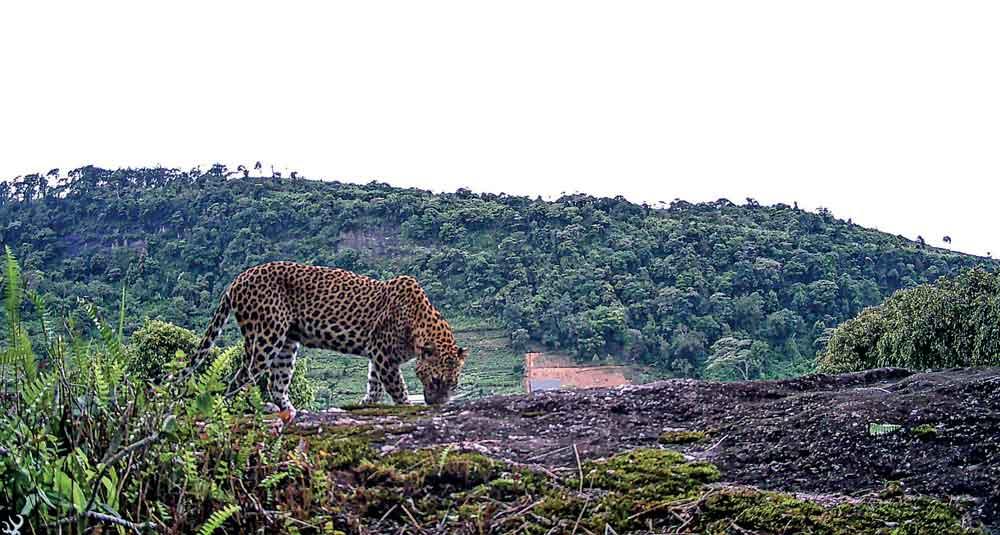
Leopard roaming in the backdrop of a human-dominated landscape in Belihul Oya. (Pics courtesy of WNPS)
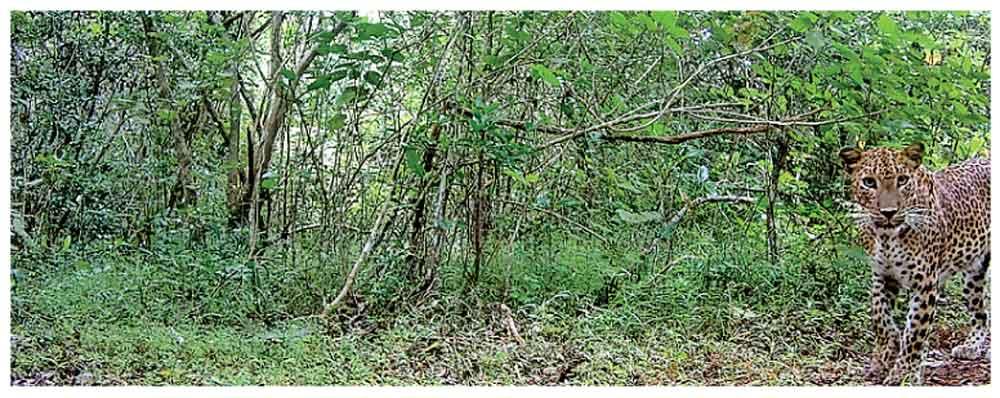
Leopard captured on a camera trap in Sigiriya study region
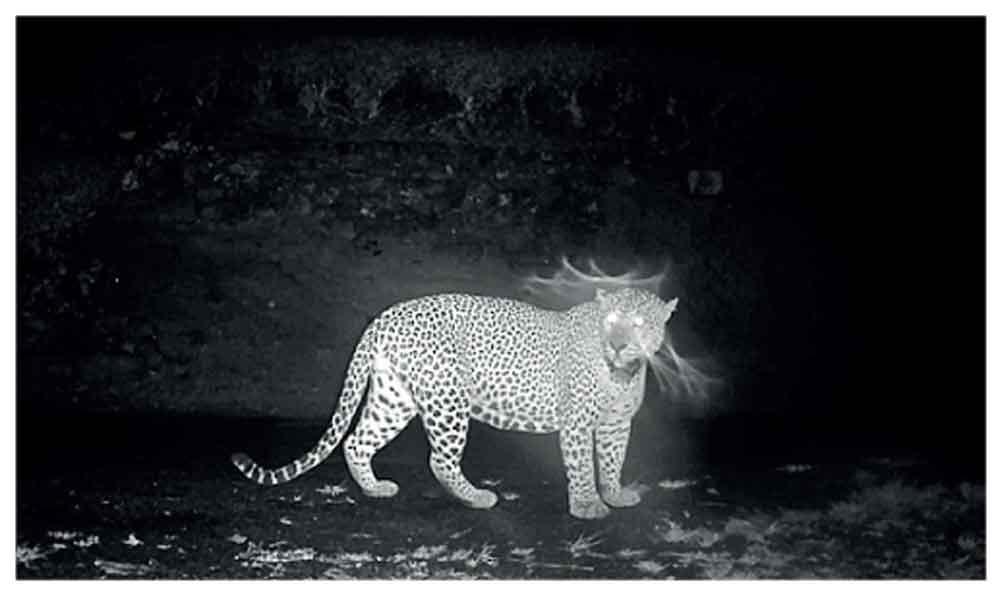
Camera trap footage of a leopard in Kotagala
“Something I have also observed from my work here is the amount of water available in the dry zone. It’s very unique where you have dry ecosystems, but it’s easy for animals to find water. This boosts productivity and the carrying capacity for big animals, especially herbivores and for carnivores”
- Prof. Ahimsa Campos-Arceiz, Tropical Conservation Ecologist
“We did a background survey and a baseline study to understand where we need to work, what are the issues, where leopards are present and so on. Based on the information gathered we started working with people, providing assistance when needed, especially rapid response and working with the Wildlife Conservation Department”
- WNPS Wildcat Sub-committee Co-Chair Prof. Enoka Kudavidanage
Shrinking habitats in increasingly human-dominated landscapes is becoming a challenge and more of a threat to protected flagship species such as the Sri Lankan leopard (Panthera pardus kotiya). This is why conservationists have now shifted the focus from the animal itself to the wider perspective of building models to foster coexistence between humans and wildlife living in shared landscapes.
During his recent visit to Sri Lanka, the Daily Mirror had the opportunity to speak with Ahimsa Campos-Arceiz, Professor and Principal Investigator of the Megafauna Ecology and Conservation Group, Southeast Asian Biodiversity Research Institute (SEABRI) and Center for Integrative Conservation (CIC), Xishuangbanna Tropical Botanical Garden (XTBG) which is part of the Chinese Academy of Sciences (CAS). However, he is not a stranger to Sri Lanka. His first visit goes back to 2003 where at the time he was pursuing his Masters’ Degree at the University of Tokyo. But during that time he was focusing on elephants with an interest in studying the regional perspective on ecology and conservation of big animals. His main focus areas include understanding the basic ecology of these animals such as what they eat, how they move; secondly, how they interact with the environment and thirdly about their interactions with people.
But now, the focus has shifted from elephants to leopards. Even though Sri Lanka is grappling with a human-elephant conflict, ongoing conservation efforts attempt to minimise the conflict between human and leopards outside protected areas. One of these projects is the ongoing WNPS-LOLC Multi-Regional Leopard Research and Conservation Project (LRCP).
The conversation began with a question regarding the suitability of the Sri Lankan landscape for the adaptation and survival of the Sri Lankan leopard. According to Prof. Ahimsa, the Sri Lankan landscape is “very suitable”. “Sri Lanka is very unique and has a long history of human-influenced landscapes,” he told the Daily Mirror. He said that places like Yala and Minneriya have been very much influenced by human activities.
“Something I have also observed from my work here is the amount of water available in the dry zone. It’s very unique where you have dry ecosystems, but it’s easy for animals to find water. This boosts productivity and the carrying capacity for big animals, especially herbivores and for carnivores because they have a lot of food to eat,” he added.
Reflecting on the history, he said that when the Sinhalese civilization began in Sri Lanka they cleared forests and introduced paddy cultivations and hydraulic systems including cascade tanks. “The amount of elephants, axis deer, wild boars and other animals in the dry zone increased. Current ecosystems include a mosaic of forests, open areas, water, crops and livestock. Compared to other places with high human density this is a place where it is easier to have a lot of animals and a lot of people,” he explained.
Multi-regional leopard study
Alongside Prof. Ahimsa, WNPS Wildcat Sub-committee Co-Chair Prof. Enoka Kudavidanage also joined the conversation to speak about the progress of the multi-regional leopard study. In fact, she was the main inspiration for Prof. Ahimsa to shift his study focus from elephants to leopards. In his own words, studying leopards in Sri Lanka “wasn’t part of the plan”, but their 23-year long friendship and his liking towards the country had drawn him towards this study.
According to Prof. Kudavidanage, the LRCP is now in its fourth year and the approach is to understand leopards in human-dominated landscapes. “We did a background survey and a baseline study to understand where we need to work, what are the issues, where are leopards present and so on. Based on the information gathered we started working with people, providing assistance when needed, especially rapid response and working with the Wildlife Conservation Department, carrying out snare removal and educational programmes for children. We now have the insurance composition. We also have a dataset based on responses from over 1000 questionnaires which was extremely valuable. On the other hand, Prof. Ahimsa’s lab is equipped with analytical testing and latest technology to carry out modeling and other research,” she said.
She said that from a species-approach the focus is shifting towards landscapes and that’s why Prof. Ahimsa’s presence is important. “All this while we tried to isolate the animal and tried to work on it but it’s not feasible anymore, we need it to be connected with other species, landscapes, people,” she added.
When asked about whether there’s a model being derived to foster coexistence between humans and leopards, Prof. Kudavidanage responded in the affirmative. “That’s what we are trying to do now. We are trying to understand ecological aspects by analysing leopard movement patterns captured on camera traps. Two new research studies have also been proposed to look at how they behave in forests, marginal areas and in human-dominated landscapes, what they eat and how the spatial and temporal patterns change. We are working on perception and people’s willingness to coexist via the LOLC project. The transition should take place from a point where people are not conservation-oriented and not willing to support to conservation-oriented and willing to support but while supporting their livelihoods as well because we cannot isolate people. Now we have the building blocks and in its last tier we are collaborating with Prof. Ahimsa’s lab to build the model,” she added.
But according to Prof. Ahimsa’s observations as an outsider, Sri Lanka sets a “good example” in terms of coexistence models.
Speaking about people’s perceptions, he said that people accept that they are encroaching into habitats, but in terms of willingness to conserve leopards the scores were mid 80%. “We combined two dimensions, the sense of being threatened by leopards and people’s willingness to conserve. The beautiful thing about it is that there are high number of people willing to conserve leopards whether they fear leopards or not. So fear doesn’t drive their willingness to coexist. Fear is normal,” he added.
Adding her remarks, Prof. Kudavidanage said that awareness programmes conducted through the LRCP have had an impact on changing people’s perceptions and to bring the fear factor down to some extent.
Snaring is one of the biggest threats to leopards in Central Highlands and most snares were removed along borders of private tea estates. When asked about the progress of discussions with tea companies, Prof. Ahimsa said that several tea companies have expressed interest in being part of the solution. “The how is yet to be discussed, but the point is to understand who is doing the snaring, why they are doing it and how it could be reduced. But having worked in Southeast Asia what I have to say is that this is not a crisis. It can get much worse, but the point is to tackle it now before it becomes ugly,” he said.
His observations indicate that there’s no conflict between humans and leopards and that it is a good indicator. But Prof. Kudavidanage foresees several challenges in terms of habitat fragmentation especially in the Hill Country. “This would confine leopards to small spaces. Declining prey in small fragments and leopards having to cross from one forest patch to another is likely to increase chances of encounters with people. The bushmeat trade is another challenge,” she said.
The future of the leopard
In this backdrop, it is important to look at what the future holds for the survival of the Sri Lankan leopard. According to Prof. Ahimsa, there’s going to be socioeconomic transition alongside economic development. “Projections by the UN reveals that the population would increase by about 10% in years to come. In the 1950s, Sri Lanka had around 8 million people but it has tripled since then. But at one point the population would start to decline. Birth rates have declined. Urbanization is another key factor. Sri Lanka remains relatively rural compared to other tropical Asian countries. But I believe that with time, people will start moving from rural areas to the cities. This has a positive side because then there’s space for leopards. Economic dependence on agriculture will not increase a lot,” he said.
Prof. Ahimsa believes that if people move towards urban areas, their economic status changes and when people become richer, they will become more supportive of conservation values. “This is happening globally. If that happens here, less people will be exposed to conflict and there’ll be more support for conservation. This would release more land that can be used as natural habitats. But in this case there’ll be a lot of interest towards human connectivity, constructing railways, roads, industrial plants and so on. This is where you don’t compromise the habitat for just one life. This is why it’s critical to think about what kind of future we want,” he added.
In her concluding remarks, Prof. Kudavidanage said that from this point onwards the future depends on what path we take. It’s about a species in a landscape. This is where everybody needs to come together. Right now we are at a crossroads,” she underscored.