 Kamanthi Wickramasinghe
 Reply To:
Name - Reply Comment
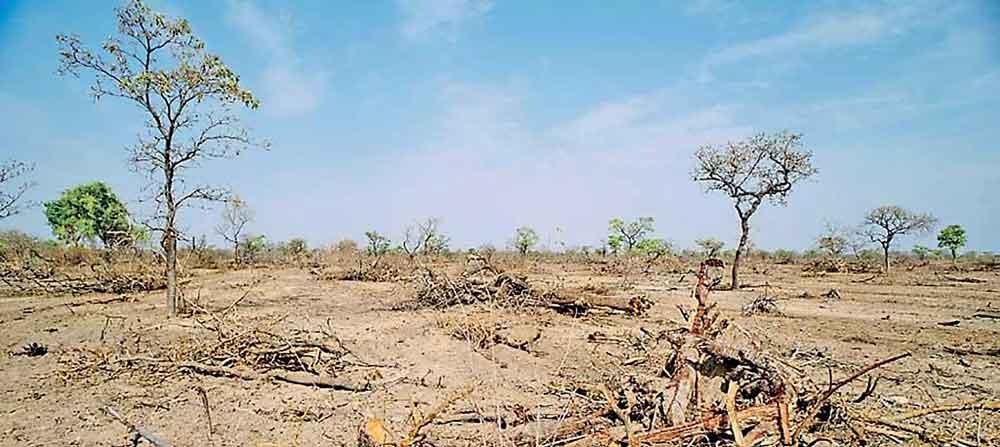
Deforestation has led to habitat fragmentation in many forest areas of the country. (File photo)
In view of World Wildlife Day (Which fell in March 3), the All Island Wildlife Officers Union (AIWU) recently organised an event to shed light on the importance of conserving Sri Lanka’s biodiversity and challenges faced by wildlife officers during this conservation process.
In the backdrop of escalating human-wildlife conflicts, wildlife officers deployed by the Department of Wildlife Conservation (DWC) are duty bound to protect wildlife as well as respond to civilian concerns. However, due to limited staff and resources allocated, wildlife officers working at the ground level are facing multiple difficulties.
Looking beyond anthropocentrism
In his keynote speech, environmentalist Sajeewa Chamikara representing Movement for Land and Agricultural Reform (MONLAR) spoke on the 2026 theme ‘Medicinal and Aromatic Plants : Conserving Health, Heritage and Livelihoods’. He spoke about the difference between wildlife and domesticated animals such as elephants and the circumstances in which they are kept in.
Chamikara described biodiversity and wildlife becaming two interconnected concepts. “Wildlife includes flora and fauna while biodiversity includes species, genetic and ecosystem diversity.
Initially we considered wildlife from an anthropocentric perspective, focusing on the benefits of an animal or a plant for man. So people would protect or conserve a natural species if that particular species is of any use to them. But from a bio-centric perspective, all living things have intrinsic value, moral standing and a right to exist irrespective of its utility to humans. So we need to look at wildlife from a bio-centric perspective to ensure the survival of any ecosystem,” he added.

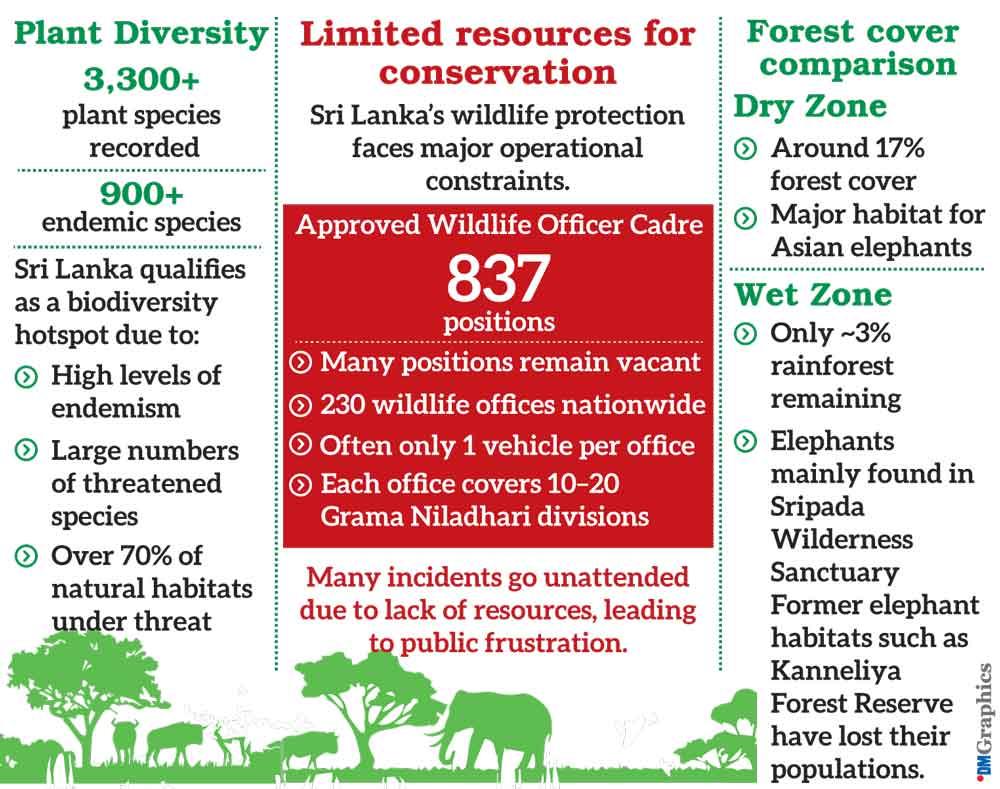
 “In the wet zone, there are around 3% of rainforests remaining. The wet zone comprises the southwestern part of the country and Central Highlands. This is because there are limited elephant habitats in the wet zone. Today, the Sripada wilderness is the only habitat for elephants in the wet zone”
- Sajeewa Chamikara representing Movement for Land and Agricultural Reform
Role of elephants in the dry zone
He said that humans tend to have some kind of connection to a plant or an animal depending on the uses. “If we take a plant species like Wallapatta (Gyrinops walla), people started to develop an interest for it over the past two decades. At present it has a high commercial value. In terms of animals, in Sri Lanka, without the presence of elephants, it would be difficult for people to engage in agriculture practices in the dry zone. This could be a debatable statement. If we compare the dry zone and wet zone, the dry zone includes a forest cover of about 17% from the total land area. In the wet zone, there are around 3% of rainforests remaining. The wet zone comprises the southwestern part of the country and Central Highlands. This is because there are limited elephant habitats in the wet zone. Today, the Sripada wilderness is the only habitat for elephants in the wet zone. Even though there were elephants in Kanneliya, those elephants had become extinct. Except for these forests, all other forests have become fragmented over time due to plantation expansion and other commercial developments,” he added.
Species endemism
Speaking about plant species, he further said that in Sri Lanka there are over 3,300 species of plant species being recorded and out of them, over 900 species are endemic. “This also contributed to Sri Lanka being recognised as a biodiversity hotspot. Some of the criteria of a biodiversity hotspot is to ensure high endemism of plants and animals in an area and a majority of these species should be marked as threatened according to the Red List. Another criterion is that over 70% of habitats in which these species live in are threatened due to anthropogenic activities,” Chamikara explained.
Chamikara also shed light on the importance of conserving mangroves and aquatic plants. “So far we have only protected about 14,000 hectares of mangrove ecosystems. The Convention on Biological Diversity too has become a politicized approach to obtain important information about plants and animals of a particular country. There are various attempts to commercialize Sri Lanka’s heritage and livelihoods. Export of endemic species has posed significant threats to biodiversity. Therefore wildlife conservation has been challenged as these species cannot be protected. Due to rapid felling of Wallapatta trees, vast forest patches are being cleared. As of now, we have still been unable to ban the export of any specimen from this tree or protect the species. But we have been able to protect certain plants such as Kothala Himbutu which was largely exploited for its medicinal properties through our laws. So while highlighting the conservation benefits of endemic species it is important to establish the conservation process from a bio-centric standpoint,” he underscored.
Challenges faced by wildlife officers
Around 16% of Sri Lanka’s forest reserves fall under the purview of the DWC, but according to DWC officials, these conservation measures are carried out by a limited cadre. “This is mainly being done by a majority of wildlife rangers who actively work in the field,” said AIWU President M. I. W Peiris. “The approved cadre for Sri Lanka is 837, but there are many vacancies. We have to collect data in order to improve conservation status of plants and animals. We have to enforce the law on bio theft, hunting and other illegal activities through the Flora and Fauna Protection Ordinance (FFPO). But it has become difficult to establish a relationship with people as they frown upon us,” he claimed.
 “The approved cadre for Sri Lanka is 837, but there are many vacancies. We have to collect data in order to improve conservation status of plants and animals. We have to enforce the law on bio theft, hunting and other illegal activities through the Flora and Fauna Protection Ordinance”
- AIWU President M. I. W. Peiris
He said that there are human-wildlife conflicts emerging from various parts of the country. “The human-elephant conflict has the biggest impact on both the animal as well as people. At least 400 elephants die every year in addition to 100-150 people. Farmers suffer crop damage and damage to property and the DWC is blamed for inefficiency. There are claims that DWC officials don’t respond to complaints. Due to encroachment and disruption of elephant corridors, the conflict aggravates. Many forest reserves such as Udawalawa National Park are being dominated by invasive species such as Lantana; reducing fodder for elephants. The DWC is taking efforts to remove these species, but it is not sufficient. As an immediate response we provide elephant crackers to farmers.
Elephants are being controlled by electric fences to an extent, but it is not a sustainable solution to the conflict,” he further said,
Explaining practical challenges, Peiris said that there are around 230 offices around the country. “Many of these offices have just one vehicle to cover 10-20 Grama Niladhari divisions. With just one vehicle and few officers we can only visit one or two places. If there are 20 incidents and we respond only to two, naturally people will start to hate us. We don’t have holidays unlike other government servants and we work round the clock. Due to limited staff and resources, we continue to face a backlash from people and we hope that relevant officials would consider these matters as a top priority,” he said in conclusion.