Reply To:
Name - Reply Comment
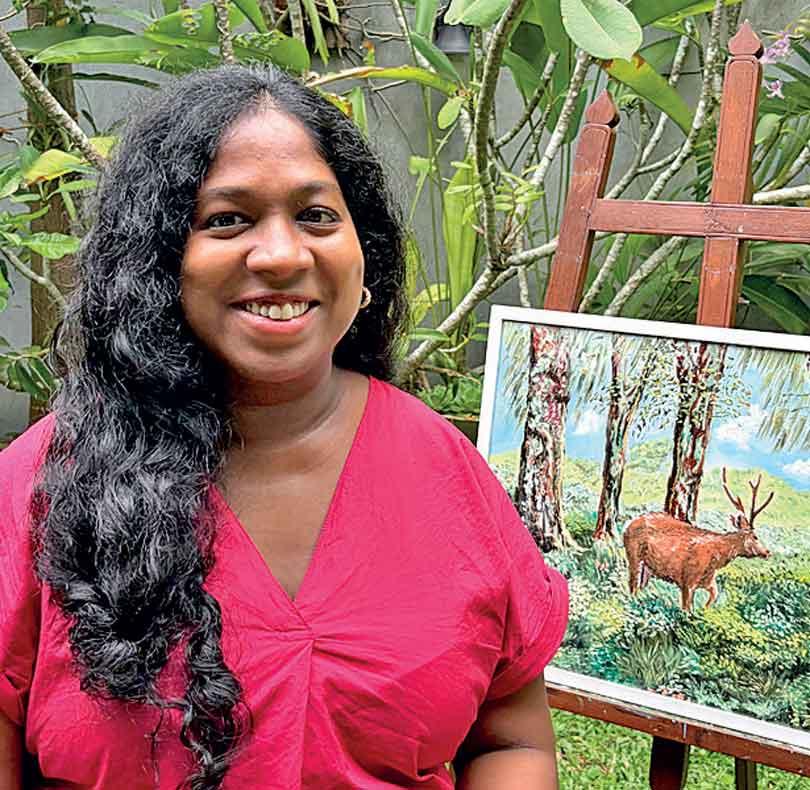
Randhini Fernando – Lawyer, Cellist & Artist
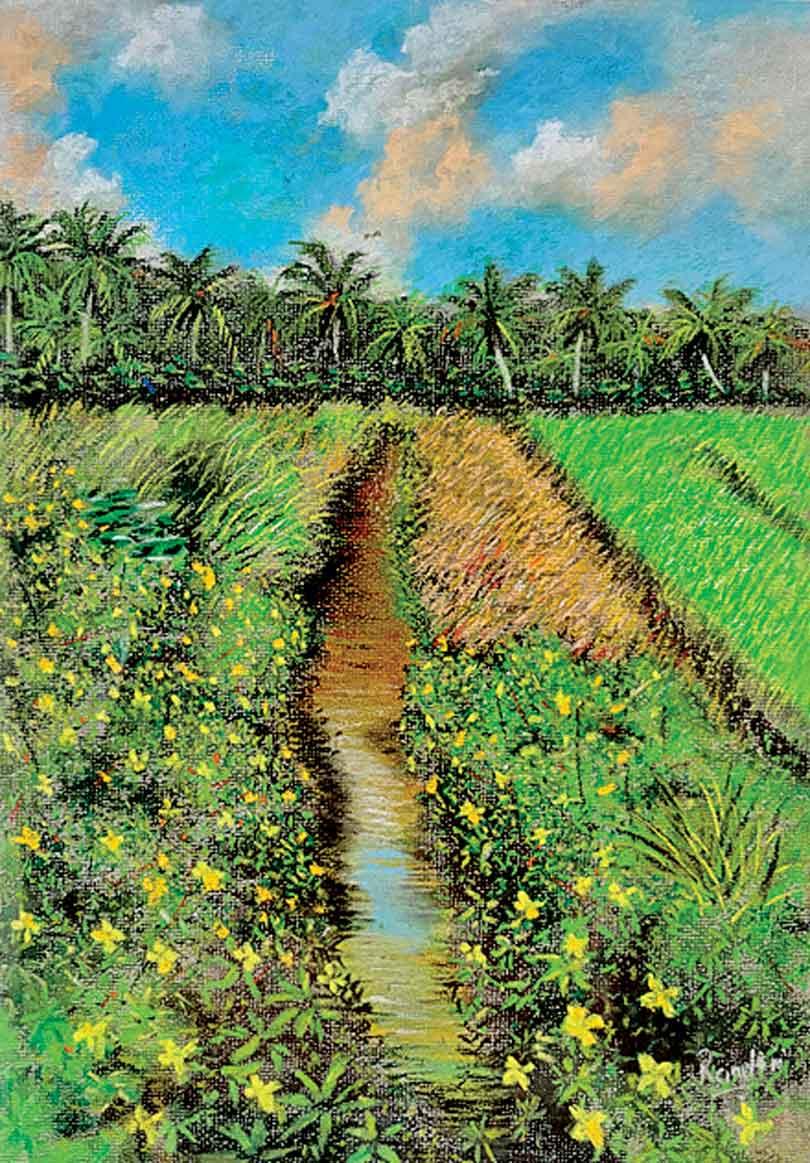
Painting of a paddy field
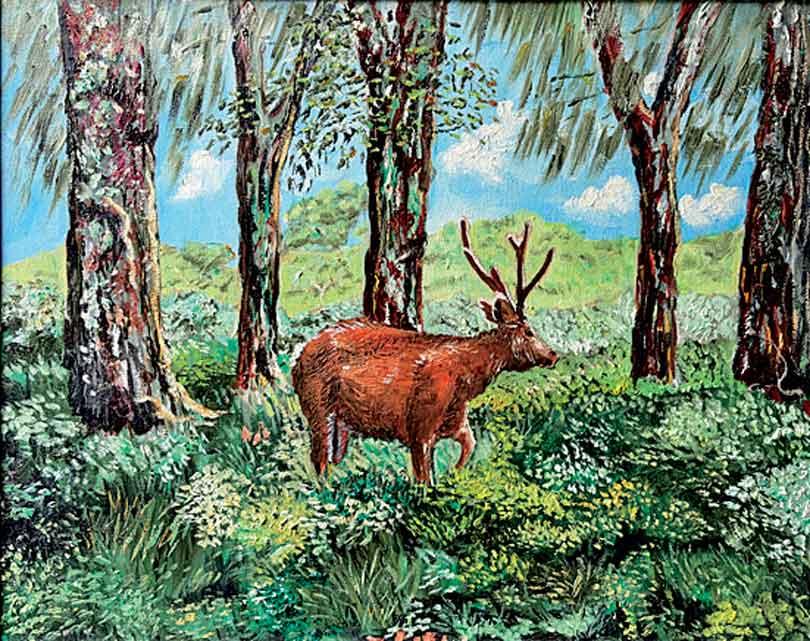
Painting of a stag grazing
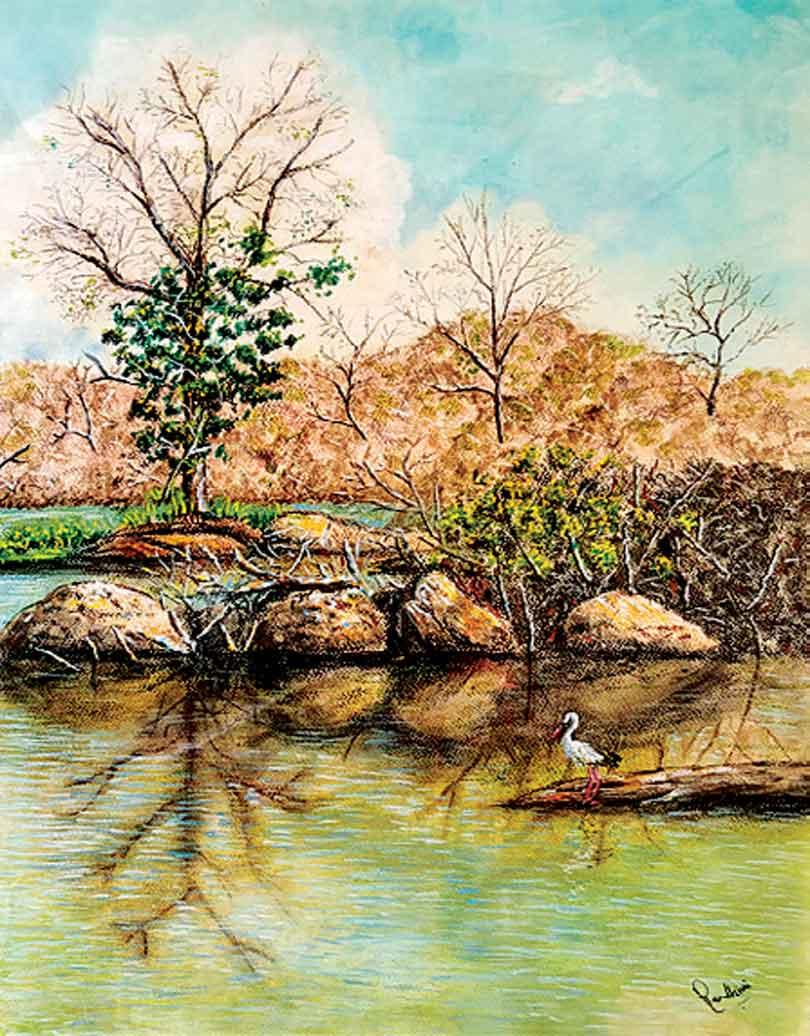
Painting of a river, oil on canvas
“Artists are soft ambassadors of a country. When you paint something from your homeland, you are promoting it. When a foreigner sees a beautiful painting of a Sri Lankan scene, you are, in effect, marketing your country.”
Randhini Fernando’s greatest skill isn’t just her ability to paint, but her ability to juggle multiple disciplines. By day, she practices law as a Junior Counsel, by evening she takes her seat at the Symphony Orchestra of Sri Lanka, cello in hand. And somewhere in the margins of her already full life, she paints. Her recently concluded exhibition, ‘Gaemi Pata’, showcased an unmistakably vivid version of Sri Lanka, capturing the hill country’s lush green landscape, the weathered walls of once grandiose colonial bungalows and the picturesque textures of village life.
This exhibition, which also happened to be her 3rd solo art exhibition, opened to an audience larger than anticipated and the ensuing reception that followed, goes beyond mere aesthetic appreciation of art.
The thematic undercurrent guiding Fernando’s artistic ark is a consistent one: Sri Lanka itself. Her art pieces are a celebration of the island she grew up travelling across, first with her parents, and now with her husband and young daughter.
“What I always wanted to show the public is how beautiful our country is. Whenever we travel and something catches my, I think to myself, ‘That would make a lovely painting.’ I take a quick photograph on my phone and come back home to try to turn it into a painting,” she says.
Her previous exhibitions have embodied the same intent. One was titled, ‘Serenity Perspective’ and the one prior to that was titled, ‘Shades of Lanka.’
“For me it has always been things that are beautiful in this country, such as historic places, landscapes, village life,” Fernando explains. She also recounts how visitors to her exhibitions have told her quite often how some of the places she had painted, had long ceased to exist.
“This made me realise that my paintings carry value as a form of documentating what was,” she reflects.
Fernando’s medium of choice is soft pastel, which is a material unfamiliar to many. Unlike ordinary chalk or crayons, soft pastel is a powdery pigment compressed into sticks, which is then applied to specialised pastel paper and sealed with a fixative.
“There is a very unique texture that soft pastels produce, and applying Sri Lankan scenery in this very European medium creates something lovely. As a result you get these beautiful, distinct pastel colours,” she says. Alongside pastels, she also works with oil paint, the more widely recognised of her two primary mediums.
The feedback Randhini received from Gaemi Pata has confirmed what she had long sensed within herself: that soft pastel is something of her forte. The texture it yields, suits landscapes quite well, and she also takes pride in several visitors encountering the medium through her work for the first time.
The public reception to Gaemi Pata caught Randhini off guard. Its opening drew a crowd far larger that she had anticipated, which included individuals from various chapters in her life.
“Knowing that people who have followed my work over time can see genuine improvement was deeply gratifying,” she says.
Out of the many responses she received, what stuck in particular with her was visitors asking in genuine disbelief, whether the places she had painted actually existed in Sri Lanka.
“We have such variety: the dry zone, the lush hill country with its vibrant greens, the wild landscapes. Seeing people enjoy that contrast was a rewarding experience,” she says.
The single most important question Fernando was asked during the exhibition was not about technique or inspiration, it was something so subtle, yet carried a good amount of weight to it: how do you do it?
Her answer to this question, is equal parts practical and gently insistent.
“Do not start with the attitude that you have no time. When life is hectic, you still have to find that tiny window, because it genuinely balances life. It gives you perspective. For me, both music and art serve that purpose: they give me a break from the relentless pace of the week,” she says.
With regards to the realism embedded in her art, Fernando has a broader argument to make, one she touched on during her opening speech at the Gaemi Pata launch, and returns to with utmost conviction.
“Artists who work in realism do not seem to get as much space or attention, as abstract art does” she says.
Her concern is with the uncritical adoption of a style such as abstract art: interior designers defaulting to abstract pieces, publications featuring predominantly modern and abstract work, the whole machinery of taste coalescing around a single aesthetic.
“When you walk through platforms like Kala Pola you will see just how talented our local artists are. It is surreal.” she says.
The deeper point, as she frames it, is about identity and representation. Realist art, art that depicts a specific place, in a specific light, with specific people does something that abstraction cannot.
“Artists are soft ambassadors of a country. When you paint something from your homeland, you are promoting it. When a foreigner sees a beautiful painting of a Sri Lankan scene, you are, in effect, marketing your country. Abstract art does not always fulfil that.” she says.
With globalisation and the steady rise of artificial intelligence, she argues, everything is starting to look ubiquitous and art is no exception to this drastic change. Realistic art, rooted in place and culture, still has the power to show the world something distinct and irreplaceable.
For Fernando, realist art is not an abstract proposition, but the reason she paints.