AI SUMMARY GENERATED ONLY FROM THIS ARTICLE'S TEXT.
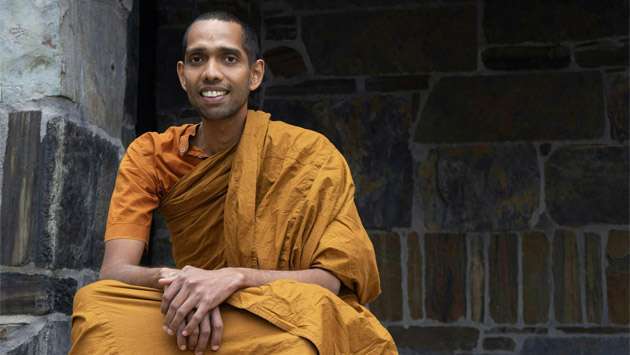
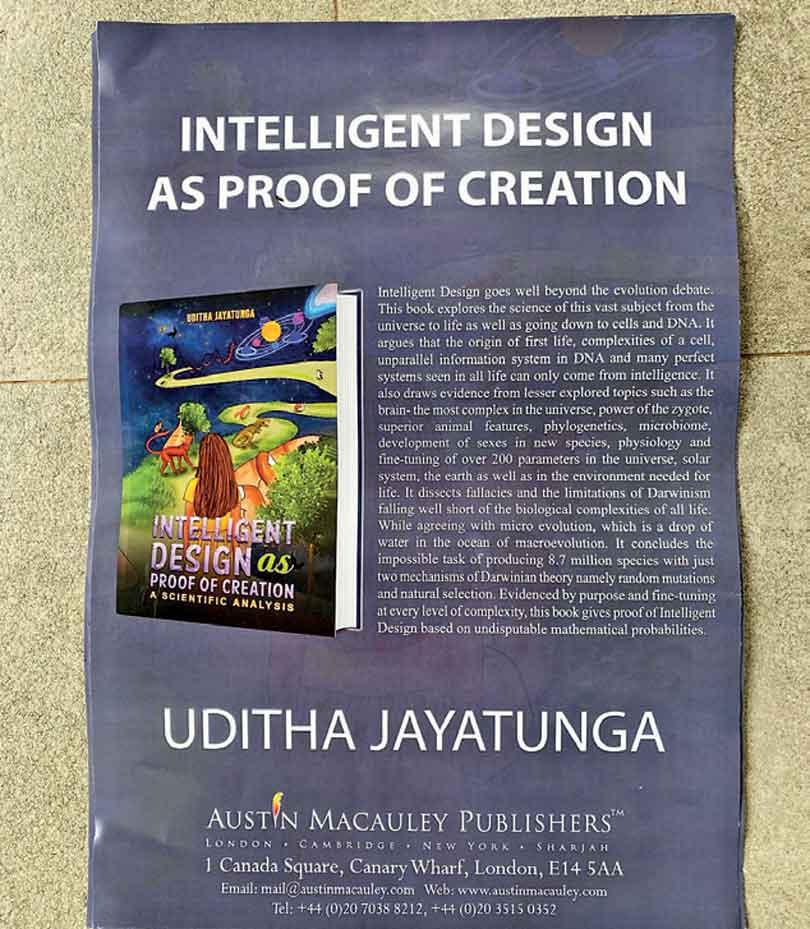
For centuries, the debate over evolution and creation has sparked curiosity, controversy, and reflection. In his new book, Intelligent Design as Proof of Creation – A Scientific Analysis, Dr. Uditha Jayatunga argues that the complexities of life point unmistakably towards design rather than chance. A proud product of Royal College, Colombo, Dr. Jayatunga has practised medicine in the UK for over three decades. Drawing on his medical and biological expertise, he challenges Darwinian theory while presenting scientific evidence for Intelligent Design—inviting readers to rethink life’s origins with fresh eyes.
QDr. Jayatunga, your new book challenges Darwinian theory. What motivated you to write it?
Darwin’s theory, though groundbreaking in its time, was built on simple examples like the shape of beaks. It struggles to explain the monumental intricacies of biology and life itself. Today, even with our advanced labs, pristine chemicals, and supercomputers, we cannot create the most basic building block of life—a self-replicating cell. That prompted me to examine whether evolution alone is sufficient, or whether there is evidence of design.
QWhy focus on the cell as a starting point?
Because the cell is the foundation of life. Even NASA, despite decades of effort, has failed to produce a self-replicating cell. If creating one is beyond human capability, with all our technology, how can we accept that such complexity arose by undirected, random processes?
QYou also compare the human brain to supercomputers. Could you elaborate?
The human brain is the most complex structure in the universe. It is millions of times more efficient than the most advanced supercomputers like Frontier in the USA, with processing power equivalent to the entire internet. An European study involving 500 scientists across 19 countries over 10 years admitted they still do not understand even the basics of our brain. This level of sophistication cannot be explained by random mutation and natural selection alone.
QWhat role does DNA play in your argument?
DNA is the most complex code ever discovered. Decoding our genome of 3.2 billion nucleotides took 2,800 scientists 13 years. One gram of DNA can hold the equivalent of 20,000 tons of computer hard drives. Codes of this magnitude are always the product of intelligence, never randomness.
QYour book also explores areas beyond DNA. What are some of these?
I discuss the power of the zygote, the microbiome, the development of parallel sexes, phylogenetics, and the fine-tuning of over 200 factors needed for life. I also examine superior features in animals that evolutionary mechanics cannot fully explain. These examples highlight systems that point towards purpose and design.
QHow do you position Intelligent Design in relation to evolution?
I acknowledge microevolution—small adaptations within species—for which we have solid evidence. But macroevolution, the rise of entirely new species, requires fine-tuning at every level: from the universe to cells and proteins. Intelligent Design goes beyond the evolution debate by presenting life’s origin and complexity as evidence of purposeful creation.
QYou claim your book provides proof. What is this based on?
I use Borel’s Law of natural occurrences, which defines the probability ceiling of what nature can produce. The mathematical probabilities in biology make that ceiling insignificant. The only reasonable conclusion is that life’s complexities, fine-tuning, and purpose point to Intelligent Design.
QFinally, what makes your book unique?
Unlike others, it presents scientific proof of Intelligent Design, not just arguments. As a practising medical consultant in the UK for over 30 years, I draw on medical and biological knowledge to dissect current evidence. The book provides ample support for Intelligent Design while dismantling Darwinian theory—aligning scientific analysis with the Biblical narrative of creation.
Comments - 0
Comments - Intelligent Design as Proof of Creation – A Scientific Analysis Dr. Uditha Jayatunga FRCP speaks on his maiden publication
222
Add comment
Comments will be edited (grammar, spelling and slang) and authorized at the discretion of Daily Mirror online. The website also has the right not to publish selected comments.




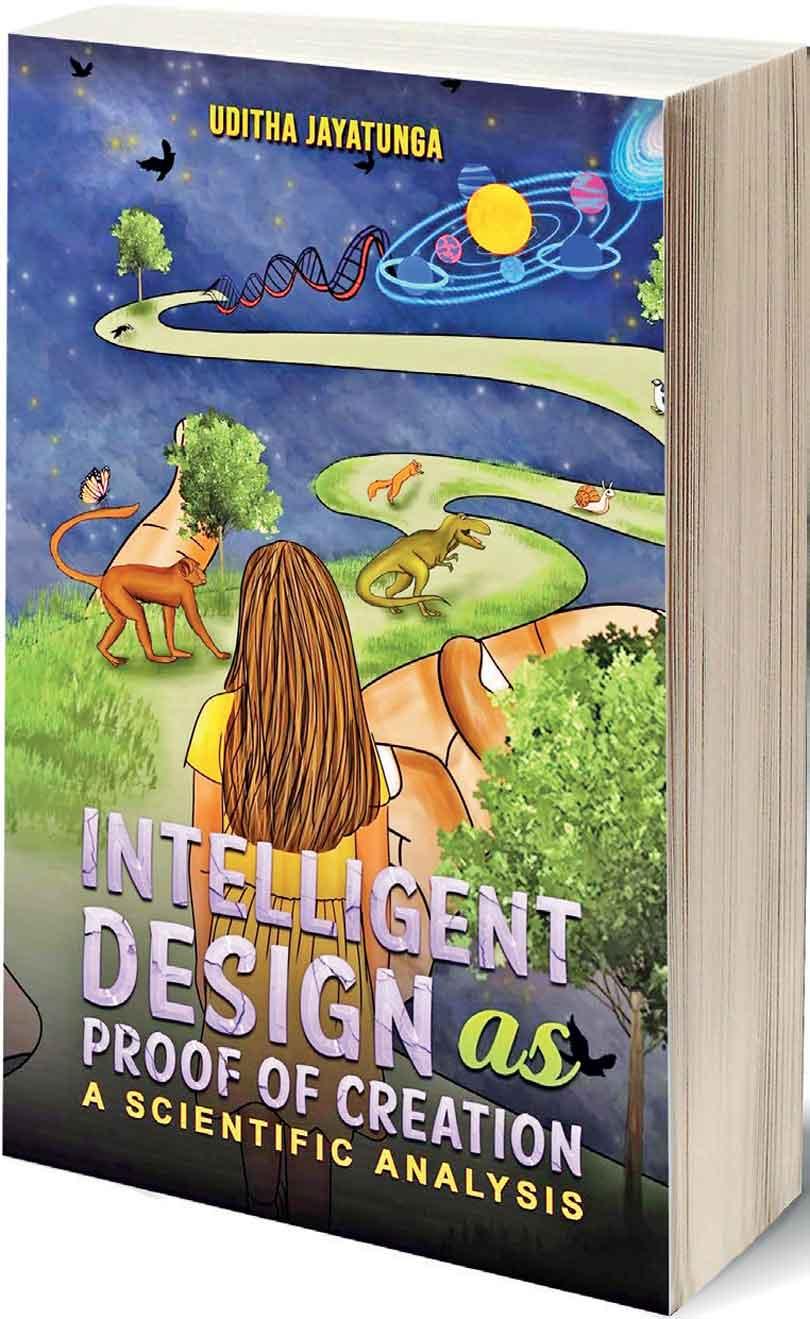
 For centuries, the debate over evolution and creation has sparked curiosity, controversy, and reflection. In his new book, Intelligent Design as Proof of Creation – A Scientific Analysis, Dr. Uditha Jayatunga argues that the complexities of life point unmistakably towards design rather than chance. A proud product of Royal College, Colombo, Dr. Jayatunga has practised medicine in the UK for over three decades. Drawing on his medical and biological expertise, he challenges Darwinian theory while presenting scientific evidence for Intelligent Design—inviting readers to rethink life’s origins with fresh eyes.