Reply To:
Name - Reply Comment
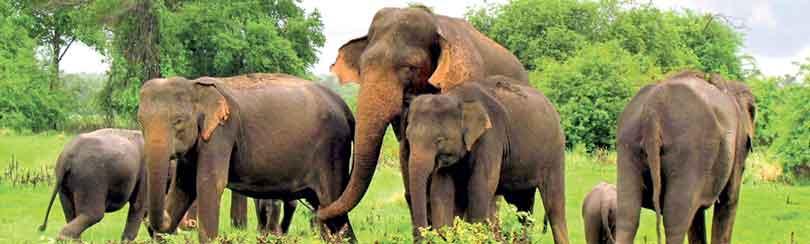
A landmark gathering took place in Colombo last week which brought together members of the Buddhist clergy, animal welfare organizations, corporate representatives, and citizens. “Adopt proven scientific methods rather than ad hoc, knee-jerk reactions that are short-lived and often do more harm than good”, was their message.
The Elephant Crisis is a National Emergency

Venerable Pagoda Janithawansha Thero
"The weapons given to farmers must definitely be taken back. Farming isn't done with guns. These are rarely used to shoot animals. It's clear that these elephants are being killed by an organized sniper gang. They are shot directly in the head. This is a well organized exercise.. The animals are found dead in the jungle, not in the paddy fields. Don't accuse the farmers. They are not committing these killings. Farmers, who worship gods and Buddha and engage in agriculture, would never take a gun and shoot such a magnificent animal. They are people who understand merit and demerit (good and bad karma). These killings are being carried out by an organized group. We're asking for these weapons to be taken back. Once these weapons are retrieved, we can find out whose weapons were used in the shooting. They have also blocked elephant pathways and elephant corridors, giving thousands of acres of large lands to their political associates for various projects. Some planted coconuts. I challenge them to tell the public how much was added to the national income by giving away thousands of acres like this? There is no development or income generated , all that has happened is that trees are being cut down and the animals killed. Sri Lanka’s elephants are a national symbol and a vital part of the country’s ecosystem. We the public DEMAND a scientifically grounded solution to the worsening Human-Elephant Conflict (HEC). Already in 2025, with just over seven months gone, 224 elephant deaths have been recorded. If this trend continues, Sri Lanka could see another tragic year of loss for one of its most iconic species”.

Rukshan Jayawardene Environmentalist, Conservationist and Wildlife Specialist
44% of Sri Lanka’s land area is now shared by humans and elephants—representing 70% of the current elephant range.
1.Elephants need large tracts of continuous wilderness land to survive in. In the absence of such large tracts of wilderness , they live in patches of forests that exist in mixed use landscapes and come out at night to raid adjacent agricultural land; exacerbating human elephant conflict. The solution is to have the political will to resettle people in alternate lands away from elephant neighbours, and allow elephants to reclaim land that was theirs until recently. Politically created problems need political solutions
2.More Managed Elephant Reserves( M.E.R’s) need to be created wherever elephants and people already exist, albeit in a state of perpetual conflict in order to promote coexistence
3.Remove all encroachments in wilderness corridors that elephants have used for millennia, in order to move between essential resources. When elephants have untrammeled access to water and other resources that are essential, they will leave people and their farmsteads alone. Many illegal fences need to come down as they not only hurt elephants who then hurt back, but they also divert elephants towards houses and roads, resulting in more conflict.
4.All elephant drives must stop ! They are disastrous failures that exacerbate human elephant conflict immensely. They remain ‘sound and light shows’ for the gullible farming community, that for generations have been gulled into believing they work.
5.The fact that human suffering caused by the Human Elephant Conflict [ HEC ] must be solved by ministry’s and departments that exist for solving human problems, MUST be reinforced in the minds of the public. All departments within government exist for alleviating human suffering. Only the understaffed, underpaid Department of Wildlife Conservation exits to look after all non human species in the entire island. They must be allowed to do their custodial and management job, and given the resources to do it with.
6.The numbers speak for themselves, revealing a modern-day tragedy unfolding across the island. Between 2015 and 2024, nearly 600 elephants were killed, most of them victims of Human-Elephant Conflict. These are not just statistics—they are a stark reminder of a collective failure and moral crisis that challenges our values as a society. Already in 2025, with just over seven months gone, 224 elephant deaths have been recorded. If this trend continues, Sri Lanka could see another tragic year of loss for one of its most iconic species. These are not just statistics—they are a stark reminder of a collective failure and moral crisis that challenges our values as a society.
Street Dogs: Myths, Realities, and Missed Opportunities

Sharmini Ratnayake, Animal Welfare Trust
"A past survey in Colombo found that 46% of the dogs seen on the streets were, in fact, owned but allowed to roam freely. Dogs are territorial by nature; removing them from an area simply invites others to take their place”.

Dr. Krishanthi Rondon Fuentes - Animal Wellness Trust
"Sri Lanka’s 2006 commitment to sterilize one million dogs in five years was never properly resourced or coordinated. Since then, a series of poorly executed, short-lived initiatives have come and gone. For example, under then Defence Secretary Gotabaya Rajapaksa, the government introduced mass caging, which removed dogs without addressing their ability to continue reproducing”.

Madri Jayasekera - Justice for Animals
"The potential for success is real. According to one veterinary expert, if the government sterilizes 400,000 female dogs over two years and maintains the effort over the next three, the entire street dog problem could be solved within a single parliamentary term. Street dogs in Sri Lanka live only 4–6 years, making population control through sterilization a realistic and humane solution."

Shilpa Samaratunge - Tails of Freedom
"The dog breeding industry is completely unregulated. Backyard breeders put profit before welfare, while unsuspecting buyers purchase pedigreed puppies without fully understanding the responsibilities involved. In countries like the UK and Germany, local authorities are responsible for issuing dog breeding licenses, inspecting breeding premises and ensuring compliance with welfare standards. In Sri Lanka, anyone can become a breeder."

Iromi Salgado - AWPA
"In the West, pets join in birthdays, holidays, photographs, social media updates, walks, and evening TV. They receive dedicated care, from special diets to regular visits to the vet, like a child or close companion. In Sri Lanka, this level of companionship is mostly limited to upper-middle-class families."
A Humane Approach to Wildlife Management

Jayantha Wijesinghe- Conservationist : The Time for Action is Now
Sri Lanka stands at a crossroads. The problems facing its elephants, wildlife, and street dogs, are not unsolvable—they require political will, scientific insight, and coordinated implementation. Proven global models are readily available. The question is whether the government will act before more animal and human lives are needlessly lost.

Dr. Ranil Senanayake - Chairman, Earthrestoration P/L : A Humane Approach to Wildlife Management
With regards to monkeys, their behavior of establishing territories makes it possible to control their impact by population reduction without resorting to culling. “Culling or killing a part of the population is abhorrent , and more so in Sri Lanka with the social value placed on ‘AHIMSA’ or not taking life . Thus we have the opportunity of demonstrating a different way. The human birth control pill used in animal experiments in the late 1930s demonstrated that high-dose progesterone could arrest ovulation. The massive animal tests that followed to demonstrate the effectiveness and safety of the birth control pill, were tested on none other than our Resus monkeys! Thus, establishing feeding stations with food laced with human birth control powder will rapidly reduce populations. Should not the people with a mandate of managing wild life begin work on humane population control methods rather than just mouthing violent knee jerk reactions ? This strategy, offers a peaceful and effective alternative to the current reliance on violence or the distribution of firearms to rural communities ”.
Vision and Political will

Rehan Samarakone - KOTTE ANIMAL WELFARE
An efficient and well managed sterilization programme, which includes vaccinating and returning the dogs to their original territories, is the only effective solution to reducing the street dog population. It requires a collaborative public-private partnership involving government agencies, veterinary authorities, private sector veterinarians, animal welfare organizations, and local government authorities, each contributing insights and expertise from their respective fields, as did Singapore.