AI SUMMARY GENERATED ONLY FROM THIS ARTICLE'S TEXT.
By Tiranya Yalindee Ranasinghe
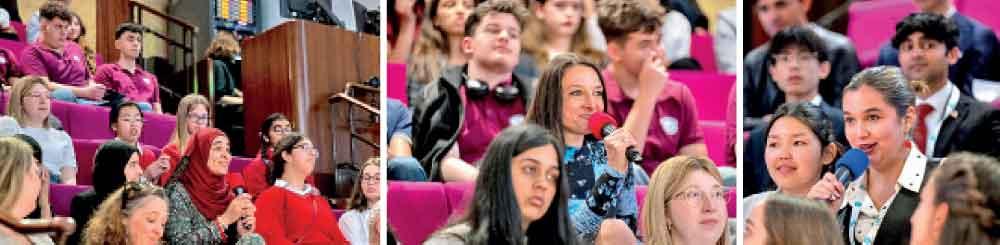
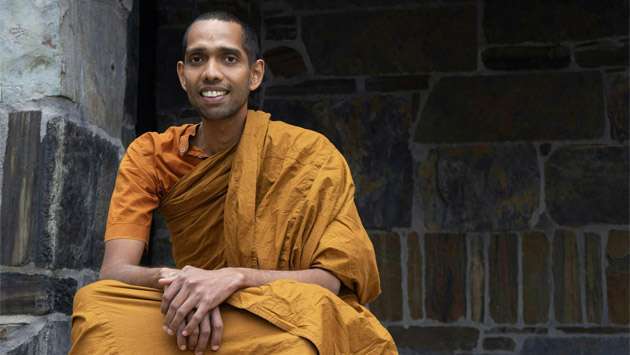
In a year already marked by remarkable global achievements for Sri Lanka, Sashane Dassanayake added another prestigious accolade to the nation’s name with a resounding victory at the 2025 International Public Speaking Competition. The event was hosted at the English-Speaking Union’s (ESU) International Headquarters at Dartmouth House in London, a historic venue that has welcomed numerous Nobel laureates over the years. Sashane captivated the judges and audience alike with a compelling and thought-provoking speech that left a lasting impression. So powerful was his delivery that during the Q&A session, members of the audience turned to him for life advice, underscoring the impact of his words and presence.
For Sashane, this was more than just a contest, it was a moment of purpose and pride, representing Sri Lanka on the world stage with grace, eloquence and inspiration.
Naturally, we had to speak to Sashane himself to learn more about his experience, what the victory meant to him, and the insights he could offer to aspiring public speakers.
QWhat inspired the speech you delivered at the international contest, and what message were you hoping to leave with your audience?
Being a science fanatic alongside a far fetched thinker, I was always intrigued by how the same carbon atom produced three completely different isomorphs: Diamond, graphite and charcoal, which of course is in spite of different pressures and temperature where the more valuable the compound the higher the pressure that made it. This fact was a good analogy to use with one of my personal experiences where at first, I scored 30/100 for English literature for my first monthly assessment, and in the end, I became the third in the world for literature in English in the O/L examination which was fully in result of me deciding to go through “pressure” and “heat”, putting in a lot of effort. When I received the finals’ theme “we know what we are, but not what we may be”, it fitted well with these analogies and stories.
QPublic speaking requires a mix of confidence, clarity and connection. What techniques or practices helped you develop those skills?
I believe I was more or less groomed for my stage presence from a very young age, whether it be the multiple advertisements I was a part of, and the different opportunities I received from school too, such as concerts.
QRepresenting Sri Lanka on an international stage is no small feat. How did it feel to carry that responsibility, and what did it teach you about yourself and your country?
It was more than an honour, to represent Sri Lanka, among 40+ countries of which some countries were also native English speaking. From the time I left I joined the other representatives. I realised they were good at what they were doing, and of course the pressure was on, but my victory is testament that even among the best of the best, we can still shine.
I also have a lot of passion in the specific area of neuroscience, which teaches us a lot on the mind, and how it is receptive to different aspect of the world, which I want to educate specifically the youth about since information is in excess today and that information affects the mind which is very evident in status quo.
QWho has been your biggest supporter or mentor throughout your public speaking journey, and how have they influenced your growth?
I was definitely what one would call a radical speaker, both in terms of content and manner, specially because I was very idiosyncratic when it came to how I went about speaking, but I continuously looked upto my spiritual father figure. Alongside, I was also given a lot of help from Mrs. Odile Melder who also pruned me at such a young age for theatre and also trained me before I went to the UK.
QWhere do you usually find inspiration for your speeches (real life experiences, books, or global events)?
I emphasise on research, so I read up a lot on particular scientific topics, and a lot of articles. I take a lot of insight from even the Bible, but surely a lot of it comes from my own real-life experiences.
QWhat’s next for you?
I’ve always been passionate of serving God using my voice, so I think that is above all in my bucket list. But on a more general scale, I want to help other young people like myself in Sri Lanka grow into big stages and opportunities because if there was one thing I realised it was that Sri Lankan youth in spite of the necessity for survival have a drive and passion like no other, so as I grow in influence I want to advocate for such individuals. I also have a lot of passion in the specific area of neuroscience, which teaches us a lot on the mind, and how it is receptive to different aspect of the world, which I want to educate specifically the youth about since information is in excess today and that information affects the mind which is very evident in status quo. Of course, these are all far fetched plans and desires, my immediate goal is obviously to find a university and learn before I can teach.
Pix courtesy SD
Comments - 0
Comments - A Landmark Win for Sri Lanka Sashane Dassanayake
222
Add comment
Comments will be edited (grammar, spelling and slang) and authorized at the discretion of Daily Mirror online. The website also has the right not to publish selected comments.



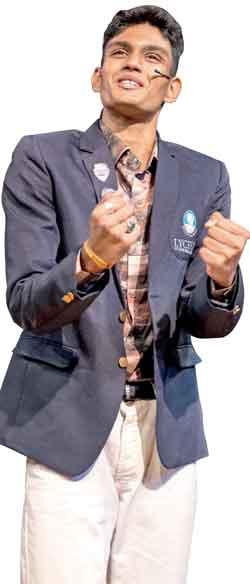 In a year already marked by remarkable global achievements for Sri Lanka, Sashane Dassanayake added another prestigious accolade to the nation’s name with a resounding victory at the 2025 International Public Speaking Competition. The event was hosted at the English-Speaking Union’s (ESU) International Headquarters at Dartmouth House in London, a historic venue that has welcomed numerous Nobel laureates over the years. Sashane captivated the judges and audience alike with a compelling and thought-provoking speech that left a lasting impression. So powerful was his delivery that during the Q&A session, members of the audience turned to him for life advice, underscoring the impact of his words and presence.
 Q Representing Sri Lanka on an international stage is no small feat. How did it feel to carry that responsibility, and what did it teach you about yourself and your country?