Reply To:
Name - Reply Comment
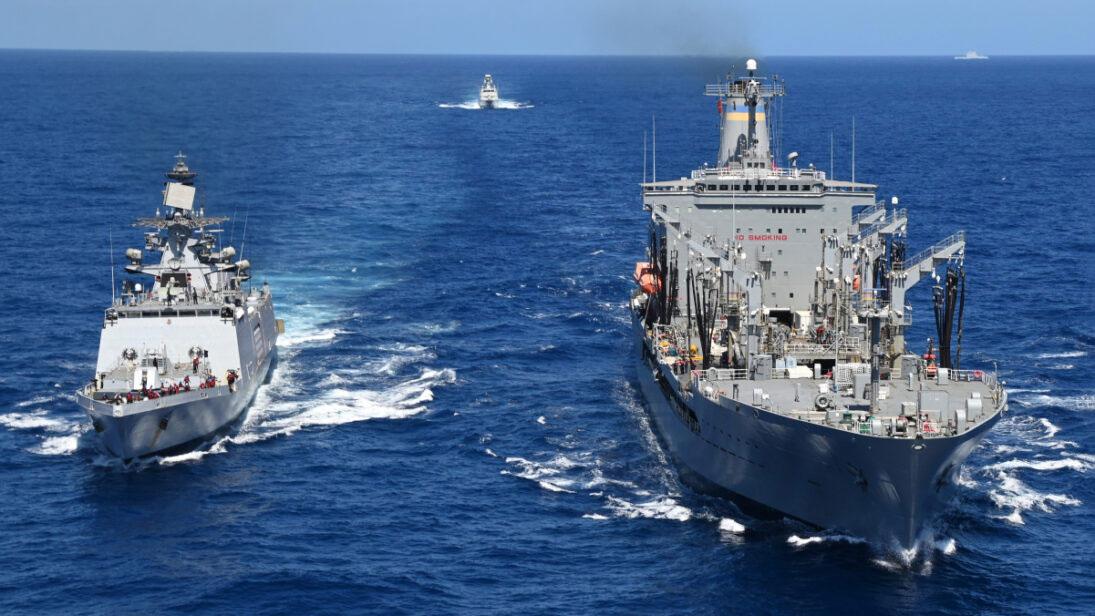 The Indian Ocean Region has historically functioned as the central, beating artery of global commerce, accommodating over one-third of the world's bulk cargo and two-thirds of global seaborne oil shipments. While South Asian states have long viewed their maritime gateways primarily as engines for economic growth, these commercial ports are undergoing a volatile transformation. Driven by the intensifying great-power competition between the United States and China, commercial ports are increasingly functioning as geopolitical pawns in a high-stakes contest for maritime supremacy and supply chain resilience.
Faced with the sprawling infrastructure of China’s Belt and Road Initiative (BRI) and kinetic threats from an increasingly unstable Middle East, the United States is fundamentally recalibrating its maritime strategy in South Asia. Washington is transitioning away from a Cold War-era posture of unilateral dominance anchored by isolated military bases, moving instead toward a complex strategy of diffusion, economic statecraft, and asymmetric minilateralism.
For decades, U.S. maritime dominance in the Indian Ocean relied heavily on its fortified base at Diego Garcia. However, China’s expanding naval capabilities and growing presence through strategic port investments, combined with emerging uncertainties over the Chagos Archipelago, have encouraged Washington to diversify its regional approach. The 2026 conflict involving the United States, Israel, and Iran further highlighted the vulnerabilities of relying on a small number of fixed military facilities.
Rather than focusing solely on traditional bases, the U.S. is increasingly expanding its regional presence through commercial infrastructure partnerships, development finance, and maritime security initiatives. While such engagement offers capacity-building opportunities for South Asian countries, it also raises concerns among states pursuing non-aligned policies. The challenge is to secure investment and development benefits without allowing critical infrastructure to become an arena for major-power competition.
The United States is strengthening its maritime strategy in South Asia through deeper engagement with key commercial infrastructure, particularly the Port of Colombo in Sri Lanka and the Thilafushi Port in the Maldives. Instead of relying only on traditional military facilities, Washington is using economic partnerships, diplomacy, and development finance to expand its influence over critical maritime hubs.
Sri Lanka has emerged as a key focus of this strategy. In June, US Deputy Assistant Secretary of State Dr. Paul Kapur visited the Port of Colombo. Publicly centered on expanding economic cooperation, the visit strategically reflected Washington's growing interest in shaping the future of one of the Indian Ocean's most important transshipment hubs alongside other global partners.
The Port of Colombo and great power competition
The Port of Colombo is South Asia’s largest transshipment hub and ranks among the world’s leading container ports. Operating above 90 per cent capacity since 2021, its strategic location along the main east-west shipping route between Asia, Europe, and the Americas makes it a vital regional maritime asset. The port is also crucial for India, handling around 45 per cent of its container transshipment traffic.
As trade volumes continue to expand, Colombo's importance has grown beyond its commercial role, placing it at the centre of increasing geopolitical competition.
The port is currently undergoing significant expansion, driven by rising regional demand and renewed international interest from countries including the United States and France. Regional transshipment volumes increased by more than 13 per cent during the first half of 2026, prompting authorities to accelerate capacity expansion with the goal of reaching 10 million twenty-foot equivalent units (TEUs) of annual deep-water handling capacity by the end of the year.
Within US policy circles, Colombo is increasingly recognised as a strategically important logistics hub in the Indo-Pacific. Washington's engagement is aimed at promoting what it describes as transparent and high-quality infrastructure partnerships as an alternative to China's growing presence across South Asia. Reflecting this growing engagement, a Sri Lankan delegation recently presented investment opportunities in Colombo Port development to the US business community during a maritime summit in Washington.
Particular attention has focused on the Colombo West International Terminal (CWIT), which has become a key project attracting international investors. The terminal is designed to handle 3.2 million TEUs annually and features advanced automated operations, a 1,400-metre quay, a 20-metre draft and some of the region's tallest electric ship-to-shore cranes, enabling simultaneous handling of the world's largest container vessels.
The project is being developed through a joint venture led by India's Adani Ports, which holds a 51 per cent stake, alongside John Keells Holdings with 34 per cent and the Sri Lanka Ports Authority with 15 per cent. Strong demand has accelerated planning for the proposed West Container Terminal 2, with detailed designs already being fast-tracked.
US engagement with Sri Lanka's maritime sector was further reinforced in June 2026, when the State Department hosted a Sri Lankan delegation at the US Forum on Indian Ocean Ports and Supply Chains in Washington, DC. The programme included discussions with the Federal Maritime Commission and technical visits to the Port of Baltimore, focusing on port technology, logistics modernisation, digital systems and cybersecurity standards that could support Colombo's future development.
While Sri Lanka welcomes foreign direct investment as it recovers from the severe 2022 economic crisis, linking its commercial ports with major-power strategic interests carries significant risks. The escalation of the US-Iran conflict in early 2026 highlighted these vulnerabilities, demonstrating how infrastructure with geopolitical significance can become exposed during regional tensions.
On March 4, 2026, the Indian Ocean became the scene of a major military confrontation when a US fast-attack submarine torpedoed the Iranian frigate 'IRIS Dena' off Sri Lanka's southern coast near Galle, killing 84 Iranian sailors. The Sri Lankan Navy rescued 32 survivors, while the damaged ‘IRIS Bushehr’ later sought emergency assistance near Colombo.
In the tense aftermath, Washington pressed Colombo for logistical support, including access to Mattala Rajapaksa International Airport to deploy fighter jets armed with anti-ship missiles. Meanwhile, Tehran requested a Colombo port call for survivor evacuation and emergency repairs.
Facing competing demands from two rival powers, President Anura Kumara Dissanayake denied military access to both sides, reaffirming Sri Lanka’s policy of neutrality and non-alignment.
As competition in the Indian Ocean grows, the Port of Colombo will continue to attract major powers pursuing economic and strategic interests. While foreign partnerships can bring investment, Sri Lanka must ensure they align with national priorities and do not compromise its strategic autonomy.
The challenge is to balance international cooperation with its policy of non-alignment, keeping the Port of Colombo an open, commercially driven hub for global trade rather than an arena for major-power rivalry.
Thilafushi Port and the archipelagic chessboard
The Thilafushi Port Development Project, led by Maldives Ports Limited (MPL), aims to modernize the Maldives’ maritime trade network by relocating major cargo and bulk handling operations from congested Malé to the artificial island of Thilafushi. With a planned capacity of 400,000 twenty-foot equivalent units (TEUs), the project is expected to reduce port congestion, improve vessel efficiency, and lower shipping costs.
The United States has signalled growing interest in the project as part of its broader effort to strengthen maritime partnerships across South Asia. During an official visit to the Maldives, US Assistant Secretary of State for South and Central Asian Affairs Paul Kapur toured the Thilafushi Port project and described it as a future logistics and distribution hub for international commerce.
Following the visit, Kapur said the United States looked forward to working with the Maldives on the Thilafushi Port project and helping unlock its long-term economic potential. During his visit, he also met President Mohamed Muizzu, Economic Development Minister Mohamed Saeed and Foreign Minister Iruthisham Adam.
Kapur's visit followed an earlier inspection of the project in May by Nicole Chulick, Principal Deputy Assistant Secretary in the Bureau of South and Central Asian Affairs at the US State Department. During her visit, Chulick met senior officials of Maldives Ports Limited (MPL), toured the existing Male' Commercial Port and visited the Thilafushi development site. She also expressed US interest in supporting infrastructure development projects across the Maldives.
The increased diplomatic engagement reflects Washington's broader strategy of strengthening relationships with strategically located Indian Ocean states as part of its Indo-Pacific policy. Rather than relying exclusively on traditional military facilities, the United States has increasingly focused on commercial ports, logistics infrastructure and maritime connectivity to reinforce regional partnerships and safeguard critical sea lanes.
Under the Muizzu administration's plan to relocate the country's commercial port, Maldives Ports Limited awarded the design and survey work for the first phase of the project to China Harbour Engineering Company (CHEC) in February. The first phase, known as the Local Harbor Relief Project, includes construction of a 650-metre quay wall, a 125-metre jetty, X-ray screening facilities, automated cargo handling systems and a bonded warehouse.
The involvement of both China and the United States in connection with the Thilafushi project illustrates the increasingly competitive environment surrounding maritime infrastructure across the Indian Ocean. While Beijing continues to play a major role through engineering and construction projects, Washington is seeking to expand its engagement through diplomatic outreach, investment partnerships and supply-chain cooperation.
For the Maldives, the priority remains transforming Thilafushi into a modern commercial port capable of supporting economic diversification and long-term growth. However, as major powers deepen their interest in strategically located infrastructure, the country's ports are becoming more than commercial assets. Like Colombo and other Indian Ocean hubs, Thilafushi is increasingly emerging as a focal point where economic development, maritime security and geopolitical competition converge, underscoring the challenge facing smaller states seeking investment while preserving their strategic autonomy.
The perils of port diplomacy: A cautious stance for host nations
Despite the influx of investment and diplomatic attention, host nations across South Asia must remain explicit and cautious about the underlying motives of the U.S. maritime strategy. For Washington, this approach frequently prioritizes American geopolitical interests, specifically deterring adversarial influence and securing vital maritime logistics far above the immediate, pressing developmental needs of local economies. When critical infrastructure decisions are heavily influenced by the strategic objectives of a distant superpower, it fundamentally complicates sovereign decision-making. Developing nations, many of which are intensely focused on sustainable growth and debt recovery, find themselves pressured to align their commercial maritime policies with Western security agendas, risking artificial policy divisions that do little to address their actual domestic priorities.
Furthermore, this security-driven engagement inherently risks turning infrastructure projects into an arena for major-power rivalry. By treating commercial ports and logistics hubs as dual-use assets in a broader global competition, the U.S. approach threatens to draw historically non-aligned states into geopolitical conflicts they have actively sought to avoid. Instead of fostering stable economic integration, utilizing South Asia's maritime gateways as tools to check adversarial powers only heightens regional tensions. For smaller states whose long-term prosperity depends on cooperative, balanced relations with all global partners, allowing commercial infrastructure to be swept into a hegemonic contest carries the severe peril of long-term instability and strategic entanglement.
The developments in Colombo and Thilafushi illustrate a broader trend in which maritime infrastructure is becoming closely linked to regional and global strategic competition. Ports and logistics networks remain essential for economic growth, but they are also gaining importance as countries seek greater influence and connectivity across the Indian Ocean. For smaller states, the challenge is to attract investment and strengthen development while ensuring that these projects continue to serve national interests rather than becoming instruments of wider geopolitical competition.