Reply To:
Name - Reply Comment
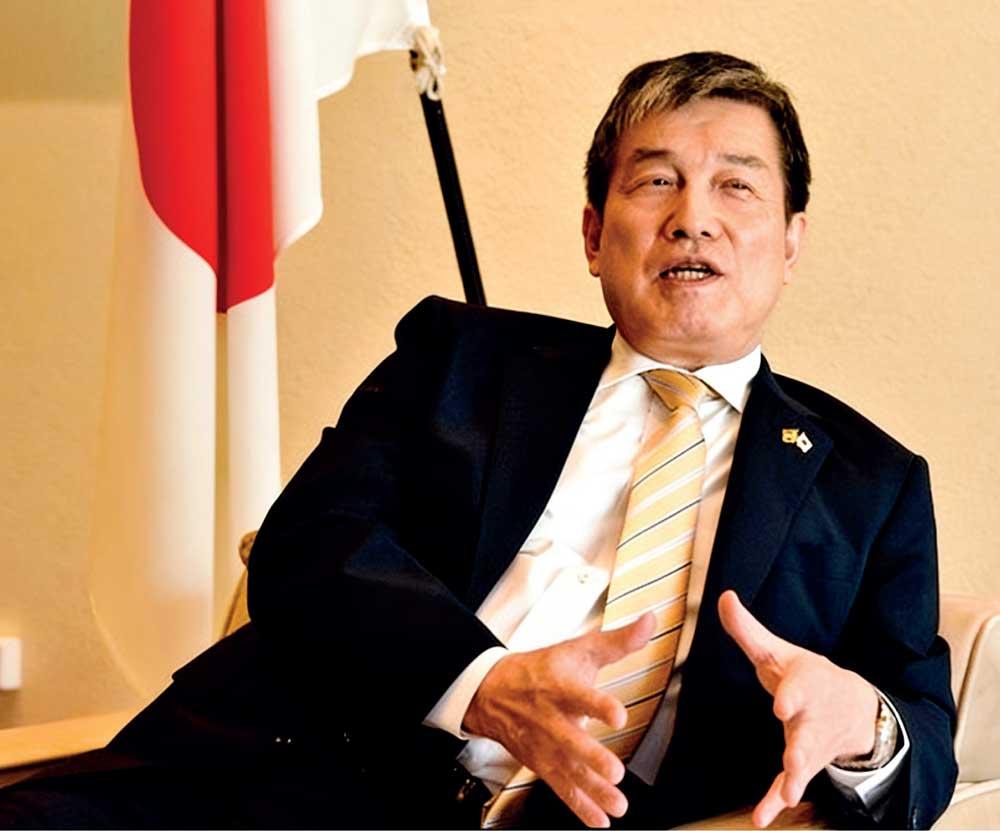
Ambassador of Japan to Sri Lanka Akio Isomata
Pic By Nimalsiri Edirisignhe
 As Sri Lanka navigates its post-crisis economic recovery, the Ambassador of Japan to Sri Lanka Akio Isomata has urged the country to move from policy discussions to implementation, warning that opportunities for investment and export-led growth cannot be delayed indefinitely. Stressing the need to “walk the talk,” he said the framework for deeper economic cooperation between the two countries is already in place and now requires action from both government and business stakeholders. In an interview with the Daily Mirror, Ambassador Isomata outlined Japan’s vision for a shift in bilateral relations from aid-driven cooperation to trade, investment and industrial partnerships. He called on Sri Lanka to adopt a stronger Eastward economic orientation, accelerate key policy reforms, and capitalize on a Japanese-backed export-oriented industrialisation initiative designed to integrate Sri Lankan manufacturers into regional supply chains linked to India, Japan and wider Asian markets. Excerpts:
 Q Sri Lanka is currently undergoing economic recovery, how does Japan plan to position itself as a long-term partner in this process?
During the economic crisis in Sri Lanka several years ago, Japan led the discussions on debt restructuring by establishing the so-called Official Creditor Committee (OCC) together with India and France, and led the discussions on debt restructuring.
After signing the Memorandum of Understanding (MOU) on the details, such as terms and conditions, of Sri Lanka’s debt restructuring in July 2024, Japan immediately announced the resumption of 11 previously suspended Yen Loan projects.
We will continue to provide maximum assistance to Sri Lanka. However, we would also like to bring in foreign investment, including from Japan, for Sri Lanka’s sustainable development.
For this purpose, most recently when President His Excellency Anura Kumara Dissanayake visited Japan in September last year, a large business forum was organized with the participation of Japanese investors. In addition, in February this year, Japan sent a high-level government delegation to Sri Lanka to hold economic policy dialogues for the first time in 10 years.
At the same time, the Japanese business sector sent its own delegation together with the afore-mentioned government mission in February. Even after that, in March this year, there was another business mission from Japan composed of small and medium-sized enterprises.
We are now trying to promote trade and investment alongside our assistance-driven cooperation.
When the President visited Japan last year, we also launched a concept called the Export-Oriented Industrial Corridor to attract Japanese investors to Sri Lanka by utilizing Sri Lanka’s export-oriented manufacturing sectors. The idea is to export goods from Sri Lanka, particularly parts and components, to India and eventually beyond India as well. We are now working on the implementation of this concept.
In addition, Japan has been assisting Sri Lanka in combating corruption through JICA and international organizations such as UNDP for the establishment of a National Action Plan on Anti-Corruption and for capacity-building efforts at the CIABOC.
Through all these initiatives, we would like to restore the confidence of Japanese investors in investing in Sri Lanka and help Sri Lanka achieve sustainable growth.
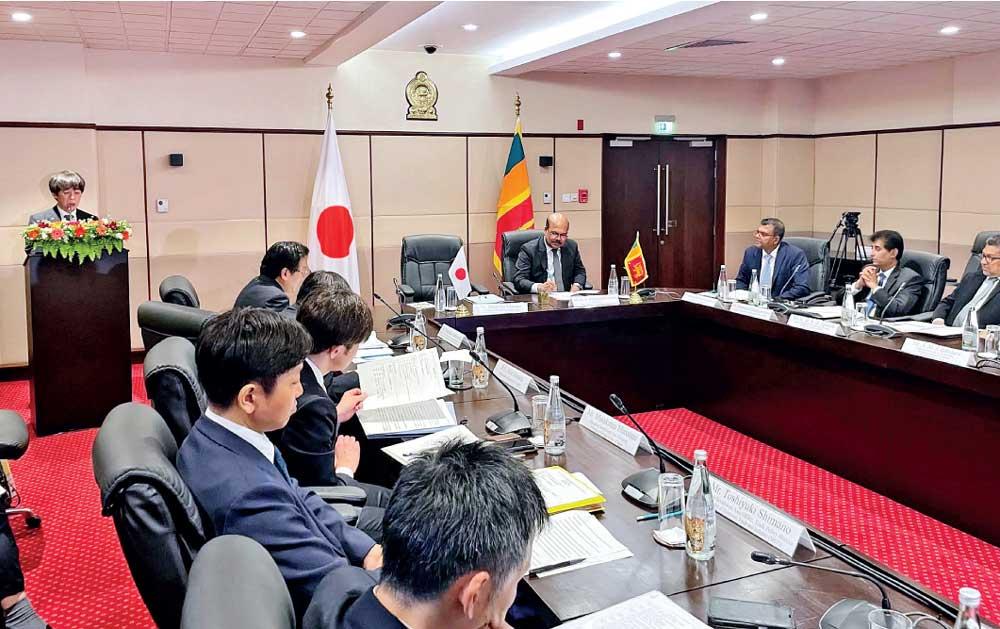
Resumption of Japan-Sri Lanka Intergovernmental Economic Policy Dialogue after 10 years, February 2026
Q Japan has historically been one of Sri Lanka’s key development partners. How do you assess the effectiveness of past Japanese-funded projects in the country?
Japan has been assisting Sri Lanka in the fields of infrastructure, medical services, livelihoods, education, human resources development, and in many other areas.
Whether and how effective it was, we would like to listen to the views of the Sri Lankan people. However, we believe that the assistance from Japan has made a substantial contribution to development in Sri Lanka.
Let me refer to some of the major projects. In the 1970s and 1980s, we assisted in implementing the Mahaweli River Development Program, which includes the Mahaweli System C Area Development Project, co-financed by JICA and the World Bank, as well as the Kotmale Hydropower Project assisted through Japan’s ODA loans.
In the field of medical services, we assisted Sri Lanka in the construction of the Sri Jayawardenepura General Hospital in the early 1980s.
In the field of education, we assisted the University of Peradeniya in establishing the Faculty of Dental Sciences. We also helped construct facilities and sent experts for capacity-building at the Faculty of Agriculture of the University of Jaffna.
Assistance in the area of human resource development includes opportunities for government administrative officers to study at Japanese graduate schools. This has been ongoing for more than 18 years under the Japanese Grant Aid for Human Resource Development Scholarship program, known as JDS.
We also established the Automobile Engineering Training Institute (AETI), so-called JapanTech.
These are only some of the examples of our assistance.
We also have a strategic plan for providing assistance to Sri Lanka in the future. Last year, in consultation with the Sri Lankan government, we developed a document called “Country Development Cooperation Policy for Sri Lanka.”
There are three priority areas mentioned in this policy paper.
The first area is structural reforms, which includes the growth of an export-oriented economy, private sector development, as well as human resources development.
The second area is social resilience, which also includes the empowerment of women, response to climate change, and biodiversity conservation.
The third area is ensuring peace and stability, focusing on national reconciliation as well as development of infrastructure and promotion of industry in underdeveloped areas, including the North and the East.
We will continue our assistance in Sri Lanka according to its development priorities in close consultation with the Sri Lankan government.
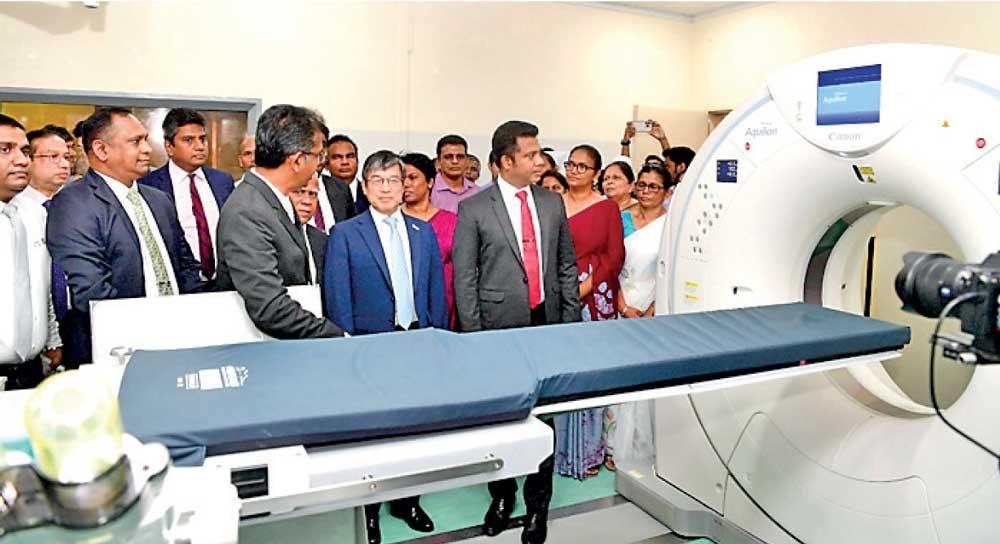 Handing over of 4D Angio CT Suite and the Dental Unit at Sri Jayawardenepura General Hospital, March 2026
Q Some major infrastructure projects backed by Japan have faced delays or cancellations in recent years. What lessons have been learned from these experiences?
I would like to make it very clear that any government-to-government agreement has to be honored, even if the administration changes.
And if there is any change in fundamental circumstances surrounding Japan’s assistance or specific projects, rather than cancelling them unilaterally, we would like to be consulted well in advance so that we can find a way to address the issues and continue our assistance.
To prevent similar situations from happening in the future, we will, on our part, continue to stay closely in touch with the Sri Lankan government regarding any assistance from our side or any project we are involved in.
Q Transparency and governance are often raised in development cooperation. How does Japan ensure accountability in projects implemented in Sri Lanka?
First of all, what is very important in any kind of assistance project is that ownership of the project is in the hands of Sri Lanka, the Sri Lankan government, and the Sri Lankan people. We are a donor providing partnership.
Accountability is also important, but the primary responsibility for accountability rests with the Sri Lankan side. As a donor Japan has systems in place when providing assistance, such as procurement procedures that ensure a transparent bidding process, so that there is a fair competition in the procurement.
Even after the completion of a project, we continue to monitor the implementation status of the projects. When necessary, we follow up with further assistance, such as technical cooperation, additional loans, or support for the rehabilitation of facilities or equipment.
This is part of our commitment to ensuring that projects remain sustainable and continue to deliver benefits over the long term.
Q With increasing geopolitical competition in the Indian Ocean, how does Japan view Sri Lanka’s strategic importance in the region?
Under the current circumstances, where the international environment is undergoing historic and fundamental changes, I believe the strategic importance of Sri Lanka is clearly increasing.
Japan would like to strengthen its relationship with Sri Lanka, particularly in diversifying supply chains and utilizing Sri Lanka as a strategic hub for logistics and transportation.
At the same time, we would like to expand cooperation in the field of security, including maritime security.
Last year, when President Anura Kumara Dissanayake visited Japan, we signed an agreement on the provision of OSA. OSA stands for Official Security Assistance, which is different from ODA, or Official Development Assistance. Under ODA, assistance cannot be provided to military or military-related organizations. However, OSA enables us to provide direct assistance to military and related organizations.
The agreement signed between the two governments was for the provision of unmanned aerial vehicles (UAVs) for maritime surveillance and disaster response to the Sri Lankan Navy.
The project is worth 500 million yen and represents the first ODA project provided to Sri Lanka.
We would like to further strengthen military personnel exchanges and cooperation in training, as well as intellectual exchanges, including organizing seminars on maritime domain awareness (MDA) and other security-related issues.
We have been offering several training programs through Japan’s Ministry of Defense to personnel from the Sri Lankan Navy, Army, and Air Force.
Many Japanese naval vessels have made port calls in Sri Lanka, and we conduct joint training exercises also using these opportunities of port calls.
In connection with this security cooperation, let me stress one important point regarding Japan’s proactive peace diplomacy.
Japan is seeking to work closely with other countries, including Sri Lanka, at a time when the world is undergoing historic and fundamental changes. We would like to maintain and strengthen a rules-based international order founded on freedom, democracy, human rights, and the rule of law.
At the same time, we must proactively help create an international environment that is peaceful and stable. For that purpose, Japan would like to continue working together with countries such as Sri Lanka, so that we can lead the world toward peace and cooperation rather than division and confrontation.
Q Japan promotes the concept of a “Free and Open Indo-Pacific.” How does
Sri Lanka fit into this vision?
Sri Lanka, in 1971, promoted the concept of the Indian Ocean as a Zone of Peace (IOPZ) at the United Nations General Assembly and took the lead in international discussions on the idea.
However, in today’s globalized environment, the challenges and problems we face in the Pacific Ocean and the Indian Ocean are closely interconnected. These regions cannot be viewed separately because the oceans are inseparable and developments in one region affect the other.
That is why Japan is advocating the vision of a Free and Open Indo-Pacific (FOIP). We believe Sri Lanka has an important role to play in supporting this vision.
There have been many misunderstandings about FOIP. It is not directed against any specific country or group of countries. Rather, it is a vision aimed at promoting a rules-based international order, connectivity, and cooperation across the Indo-Pacific region.
This year marks ten years since the launch of the FOIP vision. Earlier this year, the Japanese government announced an updated version of FOIP. We believe it is necessary to strategically evolve and update the vision in light of the significant changes that have taken place around the world over the past decade.
The updated FOIP framework is built around several pillars. In relation to Sri Lanka, one important focus is strengthening connectivity through the development of concrete projects and practical cooperation.
Secondly, establishing resilient supply chain is also envisaged under this vision.
Thirdly, we also attach importance to the capacity building of countries on maritime security.
I would like to note that even under this updated version of FOIP, the basic principles remain unchanged. These principles include upholding freedom and the rule of law, as well as respecting diversity, inclusiveness and openness.
We are discussing FOIP with many other countries and are receiving broad support for the idea. This is because its fundamental principles, respect for the rule of law, freedom and democracy, are universal values shared by many countries, including Sri Lanka.
Countries such as Sri Lanka can also benefit from enhanced connectivity projects and broader regional cooperation under FOIP. As I mentioned earlier, we would like to see Sri Lanka also supporting this vision.
Q Public trust in politicians varies significantly between Sri Lanka and Japan. In your view, what are the main factors that sustain trust in Japan’s political system?
I believe there are at least three factors that are important for any political system to sustain public trust.
First, constitutional framework. There must be a strong constitutional framework. The government, or the executive branch, should formulate and implement its policies within the confines of the Constitution.
Secondly, sound parliamentary process. Government policies should be subjected to debate and scrutiny through Parliament. This process helps ensure that policies do not deviate too far from views that are generally accepted by the public and remain aligned with the expectations and aspirations of society.
Thirdly, professional bureaucracy. Ruling party may change by elections but it is important the bureaucracy remains consistent under the principle of political neutrality and continues to deliver quality public service. It is also important that politicians and bureaucrats work closely together to adopt sound and effective policies and to implement them efficiently.
Q There are concerns about youth unemployment and skills gaps in Sri Lanka. Is Japan planning to expand technical training or employment opportunities for Sri Lankans?
There are currently two major programmes in Japan that provide employment opportunities for people from developing countries, including Sri Lanka.
The first is the Technical Intern Training Programme (TITP), while the second is the Specified Skilled Worker (SSW) Programme. For example, under the SSW Programme, Sri Lankan youth can work in nine industrial sectors, including nursing care, building management, construction, and accommodation industries.
Recently, the SSW programme has expanded to include automobile repair and maintenance as well as automobile transportation services, covering truck, taxi and bus drivers.
The number of Sri Lankans going to Japan for employment under these programmes continues to increase. At present, more than 7,000 Sri Lankans are working in Japan under the TITP and SSW programmes, and this number is growing every year.
What is particularly important is that Sri Lankan workers enjoy a very strong reputation among Japanese employers. There are candidates from many countries seeking employment opportunities in Japan, but Sri Lankan youth are known for their diligence, strong work ethic, and their ability to learn the Japanese language quickly.
It is also important to clarify that Japan does not impose country-specific quotas under these programmes. While there is an overall limit on the number of foreign workers admitted to Japan, there are no quotas allocated to individual countries. Therefore, if Sri Lankan workers continue to maintain their excellent reputation, more Japanese companies are likely to recruit from Sri Lanka.
Q What message would you like to give to young Sri Lankans who are interested in studying or working in Japan?
Japan offers significant educational opportunities. Currently, more than 300 undergraduate and postgraduate degree programmes are available in English at Japanese universities and higher education institutions. Around 18,000 Sri Lankan students are currently studying in Japan, and the total number of Sri Lankans living in Japan is also rapidly increasing, being nearly 80,000 at the end of last year.
My message to young Sri Lankans is that Japan can offer valuable opportunities for employment, education, cultural exchange, technology, and academic research. However, I would ultimately like to see those who acquire knowledge, skills and experience in Japan return to Sri Lanka and contribute to the development of their own country.
I believe this is important for Sri Lanka’s long-term sustainable development and prosperity. Strengthening relations between Japan and Sri Lanka can help create more opportunities for young Sri Lankans while also supporting the future growth of Sri Lanka.
Q You have urged Sri Lanka to “walk the talk” and warned that Japan and Japanese businesses could lose interest if progress is delayed. What specific actions would you like to see from the Sri Lankan Government within the next 12 months to demonstrate that it is serious about the proposed Export-Oriented Industrial Corridor?
As I mentioned earlier, Japan proposed last year a conceptual roadmap aimed at building an export-oriented industrial sector in Sri Lanka and translating this idea into practical action.
Earlier this year, a high-level Japanese government delegation led by the Vice Minister of the Ministry of Economy, Trade and Industry visited Sri Lanka. During that visit, the Governments of Japan and Sri Lanka signed a Memorandum of Cooperation (MoC) to advance the export-oriented industrial corridor concept.
Under this framework, a joint working group is expected to be established to put this idea into practice.
From the Japanese side, we have already submitted the list of members for the working group as well as the proposed Terms of Reference. These submissions were made recently, and we are now awaiting a response from the Sri Lankan side. The two governments can work together closely to move this initiative forward.
The conceptual roadmap has already been published and is publicly available. It is a comprehensive document of approximately 100 pages, accompanied by a four-page executive summary, and anyone interested can access and read it.
Importantly, the roadmap contains concrete proposals identifying existing and potential export sectors in Sri Lanka that can be linked with highly import-dependent and high-growth manufacturing sectors in India. It outlines opportunities for Japanese companies to invest in these export sectors of Sri Lanka and for Sri Lankan businesses to become part of regional and global supply chains.
What I would like to emphasise also is that Sri Lankan businesses do not necessarily have to wait for further government action. The opportunities and recommendations are already clearly set out in the roadmap. The document is well articulated and provides practical guidance on sectors where cooperation between Sri Lankan and Japanese businesses can be developed and expanded.
Therefore, while the two governments will continue to work together to facilitate this process, the private sector can also take proactive steps to explore investment opportunities and partnerships based on the proposals already contained in the roadmap.
The roadmap identifies export sectors in Sri Lanka such as wiring harnesses, PCB assembly, medical device components, electric vehicle materials, battery energy storage system materials, semiconductor-related products, industrial robot components, and rubber-based components.
These parts and components can be supplied to manufacturing sectors in India such as automobiles, home appliances, electronic devices and medical devices. The idea is very clear. We have proposed it, and we are promoting it.
Again, my point is, while the two governments will work together on this initiative, even without further governmental push, businesses and private sector stakeholders in Sri Lanka, as well as in Japan, can begin working according to the proposal. The opportunities are already clearly identified.
That is what I meant when I said that we need to “walk the talk.” The framework for cooperation already exists. There is an agreement in the form of a Memorandum of Cooperation (MoC) between the two governments, so the governments will work together to implement the proposal. But at the same time, the private sectors do not have to wait for governmental action. Businesses can take proactive measures and work according to the roadmap because the ideas and opportunities are already laid out.
At this stage, we are not talking about investment figures or specific numbers. That will depend on the level of interest and investment from both Japanese and Sri Lankan businesses. What we are providing at this point are ideas and directions for future opportunities.
Q You have stated that Sri Lanka lacks a clearly defined industrial strategy. From Japan’s perspective, which industries or sectors should Sri Lanka prioritise to become a more attractive destination for Japanese investment and a stronger export hub in the region?
I would note that there are several industrial policy frameworks already developed or currently being developed by the Sri Lankan government.
As we understand, there is a National Industrial Policy and a Five-Year Strategic Plan covering the period 2023–2027, although these documents have not yet been made public beyond what was reported in the media. We also understand that an updated version of the strategic plan is currently being prepared.
There is also another policy document known as the National Export Development Plan 2026–2030, which has not yet been publicly released either. In addition, discussions are underway on a National Mineral Policy for 2026. As far as I know, this policy is currently being discussed within the government and is awaiting a possible cabinet decision in the near future. So, it has not yet been made public.
There has also been discussion regarding an Investment Protection Bill since last year. I have seen media reports about this proposed legislation. It appears that a cabinet approval has already been obtained, but the bill has not yet been tabled in Parliament.
We look forward to seeing the contents of these policy documents and understanding how they will shape Sri Lanka’s industrial development priorities in the years ahead. We would also like to know the implementation status of these policies, so that what progress has been or has not been made under them in order to better understand the whole picture.
Through these exercises, we can understand more clearly what kinds of investment opportunities will be available in Sri Lanka for investors, including Japanese investors. It is important to show the investors a clearer picture of where opportunities may exist and what kind of investments could potentially be pursued.
Q Given the growing geopolitical tensions in other parts of the world and your call for Sri Lanka to adopt a stronger “Look East” approach, what concrete opportunities do you see for Sri Lankan exporters and businesses in Japan, India, and Southeast Asia over the next five years?
This policy was first proposed by Malaysia in 1982 by then Prime Minister Mahathir Mohamad under the “Look East Policy,” which was followed by ASEAN countries. India also adopted a similar approach through its “Look East Policy” in 1991, which was later upgraded to the “Act East Policy” in 2014.
What I would like to propose to Sri Lankan businesses and the people of Sri Lanka is that Sri Lanka could also consider a similar approach. Together with a rapidly rising India, Sri Lanka can also look eastward for its future development.
Under current global circumstances, it is becoming increasingly difficult to do business westward because of growing uncertainties and volatility. Of course, engagement with Western markets will continue, but in the medium to long term there are significant opportunities in the East, particularly because these markets are geographically closer to Sri Lanka.
By “Looking East,” I mean engaging more actively with Southeast Asian and East Asian countries, including Japan. My question is: why not make greater use of the resources, opportunities, technologies, and markets available in Southeast Asia and East Asia? Perhaps Sri Lanka could even upgrade the concept from “Look East” to “Join East.”
For this purpose, Sri Lanka could also consider increasing the number of Free Trade Agreements (FTAs) with countries in Southeast Asia. As far as I know, apart from India, Sri Lanka currently has FTAs with Singapore and Thailand. Expanding such agreements, including the upgrading of the existing one with India, could help Sri Lanka increase exports and gain greater access to regional markets.
With regard to Japan, I don’t say that Japan is ready to negotiate an FTA with Sri Lanka at this moment. As far as I know, there was a talk about the possibility of negotiation between the two countries more than 10 years ago, and I don’t deny a future possibility of such negotiations. But, an FTA must be mutually beneficial, including tariff reductions both sides are interested in.
We are also awaiting Sri Lanka’s FTA strategy. I understand that such a strategy is currently being developed and is expected to be released sometime this year, although we have not yet seen it.
Once that strategy and related policies become available, I believe they could also benefit Japanese investors. Japanese companies are generally looking for access to larger markets, and Sri Lanka by itself is a relatively small market. In relation to the export-oriented industrial corridor concept, Japanese investors can invest in Sri Lanka and use the country as a production base connected to larger regional and global markets through trade agreements and supply chains.