Reply To:
Name - Reply Comment
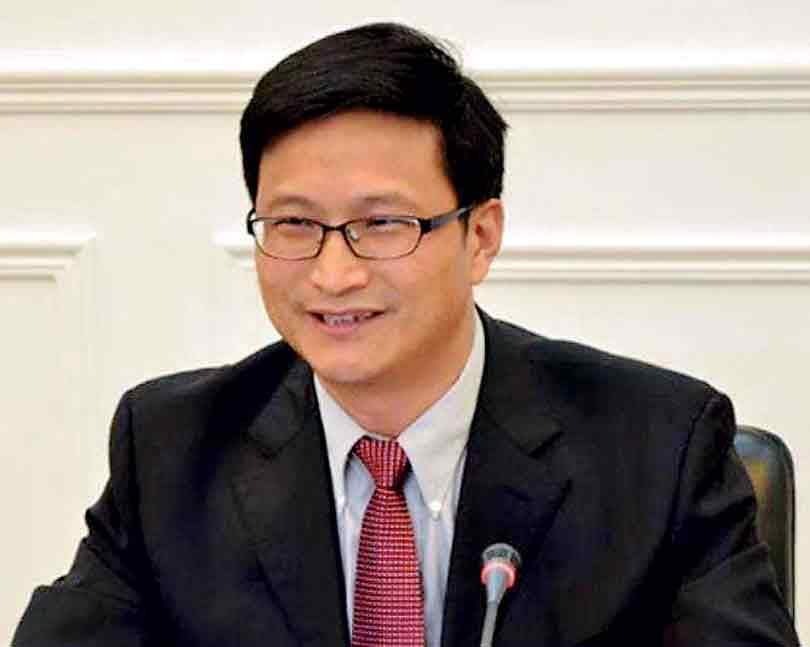
Qi Zhenhong, Ambassador of the People’s Republic of China to Sri Lanka.
This interview outlines China’s strategic outlook for 2026, focusing on its mediation role in the Middle East and its “shared future” with Sri Lanka. Key highlights include the push for a bilateral Free Trade Agreement, emergency energy support for Colombo, and a visionary proposal for trilateral cooperation between China, India, and Sri Lanka.
 Q How does China view the current Middle East crisis and the recent two-week cease fire arrangement? What steps is Beijing taking to facilitate a long-term political settlement?
The root cause of the conflict is the U.S.-Israeli launch of military attacks against Iran in violation of international law. This is a war that should not have happened—it is a war that does no one any good. China’s principled position on the Iranian situation and the broader Middle East conflict is to bring about ceasefire and end hostilities, and to facilitate peace through dialogue. We advocate for respecting national sovereignty and territorial integrity, rejecting the abuse of force, and adhering to the international rule of law.
Since the conflict began, China has held objective, just and balanced position and has been working to help bring about ceasefire and the end to the conflict. Foreign Minister Wang Yi made dozens of phone calls with parties including Iran, Israel, Russia and the Gulf states. The Special Envoy of the Chinese Government on the Middle East Issue traveled to the region in a mediation effort. China has also consistently called for an immediate ceasefire at the UN Security Council and other multilateral platforms. Together with Pakistan, China proposed a five-point initiative on restoring peace and stability in the Gulf and the Middle East, which aligns with the common aspirations of the international community. Furthermore, China has coordinated with Global South countries, including Sri Lanka, to address shifts in the global energy landscape and safeguard regional and international energy and economic security.
China welcomes all efforts conducive to ceasefire and the end of hostilities. During his meeting with Sheikh Khaled bin Mohamed bin Zayed Al Nahyan, Crown Prince of Abu Dhabi, the UAE, President Xi Jinping made four propositions on safeguarding and promoting peace and stability in the Middle East: upholding the principles of peaceful coexistence, respecting national sovereignty, adhering to the international rule of law, and balancing development and security. These proposals provide a Chinese solution for resolving conflicts and achieving peace, garnering increasing recognition and support from regional countries and the international community.
As a responsible major country, China will continue to play a constructive role in easing the situation in the spirit of President Xi’s four-point proposal. We remain committed to working with regional countries and the international community to make sustained efforts toward the early restoration of peace and stability in the Middle East.
Q Given the global energy crisis caused by the conflict, is China considering specific assistance to Sri Lanka regarding oil and gas supplies?
The ongoing situation in the Middle East has impacted global economy and energy security, and Asia has been one of the most directly and severely affected regions. In recent years, China has been making efforts to improve coal utilization efficiency and vigorously developing new energy. However, China’s external dependence on oil remains at over 70%, making it the world’s largest crude oil importer, with about 40% of its imported oil transiting through the Strait of Hormuz. The surge in transportation costs caused by the Middle East conflict has significantly affected China’s trade with Middle Eastern countries, with transportation costs rising sharply. Moreover, China’s large-scale investments in high-risk regions and the safety of tens of thousands of Chinese citizens there have been put at risk. At this critical juncture, instead of scrambling for energy in the international market, China has been working hard to ensure the stability of its own energy supply. Instead of leveraging the situation to bargain with its neighbors, China has been coordinating with other countries, especially neighboring countries, to deal with energy issues. China has thus made significant contributions to safeguarding international energy security and played a key role in ensuring the stability of the regional energy market.
Sri Lanka is currently facing severe fuel shortages, and the government has introduced a series of emergency energy measures. China understands Sri Lanka’s current situation. As a trusted long-term partner, China, despite its own challenges, has made great effort to provide emergency energy support to Sri Lanka. China is currently the only country providing government-level fuel support to Sri Lanka. In addition, two shipments of fuel from Sinopec Energy Lanka have arrived in Sri Lanka on March 18 and April 18 respectively. China stands ready to work closely with Sri Lanka to advance cooperation in the fields of new energy and sustainable development including wind and solar power, so as to jointly maintain Asia’s energy industrial and supply chains stable and smooth.
Q How would you describe the current state of China-Sri Lanka relations in 2026?
China and Sri Lanka enjoy a traditional friendship that has a long history and continues to grow stronger over time. The friendly relations are rooted in deep historical ties, a solid political foundation, strong bonds of shared interests, and broad social support. Since the establishment of diplomatic ties, despite the changing international landscape, the two countries have always developed bilateral relations on the basis of the Five Principles of Peaceful Coexistence, and rendered mutual support on issues involving each other’s core interests and major concerns, setting a fine example of friendship and mutually beneficial cooperation between different countries. At present, China-Sri Lanka relations are facing a historic opportunity to both build on past success and forge ahead into the future. Under the strategic guidance of the leaders of both countries, the two sides are committed to deepening the China-Sri Lanka strategic cooperative partnership featuring sincere mutual assistance and everlasting friendship.
China and Sri Lanka are fellow travelers on the path toward development and revitalization, and good partners of win-win cooperation. China has always supported Sri Lanka in safeguarding its national sovereignty, independence and territorial integrity, pursuing a development path that suits its national conditions, and focusing on economic development to achieve national prosperity. In recent years, China and Sri Lanka have achieved fruitful outcomes in high-quality Belt and Road cooperation. The Colombo Port City and the Hambantota Port have prospered by harnessing the sea, effectively boosting Sri Lanka’s economic and social development, while also delivering tangible benefits to the people of both countries. wChina and Sri Lanka are good brothers, good partners and good friends sharing weal and woe. Whenever Sri Lanka faces difficulties and challenges, China always extends a helping hand through bilateral and multilateral channels to help Sri Lanka get through its hardships. We will continue supporting Sri Lanka’s efforts to safeguard national security and identity, as well as the economic and social development.
China’s friendly policy and mutually beneficial cooperation with Sri Lanka are directed at all Sri Lankan people, covering all ethnic groups, religions and regions. This has not changed in the past, nor will it in the future. China hopes that the Sri Lankan government could adhere to an independent foreign policy, uphold principles, overcome challenges, and develop a more active relationship with China.
Looking ahead, China is willing to work with Sri Lanka to carry forward traditional friendship, expanding mutually beneficial cooperation, and jointly building a China-Sri Lanka community with a shared future to deliver greater benefits to the people of both countries.
Q What is the current status of the China-Sri Lanka FTA negotiations, and what are the remaining hurdles to its signing? Is China planning to further open its domestic markets to Sri Lankan exports to help bridge the trade deficit?
China is actively working to advance negotiations on a bilateral free trade agreement(FTA) with Sri Lanka, with the aim of further upgrading China-Sri Lanka economic and trade cooperation, boosting bilateral investment collaboration, and deepening the longstanding friendship between the two countries.
The China-Sri Lanka FTA negotiations, launched in 2013, have been at a standstill since March 2017 after six rounds of talks. Sri Lanka’s industrial sector is concerned about the significant disparity in economic scale between China and Sri Lanka, worrying that an FTA could damage Sri Lanka’s domestic market through an influx of Chinese goods.
In January 2025, during President H.E. Anura Kumara Dissanayake’s visit to China, the two sides agreed to “work toward the early conclusion of a comprehensive free trade agreement in one package.” At present, the United States is wielding the big stick of tariffs, including the imposition of high reciprocal tariffs on Sri Lanka, prompting the country to seek greater diversification of its export markets. To implement the consensus reached by the leaders of the two countries, Hon. Wang Wentao, China’s Minister of Commerce, and Hon. Wasantha Samarasinghe, Sri Lanka’s Minister of Trade, Commerce, Food Security and Cooperative Development, held an in-depth exchange of views on the resumption of bilateral FTA negotiations during the eighth session of the China-Sri Lanka Joint Commission on Economic and Trade Cooperation in May 2025.
To facilitate the early resumption of negotiations and achieve substantial progress, China has demonstrated full sincerity by putting forward a more flexible and pragmatic proposal, and stands ready to give priority to addressing Sri Lanka’s concerns. In addition, to expand exports of Sri Lanka’s distinctive and competitive products to China, China has provided strong support for Sri Lankan enterprises to participate in major exhibitions, including the China International Import Expo (CIIE), the China Import and Export Fair (Canton Fair), and the China-South Asia Exposition (CSAE). China has also helped them gain access to the Chinese market through e-commerce platforms.
I believe the concerns expressed by some of our Sri Lankan friends that Chinese products may impact the local market are unnecessary. Looking back at history, the Rubber-Rice Pact was signed by China and Sri Lanka in 1952 when China was facing severe domestic and external challenges. However, China still offered favorable terms to its Sri Lankan friends under difficult circumstances. Therefore, there is no need to worry that China would seek to take advantage of Sri Lanka, given the remarkable development achievements China has made.
At present, bilateral trade between China and Sri Lanka stands at 6.163 billion USD, accounting for merely about one-thousandth of China’s total foreign trade. Moreover, China has already become Sri Lanka’s largest source of imports. The conclusion of a China-Sri Lanka FTA would only bring a wide range of tangible benefits to Sri Lanka.
It would facilitate the further expansion of Sri Lanka’s exports to China, including competitive products such as tea, spices, fishery and agricultural products, gemstones and apparel. It would also enhance the resilience of Sri Lanka’s export sector against external risks, establish a legal framework that will safeguard the China–Sri Lanka economic and trade cooperation, boost the confidence of Chinese enterprises in investing in Sri Lanka, facilitate Sri Lanka’s integration into China’s industrial and supply chains, support the upgrading of Sri Lanka’s industries, and deliver tangible benefits to the development of Sri Lanka’s export-oriented economy.
Q Is there a specific interest from Chinese enterprises to invest in the Northern and Eastern Provinces of Sri Lanka?What is the area China going to invest in Sri Lanka in the coming years?
It is widely known that, due to undue external pressure, Chinese enterprises have long faced obstacles when making investment or seeking cooperation in Sri Lanka’s Northern and Eastern Provinces. We firmly oppose all acts of regional bullying. For example, in 2019, the Sri Lankan government invited bids for a hybrid power generation project on three islands off the coast of Jaffna to address the high cost and instability of power supply there. A Chinese enterprise actively took part in the bidding and was awarded the contract. Despite receiving Cabinet approval, the project was ultimately suspended in 2021 due to external pressure. It is learned that the power supply issue affecting residents on the three islands remains unresolved. Had the project proceeded without interruption, around 10,000 local islanders would have gained access to a reliable and high-quality power supply.
China and Sri Lanka are traditional friendly neighbors, with a history of friendly exchanges spanning more than 2,000 years. As early as the period of the ancient Maritime Silk Road, the two countries had established close ties through trade and cultural exchanges. More than 600 years ago, the fleets of Chinese navigator Zheng He made several stops at Trincomalee, where the name “China Bay” is still preserved at Trincomalee Port to date. China has long provided support and assistance to the Northern and Eastern Provinces to the best of its ability. During the COVID-19 pandemic, the Chinese government donated one million doses of Sinopharm vaccines to the two provinces, making an important contribution to protecting the health and safety of local people. In 2024, the Chinese government provided assistance worth around 1.5 billion Sri Lankan rupees to the two provinces, including rice, prefabricated houses and fishing nets, helping disaster-affected people overcome difficulties. I have visited the Northern and Eastern Provinces several times and donated a large number of food packs to local people in need. These visits have given me a clear understanding of the local people’s strong desire for development. They are very friendly toward China and eagerly look forward to Chinese enterprises investing there and promoting local economic development. What puzzles and frustrates me, however, is that whenever the Chinese side seeks to advance investment projects in the two provinces, it invariably encounters inexplicable problems and resistance.
Sri Lanka was among the first countries to support and participate in the Belt and Road Initiative. The Colombo Port City Special Economic Zone and the Hambantota Port Integrated Development Project, two flagship projects of Belt and Road cooperation, have maintained strong development momentum, effectively promoting Sri Lanka’s economic and social development and improving people’s livelihoods. As a friendly neighbor, China has both the willingness and the capability to help Sri Lanka achieve better development. China will continue to encourage Chinese enterprises to invest and do business in Sri Lanka, and support Sri Lanka in advancing economic transformation, upgrading and sustainable development. It is hoped that Sri Lanka will work with China in the same direction by providing an open and transparent business environment for Chinese enterprises and protecting their legitimate rights and interests.
China is one of Sri Lanka’s largest sources of foreign investment. During President H.E. Anura Kumara Dissanayake’s visit to China in January 2025, he stated that Sri Lanka welcomes more Chinese enterprises to invest in the country and is ready to strengthen cooperation with China in areas such as infrastructure, energy, agriculture, finance, poverty reduction, digital transformation, tourism, maritime affairs and personnel training. China stands ready to strengthen the alignment of development strategies with Sri Lanka, deepen industrial and investment engagements, and advance high-quality Belt and Road cooperation. By leveraging its advantages in geographical location, ports and shipping, Sri Lanka can promote the development of port-adjacent industrial parks to attract Chinese manufacturing enterprises to invest in the country. The two sides can strengthen cooperation in new energy and green development, including wind power, photovoltaic power and energy storage, so as to support the Sri Lankan government in achieving its target of generating 70 percent of its electricity from renewable energy by 2030. The two sides can also focus on areas conducive to agricultural modernization in Sri Lanka including modern agricultural breeding technologies, water-saving technologies, the deep processing of agricultural products, and the increase in the added value of Sri Lanka’s traditional export products such as tea and rubber. Building on Sri Lanka’s advantages in port logistics, the two sides can strengthen cooperation in aquaculture, processing of seafood products, cold-chain logistics at fishing ports, and blue economy. China’s experience and technologies in the digital economy can also be drawn upon to help Sri Lanka implement its National Digital Economy Strategy 2030. In light of the six future industries identified in China’s 15th Five-Year Plan—namely quantum science and technology, biomanufacturing, hydrogen energy and nuclear fusion energy, brain-computer interfaces, embodied intelligence, and sixth-generation mobile communications—the two sides may explore cooperation in areas related to new quality productive forces.
Q China is the second largest economy in the world? How is its relationship with India, which is a fast growing economy?
China and India are two great ancient civilizations that have coexisted side by side for centuries. They are, respectively, the largest developing country and a representative of emerging economies, and each has a population exceeding 1.4 billion. They are also two main forces in promoting multi-polarization of the world, economic globalization, diversity of civilizations, and democratization of international relations. According to the latest estimate from the International Monetary Fund (IMF) , China’s GDP reached 19.63 trillion USD in 2025, while India’s GDP reached 3.92 trillion USD. Together, the two countries account for about approx. 20% of global GDP.
As for the boundary issue between the two countries, it is, in essence, a issue left over by Western colonialists. Resolving it requires time, patience and wisdom. History and reality have repeatedly shown that, as mature and rational major developing countries, China and India should put the boundary issue in a proper place in bilateral relations, and should not let the boundary issue define or even affect the overall development of bilateral relations.
Our shared task is to promote national development and revitalization , and to improve the livelihoods of our peoples. China and India should help each other succeed, rather than engage in attrition; support each other, rather than exclude each other; engage in close cooperation, rather than mutual suspicion. This is what fundamentally serves the interests of both countries and our peoples. In August 2025, President Xi Jinping and Prime Minister Narendra Modi had a successful meeting in Tianjin, which brought about further improvement in China-India relations. Both sides are earnestly implementing the important understandings of our leaders. We are heartened to see reenergized interactions at all levels, closer people-to-people exchanges, and a new record in bilateral trade. In 2025, the bilateral trade reached 155.6 billion USD, with China once again becoming India’s largest trading partner, which has brought tangible benefits to the two peoples.
Q You recently spoke about China-India-Sri Lanka trilateral partnership approaches? Can you elaborate on it?
China, Sri Lanka and India are all developing countries, jointly committed to expanding domestic production and improving the well-being of their peoples. The three countries are friendly neighbors to one another, each possessing unique strengths and resources, and enjoy vast potential for cooperation. We can fully engage in open and inclusive trilateral cooperation, aligning the respective strengths, achieving mutual benefit and win-win outcomes, to create a more efficient “1+1+1 > 3” effect.
Recently, I visited Kelun Life Sciences Sri Lanka in Kandy. This company stands as a successful example of trilateral cooperation among China, Sri Lanka and India. It is Sri Lanka’s first manufacturer of sterile pharmaceuticals, operating soundly and already occupying an important position in the pharmaceutical industry chain, demonstrating development resilience and significant potential for regional outreach.
The Chinese side supports such trilateral cooperation. I am convinced that “where there is a will, there is a way.” As long as we uphold an open and inclusive mindset and maintain firm confidence in win-win cooperation, trilateral collaboration among three countries will surely enjoy broad and promising prospects.