Reply To:
Name - Reply Comment
 All Catholic houses and institutions requested to hoist the Catholic Flag at half-mast
By Yohan Perera
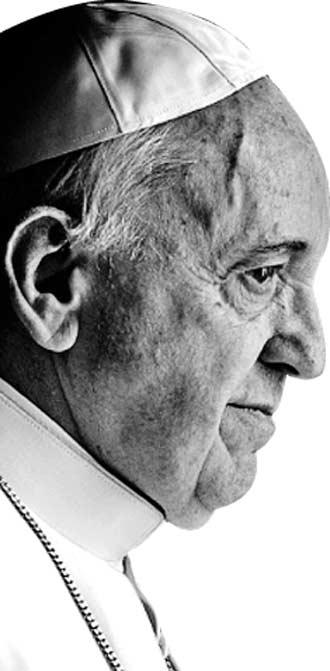 The world including Sri Lanka received the news about the demise of Pope Francis, the spiritual head of 1.4 billion Catholics in the world making thousands across the globe to express their sadness on social media and through other means.
The Vatican announced the death of Pope Francis around 11.30 local time and 7.30 Roman time.
Pope Francis, who was the 266th Pope of the Catholic Church, died at the age of 88. He was battling respiratory conditions for weeks and was hospitalised during early March.
The Archdiocese of Colombo joined the Universal Church in mourning the passing of His Holiness Pope Francis, who returned to the House of the Father on Easter Monday, 2025-04-21, this morning, at the age of 88. “All churches in Sri Lanka were asked to sound bells, which is a tradition of the church whenever there is a bereavement of an important person or any Catholic in a given parish,” Director Mass Communications Catholic Church in Sri Lanka Fr. Jude Krishantha said.
“It will be requested that all Catholic houses and institutions hoist the Catholic Flag at half-mast from today,” he said.
Sri Lankan President Anura Kumara Dissanayake, who paid a tribute to the Pope, said he left an indelible mark on the world through his unwavering commitment to peace, compassion and humanity.
Shortly after the official announcement of a pope’s death, Vatican officials start the process of confirming his death. This responsibility typically falls to the Vatican health department and the Camerlengo. The acting Camerlengo, Cardinal Kevin Joseph Farrell, aged 77, will be tasked with confirming the death and overseeing the initial arrangements. Then the pope’s body will be moved to his private chapel. The body will be dressed in a white cassock and laid in a zinc-lined wooden coffin, underscoring both reverence and continuity of ritual. Vatican procedures indicate that his mitre and pallium will be respectfully set aside, while his body will be adorned in red vestments, in keeping with longstanding custom. In a symbolic ritual marking the end of a papacy, the pope’s official signet, commonly known as the “Fisherman’s Ring,” will be ritually broken. Historically, the Camerlengo carries out this task using a special hammer to crush the ring—a poignant gesture that prevents any possibility of false use and visually confirms the conclusion of the pontificate.
Usually after a papal death, the Vatican declare a nine-day mourning period known as Novendiale. During these nine days, various services and memorials will be held, allowing Catholics to pay tribute to Pope Francis and mourn his passing. The most poignant event of this period will likely be the public exhibition of the pope’s body.
In a departure from earlier traditions, the embalmed body will not be placed on a raised platform or catafalque but will likely remain in its coffin.
This aligns with Pope Francis’ preference for simplicity and his expressed dislike of elaborate arrangements for his death. A formal procession is expected to transport the body to St. Peter’s Basilica, where thousands of worshippers, officials, and international observers will visit to pay their respects. During this period of mourning, the Vatican will be in a state known as sede vacante, which means “the seat is vacant.”
This transitional period places the administration of the Church in the hands of the College of Cardinals. While the cardinals will manage routine matters, no major decisions will be made until a new pope is elected.
Traditionally, a pope’s funeral is held a few days after death. In Pope Francis’ case, the funeral is expected to take place four to six days after his passing, followed by up to nine days of additional ceremonies. These ceremonies are typically conducted in various churches in Rome to facilitate religious and public commemoration.
Historically, popes were entombed in three nested coffins made of cypress, zinc, and elm. However, in accordance with his humility, Pope Francis is expected to be buried in a single wooden coffin lined with zinc.
At the funeral, it is customary for the coffin to be sealed following the placement of a white silk cloth over the pope’s face—a symbolic gesture marking the transition from life to eternal rest. Additionally, a bag of coins minted during his reign and a document known as the rogito might be placed inside the coffin.
The rogito, which outlines the life and accomplishments of the Pope, is traditionally read aloud before the coffin is sealed. As per ancient tradition, Pope Francis will be buried in the Basilica of St Mary Major — a church he frequented for private prayer and contemplation, fulfilling his personal wishes.
The conclave, which is the process of electing a new pope, will take place in 15 to 20 days. During this interim period, the College of Cardinals, which temporarily oversees the Church, will prepare to elect a new pope.
The conclave is expected to be presided over by Cardinal Giovanni Battista Re, 91, the current dean of the College of Cardinals. Only cardinal electors. Those under the age of 80, numbering no more than approximately 120, are eligible to participate in the voting process.
The election takes place in the Sistine Chapel in a private, highly controlled environment, ensuring that the decision is reached free from external influence.
The dean typically oversees the conclave, but since the Cardinal is over 80, he will not be eligible to vote. In this case, the sub-dean or a younger senior cardinal is likely to take his place.