Reply To:
Name - Reply Comment
By Sheain Fernandopulle
 The Thai woman who made headlines for walking topless near a hotel in Arugam Bay, had undergone a sex reassignment surgery four years ago, transitioning from male to female.
According to police, the tourist is biologically male, though ‘she’ had undergone a full surgical transition.
The incident came to public attention when images of the topless tourist surfaced on social media prompting police to arrest her on July 14 for indecent behaviour and causing a public disturbance.
She was then handed a suspended five-year prison sentence after being produced before the Pottuvil Magistrate’s Court where she pleaded guilty.
The court imposed a sentence of two weeks’ imprisonment for indecent behaviour and one month for causing public disturbance, both suspended for five years.
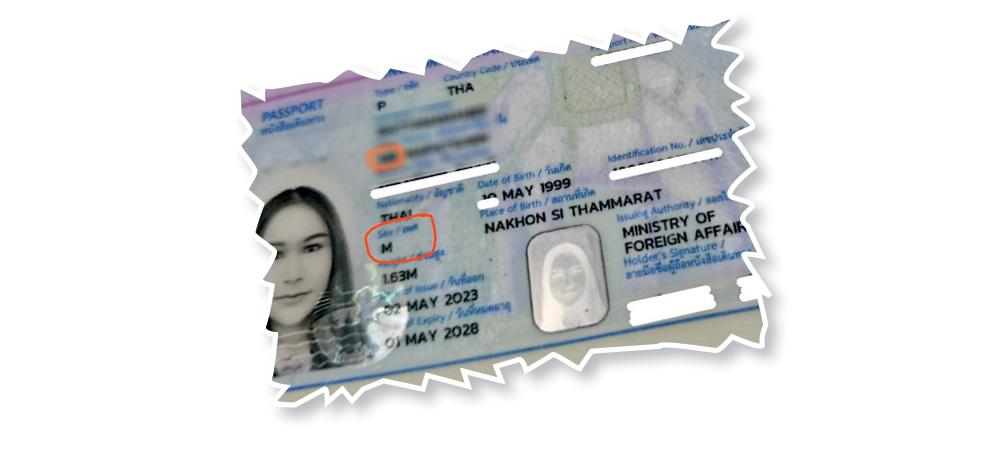
While the court accepted her self-identified gender as female during proceedings, the situation has taken a dramatic turn after a photo of the Thai national’s passport, also shared online, shows the sex listed as ‘M’ (male) and includes the title ‘Mr.’
This has raised questions about how gender is interpreted legally in Sri Lanka, especially in cases involving public decency laws.
The discrepancy between her physical identity and official documentation has ignited debate about the rights and recognition of transgender individuals in legal systems that may not fully accommodate gender diversity.
It was revealed that she had arrived in Sri Lanka accompanying a US national and had booked accommodation at a tourist hotel in Arugam Bay from the 11 to 20.
By Lakmal Sooriyagoda
In Sri Lanka, public nudity for both men and women is prohibited under several laws and regulations. Public nudity remains strictly prohibited under a combination of criminal statutes and public morality laws.
The legal framework governing this issue reinforces the country’s cultural values and stance on decency and public behaviour, with several provisions outlining punishments for acts deemed indecent or disruptive in public spaces.
One of the primary legislative instruments addressing public behaviour is the Vagrants Ordinance No. 4 of 1841, which contains multiple provisions relevant to public nudity and indecency. Under Section 2 of the Ordinance, individuals behaving in a “riotous or disorderly manner” in any public street or highway are liable to a fine. While this provision broadly addresses disorderly conduct, it provides a foundation for penalizing behaviour deemed inappropriate in public settings. More explicitly, Section 7(1)(b) of the Vagrants Ordinance criminalizes acts of gross indecency in public. The section states:
“Any person found committing any act of gross indecency, or found behaving with gross indecency, in or about any public place shall be liable on summary conviction to imprisonment of either description for a period not exceeding six months, or to a fine not exceeding one hundred rupees, or to both.”
These provisions are frequently invoked by law enforcement to take action against acts such as public nudity, regardless of the gender of the individual involved.
Recently, the Kadugannawa Police arrested and produced in court a young man who was riding a motorcycle naked along the Colombo-Kandy Road.
In addition, the Obscene Publications (Amendment) Act, No. 22 of 1983 further outlines offenses relating to the publication, distribution, and display of obscene material in public. While focused on media and publications, the Act reflects the broader public policy of discouraging obscenity and protecting societal morals.
The Penal Code of Sri Lanka also reinforces this legal stance through Section 261, which defines public nuisance. According to the Code:
“A person is guilty of a public nuisance who does any act, or is guilty of an illegal omission, which causes any common injury, danger, or annoyance to the public... A public nuisance is not excused on the ground that it causes some convenience or advantage.”
This provision emphasizes that even if a particular act, such as public nudity may be perceived by some as a form of expression or comfort, it remains punishable if it disturbs public order or morality.