Reply To:
Name - Reply Comment
By Yohan Perera
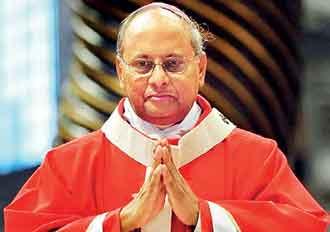 Referring to the reports on social media that Archbishop of Colombo Cardinal Malcolm Ranjith is a contender for the papacy which has fallen vacant with the death of Pope Francis, a spokesman for the Catholic Church in Sri Lanka said there is no such thing called contenders for the papacy.
“There is no such thing called contenders for papacy. Anyone out of the 252 in the College of Cardinals can be elected as the next pope,” Member of the Communications Committee Archdiocese of Colombo Fr. Cyril Gamini Fernando told Daily Mirror.
The 117 cardinals who are eligible to vote will elect the new pope,” he said.
Meanwhile, National Catholic Mass Communications Director Fr. Jude Krishantha told media that Cardinal Ranjith is a popular figure among the College of Cardinals. “I only said that Cardinal Ranjith is eligible to be elected for papacy. I never said he is a close contender,” Fr. Krishantha told Daily Mirror. The new pope will be elected by the College of Cardinals who will assemble in Rome, usually 15-20 days after the pope’s death. They will gather at the Sistine Chapel to begin their deliberations.
The cardinals swear an oath of absolute secrecy, and are not permitted to have any contact with the outside world for the duration of the election process. Their phones are removed while no newspapers, television, letters or messages are allowed. The chapel is also swept for listening devices before and during the conclave. The cardinals sleep and eat in a purpose-built hostel, St Martha’s house, near the Sistine Chapel
The conclave begins with a celebration of mass, after which deliberations and voting begins. Votes are taken each day, morning and afternoon, until a candidate wins a two-thirds majority. There is a day’s break for prayer and reflection after every seven ballots. The longest papal conclave in recent history was in 1922, when the cardinals took five days to choose their new leader.
Any baptized male can be elected as pope, although a serving cardinal is invariably chosen. Each elector is given a ballot card with the words eligo in summum pontificem (I elect as supreme pontiff) printed at the top. They insert the name of their choice, fold the card and drop it into a chalice. The ballot is secret, but that does not mean the process is immune from factionalizing, intrigue and lobbying.
After each round of voting, the ballot cards are burned. Chemicals are added to make the smoke black or white. Black smoke emerging from the 60ft chimney indicates that no one has been chosen while white smoke announces to the world that a new pope has been elected.
The successful candidate is asked if he accepts election and, if so, which name he chooses to take as pontiff. The cardinals pledge obedience to the new pope, who is led into the adjacent Room of Tears to be dressed in a white cassock and skull cap, and red slippers. Three sets of vestments in different sizes are made by Vatican tailors in advance.
The dean of the cardinals steps on to the main balcony of St Peter’s Basilica, in front of which thousands of Catholic devotees and tourists will be gathered. The dean will declare: “Annuntio vobis gaudium magnum: Habemus Papam in Latin. This means ‘I announce to you with great joy: We have a pope.” The name of the cardinal who has been elected pope and the new name he has chosen will be announced then.