Reply To:
Name - Reply Comment
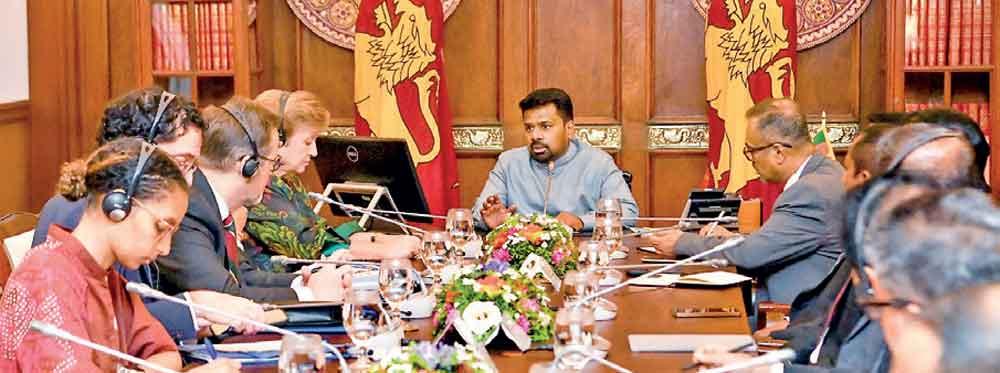
With the current government committed to good governance and anti-corruption reforms, visiting Managing Director of the International Monetary Fund (IMF), Kristalina Georgieva said that Sri Lanka now has a unique opportunity to accelerate development and achieve sustained economic progress.
She said this when she met President Anura Kumara Dissanayake last morning (17) at the Presidential Secretariat to discuss Sri Lanka’s economic recovery, post-disaster assistance and the next phase of the IMF-supported reform programme.
Discussions focused on how the IMF could continue to provide the most effective support to Sri Lanka under the ongoing programme, which has contributed to restoring macroeconomic and financial stability.
The Managing Director noted that the partnership between Sri Lanka and the IMF is delivering tangible benefits for both the economy and the public and that the intention is to continue along this path while pursuing higher ambitions for growth and productivity.
Ms Georgieva observed that Sri Lanka has faced multiple shocks, including the civil conflict, the tsunami, terror attacks, the pandemic and governance challenges, which had constrained long-term growth.
With the current government committed to good governance and anti-corruption reforms, she noted that Sri Lanka now has a unique opportunity to accelerate development and achieve sustained economic progress.
The IMF - MD highlighted the importance of achieving higher growth rates of around 7–8 per cent to meet the aspirations of the public, alongside strengthening disaster preparedness through improved early warning systems. Emphasis was also placed on enhancing governance and institutional performance, including the implementation of the Governance Diagnostic Assessment, in which Sri Lanka is the first country in Asia to participate. Strengthening public investment management and addressing strengthening and promoting opportunities to private sector investment were also identified as key priorities for supporting long-term growth.
Agricultural productivity and rural economic transformation were key areas of focus. It was noted that a significant share of the population is engaged in agriculture while contributing a relatively smaller portion to GDP, underscoring the need for a medium-term strategy to enhance productivity and diversify employment opportunities in rural areas while preserving land ownership and cultural traditions.
Collaboration with development partners, including the World Bank and the Asian Development Bank, was also discussed in relation to sectoral development and investment promotion.
President Anura Kumara Dissanayake welcomed the IMF Managing Director and appreciated the continued support extended to Sri Lanka during a period of severe economic hardship. He noted that international cooperation had been instrumental in stabilising the economy and improving the living conditions of the public, particularly vulnerable groups affected by recent crises. He reaffirmed that extending the benefits of economic recovery to every citizen, stands as a paramount priority of the Government.
The President highlighted the Government’s ongoing efforts to rebuild the economy while addressing the immediate needs of the people, including resettlement and housing for families displaced by disasters and landslides, as well as ensuring access to basic services such as water, electricity and other essential infrastructure in rural areas.
He emphasised that improving rural livelihoods, particularly through new economic opportunities beyond traditional agriculture, remains a key priority of the Government’s development agenda.