Reply To:
Name - Reply Comment
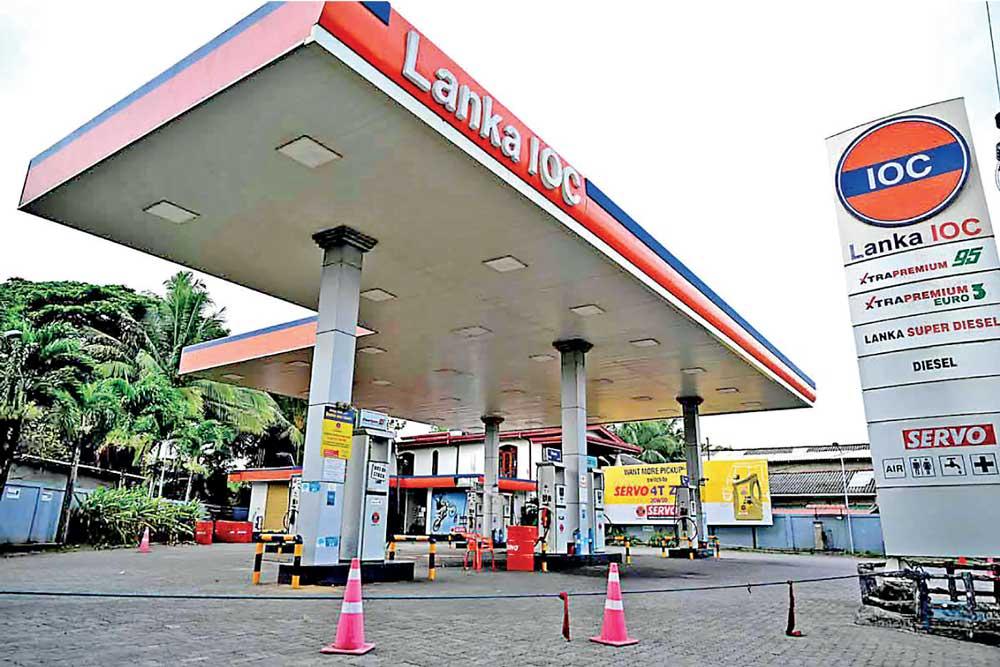
Lanka IOC dealers accuse its management of not increasing the dealer commission that was trimmed from March this year despite gaining profits in billions of rupees annually
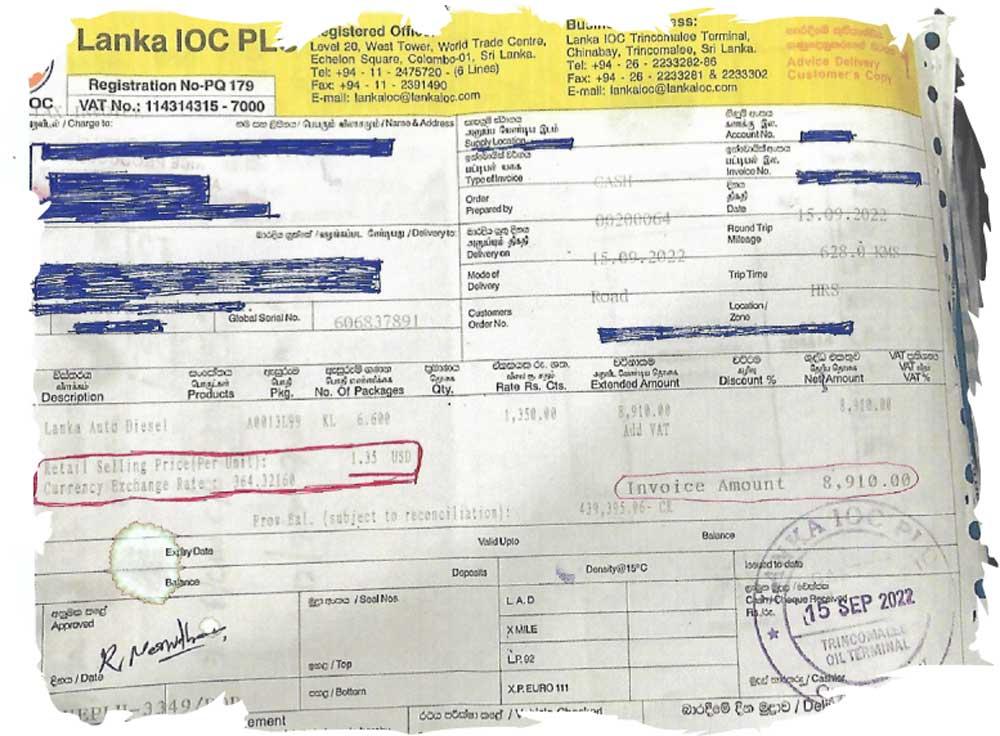
LIOC invoice issued to a factory selling fuel for US Dollars during the fuel crisis period
By Nirmala Kannangara
Petroleum dealers of Lanka Indian Oil Company PLC (LIOC) are up in arms against its management for the failure to ‘raise the dealer commission’ that was pruned, despite gaining profits in billions of rupees annually.
Following the new scheme implemented by the Ceylon Petroleum Corporation (CPC) to withdraw the 3% dealer margin, paid over the past several years as and when the retail price was determined, LIOC too followed suit although the other two contenders in the market- RM Parks and SINOPEC- continued to pay their dealers the 3% commission.
CPC implemented the new dealer commission scheme from March 1, 2025, without consulting their dealers. However CPC sent their dealers prior notice regarding their intended plan. But, LIOC failed to consult their dealers before this scheme was introduced. According to these dealers, not even a WhatsApp message had been sent to them informing them of the decision to slash the dealer margin and pay them a flat rate of Rs. 6.96 per litre in future.
According to these dealers, although LIOC had entered into contracts with them when offering the dealerships, when slashing the 3% without being informed is a violation of their contracts. They maintain that this decision has been taken unilaterally.

“A percentage of the taxes we pay on fuel to the General Treasury is being utilised to offer relief to the people and the rest to develop the country. Why should the government pay a certain percentage of this tax which is given to petroleum dealers as a commission”
- Dr. Mayura Neththikumarage CPC Managing Director
“How can the LIOC management unilaterally violate the contracts? We were paid this 3% from 2016 when there were only CPC and LIOC in the petroleum retail business. Before the other two contenders entered the market, a new pricing formula was implemented in 2023 by the Finance and Energy Ministries. This method was carried out till February 28, 2025. However with the implementation of the new scheme, LIOC dealers were promised a flat rate of Rs.6.96 commission per litre whilst CPC introduced the new bowser load slabs for their dealers. Under the new scheme, for the CPC dealers Rs. 6.96 is paid per litre for the first fifteen loads. From the16th to 30th loads the commission has been brought down to Rs 6.28 per litre. This has been further scrapped to Rs. 5.42 per litre for the loads from 31st to the 60th. From the 61st load up wards a mere Rs. 4.58 is paid per litre. These rates are for the petrol stations that have businesses, but this varies for the shed that has lesser business,” sources from the Petroleum Dealer Association who wished to remain anonymous told this newspaper.
According to LIOC sources, requests were made to the LIOC management to reconsider paying the dealer margin of 3%. As an alternative, a proposal has also been made requesting the payment of Rs. 10.38 per litre. This is to ensure that dealers can earn a risk free rate of return for investment. They further stated that the other two private companies in the market are continuing to pay a dealer margin of 3% without following the procedures adopted by CPC or LIOC.
 According to the sources, R. M. Park and SINOPEC have not their dealer margins and have granted more lucrative and attractive packages to retain their present dealers and attract new dealers.
“We came to know that many CPC and LIOC dealers are contemplating on working with these two new contenders as they have extended attractive schemes by offering a good rate of return on their investment,” sources added.
The dealers who met LIOC Managing Director Dipak Das on April 10, 2025, maintain how the management tried to hoodwink them by saying that they are incurring losses from the petroleum business over the years, hence the reason why they cannot grant a higher dealer commission as requested.
“When we met Mr. Dipak Das on April 10, 2025, to discuss this issue, we were told that LIOC is making losses and finding it difficult to operate the business given the present situation. How can Mr. Das say so when LIOC Annual Reports from 2019 to 2024 clearly reveals how much profit they have accumulated over the last five years? According to these reports, the gross profits they have gained during 2019/ 2020 was Rs.4, 106 million, in 2020/ 2021 it was Rs 3, 113 million, in 2021/ 2022 it was Rs.2, 845 million, during 2022/2023 the gross profit was Rs. 54, 182 million and for the period 2023/ 2024 it was Rs.24, 108 million. Their total assets too has increased between 2019 and 2024. In 2019/20 the total assets were Rs 39,760 million, in 2020/21 it was Rs 46, 407 million, in 2021/ 22 Rs 65, 071 million, during 2022/23 Rs.82, 213 million, in 2023/ 24 Rs.101, 795 million,” sources said.
Profits through other businesses
Although LIOC dealers maintain that the company has gained huge gross profits during the past five years, when this newspaper met LIOC MD Das, he said that LIOC is gaining profits because they are into lubricant, bunkering and different other businesses as well.
“We are making profits from our other businesses which is recorded in our Annual Reports as a whole,” Das said.
However, LIOC sources queried as to how Das can claim so, when he himself specifically had told the dealers when he met them recently, that 80% of their income is generating from the petroleum retail business.
At a meeting with Das, members representing the Petroleum Dealers Association (PDA) has requested to revise the dealer commission. They had maintained that as an association, representing all fuel distributors in the country, they are continuing to engage in a dialogue with CPC to resolve the matter.
The sources revealed how Das had told them that whilst LIOC was incurring losses the dealers have made undue profits, which according to them is wrong.
“We never gain any profits, but during the fuel crisis, LIOC gained huge profits not by selling fuel to the general public, but to factories for US Dollars. When the people were in queues near petrol stations, LIOC sold their stocks to factories to operate their machines. These stocks were sold not for rupees, but for US Dollars and we have all documents to prove this if LIOC refutes our claim,” sources said.
Further to this discussion, PDA members by ‘letter’ dated April 11, 2025, to Das, has stated they are disappointed to note how the LIOC management has taken a completely negative approach in addressing the most critical issues that their association is faced with.
The letter further states, ‘We expected you to be much more business friendly and understand the actual situation of your own distributor network, which brings the company the much needed businesses by delivering LIOC products to the final users by using assets built utilising their own funds for which you have a moral, ethical and business commitment to protect the dealers in return.
‘We would like to draw your attention to the fact that you highlighted at the meeting that LIOC is incurring losses and finding it difficult to operate the business which is disproven with your own financial statements.
‘As we can clearly see, LIOC has been very efficient in managing the business and providing above satisfactory returns to your investors and shareholders by way of exceptional performances throughout last five years. You have shown exceptional profits during the financial year 2022/ 23 and an accumulation of wealth by way of retained earnings and total assets which is very impressive, whereas we, being your own distributors are deprived of at least minimum risk free rate of return on our investments. As you are well aware, year 2022/23 was a very difficult period with lots of volatility in the market the world over and that there was a silver ray with golden return during that time for corporate entities including LIOC. While you have recorded an impressive gross profits during the last five years, your statement that we as members of the association made undue profits is an accusation that others could re-direct at you. Therefore we would earnestly request you to be more pragmatic and apply the same justification and explanations in describing the business performances of corporate entities, which include you and us as partners in the business. Let’s make sure that our rights are honoured and respected as we do this business as partners in the same industry.’.
‘We would like to bring to your attention that the Ministry of Energy has requested the approval from the Cabinet through their Cabinet memo No: 23/2025/E, dated February 25, 2025 that marketing companies in the petroleum industry other than CPC be allowed to introduce their own dealer commission schemes to optimise their cost structures, remain competitive and foster innovation within the industry. Therefore we do not see any obstacles in introducing an appropriate dealer margin scheme by LIOC as requested by the Dealer Association to remain profitable in the industry.
‘In case LIOC prefers a constant and predefined rate without making variable percentage rate payments according to bowser load slabs or selling price of fuel, we would like to propose that Rs. 10.38 be paid to the dealers to ensure that at least they would earn a risk free rate of return on their investment which is available in the market currently.
According to the sources, with the proposed new labour laws to increase the minimum basic salary of an employee to Rs.27, 500 per month, the pruning of dealer commissions has dealt a severe blow to the existence of the dealer business.
“The proposed minimum wage will increase by approximately Rs. 9,750 per employee including EPF, ETF, workman compensation insurance and other statutory payments. In addition we have to provide uniforms, welfare facilities and other incentives for our employees,” sources claimed.
According to CPC Managing Director Dr. Mayura Neththikumarage, the reason why the CPC decided to remove the 3% dealer margin was due to the undue financial benefits their dealers enjoyed over the years.
“After the Finance Ministry introduced tax on fuel a few months ago, the dealers received their commission even from this tax potion which is borne by the general public. A percentage of the taxes we pay on fuel to the General Treasury is being utilised to offer relief to the people and the rest to develop the country. Why should the government pay a certain percentage of this tax which is given to petroleum dealers as a commission? Although the previous governments did not consider this, we as the members of the new government had lengthy discussions with the stake holders and decided that the commission paid to dealers from this tax component should be cut off,” Dr. Neththikumarage said.
According to him, the price of a litre of fuel is decided by the Finance Ministry in consultation with the Ministry of Energy.
“There are five components that are taken into consideration when fuel prices are determined. They are- Import/ product cost, product handling cost, marketing companies’ fixed and variable component margin, government taxes and the dealer margin. Based on the actual price of the previous month, the prices are determined. If there are no price changes in fuel, it means that there were no major price changes of these components during the previous month, but maybe a mere price increase or decrees which is not considered for any price revision,” Dr. Neththikumarage said.
However, PDA sources said that the dealer margin calculated using the current percentage point system has taken into consideration applicable taxes for fuel at the point of import and processing. Hence these sources point out that the claim which states that this calculation allowed extra earnings for dealers is flawed in its validity and logic.
“We are very confident that the DG CPC has sufficient knowledge and experience to understand how product pricing is done in the market for any product. We understand that no one in the market calculates applicable retailer, distributor or modern trade margin by eliminating applicable taxes at the point of invoicing. CPC is the sole authority to determine the maximum retail price of fuel in the country. All taxes are compounded within the stipulated maximum retail price which has never benefited dealers. Instead it has directly resulted in 18% reduction of the income of dealers as all the dealers are requested to pay VAT on their commission earned as output taxes in its entirety as there is very little Input Tax available to settle against the Output Tax,” PDA sources said.
Although LIOC told this newspaper that they spent around Rs100,000 monthly for each petrol station to maintain the fuel tanks and pumps, the dealers refutes this claim. LIOC in response said, “Unlike other Oil companies, we provide as well as maintain tanks and pumps even for franchise retail outlets under annual maintenance contracts which includes preventive and breakdown maintenance”.
When asked how it is possible for LIOC to violate their agreements with the dealers unilaterally, the LIOC said that they do not agree to it.
“We do not agree to the above,” LIOC said.
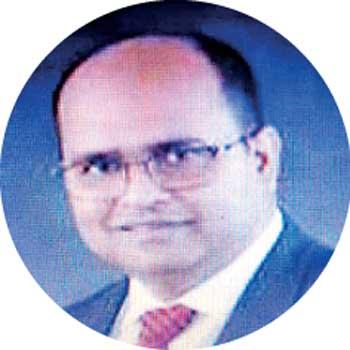 Meanwhile Managing Director LIOC, Dipak Das told this newspaper that it was the CPC that considered to revise the dealer commission although LIOC still pays a better commission compared to the commission paid by the CPC to its dealers.
Das sent the following comments in this regard by email.
“Retail selling price of petroleum products are finalised by the Energy Ministry based on a cost reflective formula which includes dealers’ commission. Till March 1, 2025, the amount of dealers’ commission considered in the pricing formula was approximately 3% and the same amount of commission was paid to the dealers by Lanka IOC. The Government has undertaken a comprehensive study in the recent past to ascertain the cost structure for operating a petroleum shed. Based on this study, a revised commission structure has been determined, which is lower than the previous commission. It is also understood that the study was undertaken to ascertain reasonable return to the dealers based on actual expenditure and to avoid excess payments which is ultimately borne by the customers.
“It is understood that the revised reduced dealer commission has been considered for determining the Retail Selling Prices with effect from March 1, 2025, by the Ministry. Accordingly, LIOC implemented the same reduced dealers’ commission as implemented by the leading Public Sector Oil Company. LIOC is committed to pass on the same dealers’ commission to our dealers which has been considered in the pricing formula for ascertaining Retail Selling Price (RSP) by the Ministry on monthly basis. Payment of higher commission than the one considered in the pricing formula will lead to under-recovery and is not financially sustainable for LIOC.
“For over two decades, Lanka IOC has been a trusted partner in Sri Lanka’s progress. Through times of growth and hardship, we have stood shoulder to shoulder with the nation. As acknowledged by Government officials, Lanka IOC has worked tirelessly to fulfill the energy requirements of the country, especially during the energy crisis operating the Trinco terminals 24/7, full filing the requirements of essential services & industrial sectors.
When requested for a comment for the allegations LIOC dealers level against the company on giving preference to sell fuel to factories for US Dollars by depriving their own longstanding customers who were in queues near LIOC petrol stations, the Managing Director said that it is mere a baseless allegation and has no relations to the issues of revision of dealer commission.
“This is a baseless allegation aimed at maligning the reputation and goodwill of the company by a section of people with vested interest. It has been acknowledged by Government officials that Lanka IOC has worked tirelessly to fulfill the energy requirements of the country, especially during the energy crisis by operating the Trinco terminals 24/7, full filing the requirements of essential services and industrial sectors”.