Reply To:
Name - Reply Comment
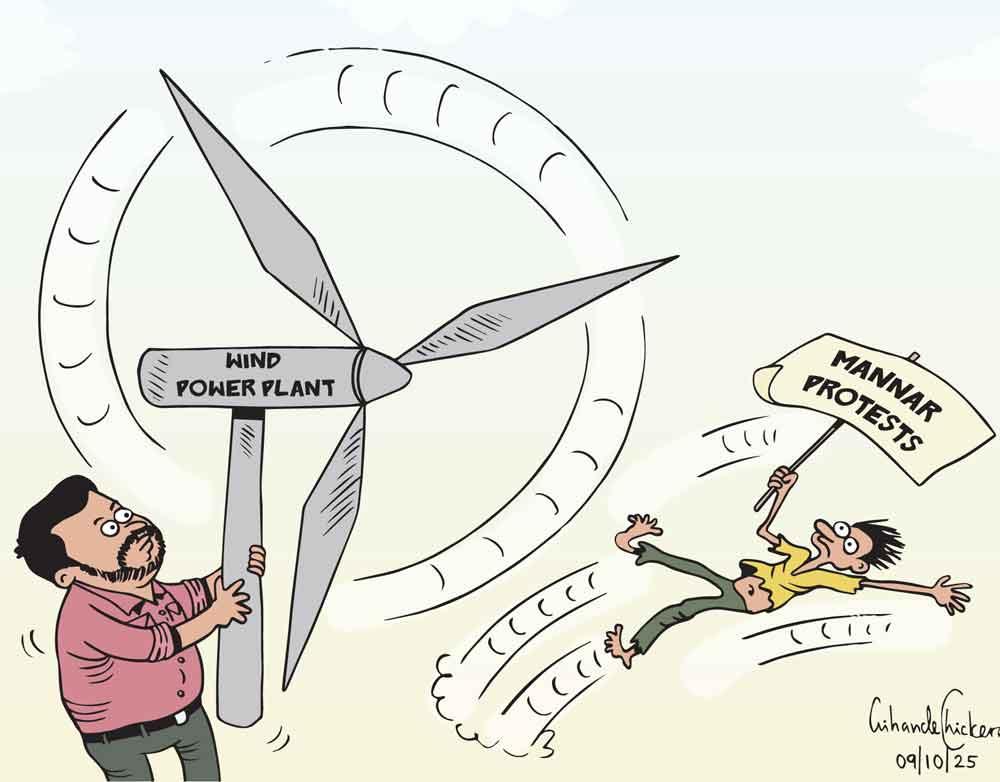
The cartoon offers a biting critique of how “development” projects—particularly in the renewable energy sector—can sweep away those they claim to benefit. It depicts a man, likely representing the government or an official figure, turning the blades of a massive “Wind Power Plant.” One of the spinning blades carries away a helpless protester clutching a sign that reads “Mannar Protests.”
The image captures the paradox of progress: clean energy, symbolized by the wind turbine, is supposed to represent sustainability and a greener future. Yet here, it becomes an instrument of displacement and silencing. The protester, representing local communities, is literally blown away by the force of the project—an eloquent metaphor for how development often marginalizes the very people it affects most.
The cartoon’s genius lies in its duality. On one hand, the Wind Power Plant signifies modernization, innovation, and environmental consciousness. On the other, the human cost is made painfully clear—the powerless are physically and politically swept aside. The protester’s terrified expression and tattered clothes underline the socio-economic divide: while policymakers praise progress, the poor bear its impact.
The Mannar Protests reference grounds the image in a real context—the local opposition to large-scale wind power projects in Sri Lanka’s Mannar district, where concerns about environmental damage, land rights, and community displacement have been largely ignored. The cartoon suggests that the rhetoric of “green energy” is being used to mask a familiar pattern of exploitation: replacing fossil fuels with wind, but not inequality with justice.
At its sharpest, the image exposes a global hypocrisy. Sustainability cannot be measured by megawatts alone—it must include social consent, fairness, and respect for people’s lives. Otherwise, renewable energy becomes just another form of power—one that spins relentlessly, indifferent to those caught in its path.
The question the cartoon leaves us with is piercing: when the winds of progress blow, who truly feels the breeze—and who gets blown away?