Reply To:
Name - Reply Comment
By Srilal Miththapala
I published an article titled ‘Sri Lanka and the Middle East War: Life and Business as usual or face reality?’ (https://lnkd.in/gV5uSzyF), during the last week of March 2026, in the Daily Mirror.
There now seems to be a false sense of complacency that has set in at government level. Life seems to be going on as usual, with no sense of any impending crisis. These are some follow-up thoughts.
There seems to be an uneasy calm now, in the Middle East, however temporary. Perhaps a faint light at the end of the tunnel. But regardless, there is absolutely no room for complacency.
The fighting has ceased but now a much more dangerous economic war is unfolding, which is having an impact all over the world.
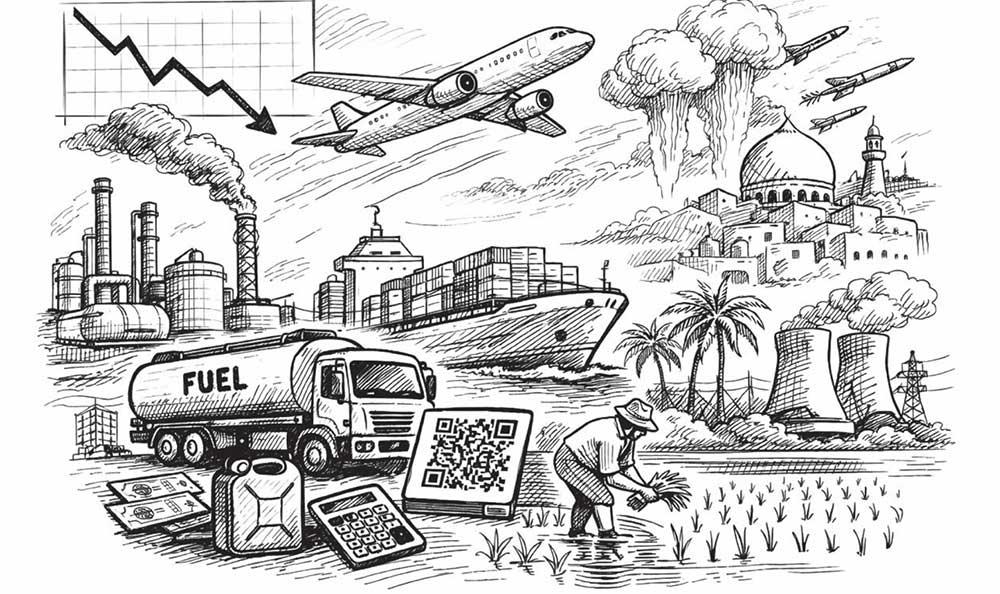
Already the world over there is:
The economic experts the world over and the International Monitory Fund, World Bank, Asian Development Bank and European Union, all warn of the impending danger in the long term (six to 12 months), even if hostilities were to cease immediately. Asia and in particular Sri Lanka, will be most vulnerable.
All South Asian countries have implemented strict energy and fuel saving measures. Sri Lanka also did creditably well initially with fuel rationing via QR codes, compulsory mid-week holidays and energy saving guidelines for offices.
But what has happened now? One can fill up the fuel tank at most petrol stations without too many restrictions (regardless of QR or odd and even days); we are back to full-week working (productivity in the government offices is of course another matter) and energy saving guidelines are all forgotten.
All because we got a couple of shipments of fuel? We may be having reasonable reserves but how can we predict what the cost of oil shipments and other essential imports will be in the future? Will our reserves be enough? Are we immune to the impending crisis? Complacency has set in.
While Sri Lanka has certainly built-up good reserves and the economy was showing good recovery, we may be heading into the ‘perfect storm’, which the reserves may not cushion us from.
Power shortages
To add to Sri Lanka’s woes, according to the Meteorological Department, there may be a drought in the near future. This would inevitably increase reliance on thermal power generation, requiring scarce diesel and heavy fuel oil.
Sri Lanka has limited storage capacity for fuel and the throughput from the refinery is constrained. In addition, we rely on about one-third of our power generation on coal power, which obviously needs uninterrupted coal shipments, which already have problems. For the first time, Sri Lanka’s max power demand is exceeding 3,000 MW and there are already reports of selective load shedding being resorted to manage the peak load.
On April 20, the day’s power requirements have been met with 15 percent solar, 19 percent from hydro, 24 percent from coal (although the coal plant should generate about 40 percent of our power requirements at low cost).
More alarmingly, to offset the shortage, diesel generation (both private and government) has accounted for 37 percent! With diesel becoming very costly, due to the ongoing war and unreliability of supply, this is quite serious!
So, all in all, the power production situation does not look too good and unless some drastic action is taken immediately, power cuts seem to be on the horizon.
Water shortages
There were reports of significant water shortage and there was a flurry of activity with water cuts announced and wide publicity given to conserve water. A few isolated showers and where have all these initiatives disappeared today? Have the catchments miraculously got filled up?
Forex – tourism and worker remittances
There is also the issue of foreign exchange. Sri Lanka is still walking a very tight rope and higher fuel import costs will inevitably put pressure on the external account.
At the same time, tourism, one of our key forex earners, is already showing a downturn of about 20 percent in occupancy, due to higher airfares, rising travel costs and disrupted connectivity through Middle Eastern hubs.
Long-haul travel is becoming more expensive and less convenient and travellers are beginning to defer or shorten trips. More concerning is that revenue has dropped by about 35 percent since the segments we have lost are the high-spending markets from the west.
The higher cost of jet fuel is resulting in airfares skyrocketing and being an island nation, we are almost totally dependent on airlines for tourism. So, regardless of the Middle East hub disruption, airline travel worldwide will also be disrupted.
Remittances from the Middle East, the largest foreign exchanging sector, may also come under pressure, if the economic conditions in that region weaken, although right now they seem to be unaffected. Already there are reports of workers being asked to stay away from work with their salaries halved.
Inflation
Another concern is food inflation. While headline inflation may still appear under control for now, the transmission of higher fuel and transport costs into food prices is only a matter of time.
Fertiliser supply constraints will also begin to affect the agricultural output in the coming Yala seasons. For a country where a large proportion of household income is spent on food, this could have serious social consequences.
SME sector
Industry and small businesses will also begin to feel the strain. Higher energy costs, unreliable supply chains and rising input prices will compress margins. Many businesses that have only just recovered from the last crisis may not have the resilience to absorb another shock. The SME sector, which forms a large part of the economy, will be particularly vulnerable.
If this so-called calm lulls us into complacency, then the next crisis will not be a surprise but it will be self-inflicted. With the recent New Year festivities, the government has ‘taken its foot off the pedal’, in my opinion. We cannot afford another cycle of denial followed by panic.
It is imperative therefore that the socialist policies must be set aside and there should be demand disruption created by the government by increasing the fuel prices, however unpalatable they may be.
Many experts in a seminar organised by the International Chamber of Commerce were of the view that diesel should be selling at around Rs.600 per litre.
Hence, what is now required is to accept reality and stop defensive thinking and implement a well-planned, disciplined and controlled slowdown.
Consistency in execution and follow-up is vital while clear cohesive communication is key to managing the unfolding situation. People will, by and large, tolerate inconvenience but they find it difficult to tolerate not knowing what comes next.
A responsible government needs to give leadership to the country and communicate honestly to educate the public on the actual situation, rather than play politics.