Reply To:
Name - Reply Comment
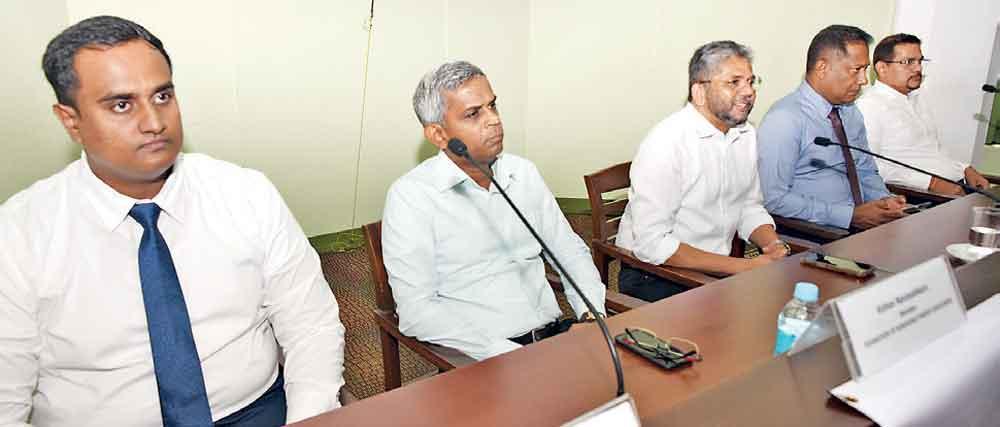
From left: The Federation of Renewable Energy Developers Member Afzal Muhammad, Kishan Nanayakkara (member), Federation President Manjula Perera, Federation Vice President Prabath Wickramasinghe and P.K Pathmanatha (member)
By Nishel Fernando
The Federation of Renewable Energy Developers has warned that Sri Lanka’s domestic renewable energy sector is on the brink of collapse, as the government continues to prioritise payments for expensive emergency thermal power over clean energy to cover generation shortfalls stemming from a controversial coal tender scandal.
Addressing a press conference in Colombo yesterday, industry representatives revealed that the National System Operator has entirely halted payments for renewable energy supplied to the national grid since December 2025 to finance fossil fuel generators.
With Rs. 2.5 billion falling due each month, the outstanding arrears have now ballooned to an unsustainable Rs. 10 billion as of April 2026. Despite these massive financial hurdles, independent producers currently contribute approximately 14 percent to the national grid - representing 1,073.9 megawatts of installed capacity across 389 plants - with ongoing projects expected to push this share to 20 percent over the next two years.
Federation President Manjula Perera elaborated on the direct and damaging link between the recent Norochcholai coal procurement controversies and the current non-payment crisis. The severe liquidity drain at the state utility stems from its desperate need to finance diesel and heavy fuel power generation.
This emergency conventional power is being utilised to manage a daily supply shortfall of 100 to 150 megawatts, a deficit directly caused by delays and operational inefficiencies resulting from the procurement of substandard coal. Recent audits into the Lanka Coal Company revealed that relaxed registration criteria allowed unqualified suppliers to secure multi-billion-rupee contracts, resulting in the delivery of low-grade coal with high moisture and pyrite content.
The use of this substandard fuel led to severe operational degradation at the Lakvijaya plant, forcing emergency shutdowns and creating a massive generation gap since late last year.
Driven by ongoing geopolitical tensions, the cost of generating emergency thermal power to plug this gap has skyrocketed, nearing or exceeding Rs. 100 per kilowatt-hour, effectively draining the treasury of funds meant for renewable energy payments. Industry veterans at the briefing pointed out a troubling historical pattern, noting that chronic payment delays have been a standard practice of successive governments, effectively discriminating against local small and medium-scale entrepreneurs in the renewable sector.
“It is fundamentally unfair for conventional fossil fuel generators to receive preferential treatment for disbursements while the renewable energy sector, which provides significantly cheaper power, is starved of its rightful dues,” Perera stated.
He further stressed the need for an urgent pricing adjustment. “Our developers are struggling under existing agreements. We are currently operating at tariff rates of Rs. 22 to Rs. 25 per kilowatt-hour, but with surging maintenance and equipment costs, we are formally seeking an increment to Rs. 35 per kilowatt-hour just to remain financially viable,” he added.
The ongoing payment crisis has devastated close to 400 local companies across the country. The affected capacity currently bearing the brunt of this non-payment includes 134 ground-mounted solar plants, 221 mini-hydro facilities, 20 wind installations, and 14 biomass and dendro projects. Power plant owners are increasingly unable to service their bank loans, a situation that threatens to trigger a massive wave of non-performing loans within the banking sector and risk broader economic instability.
“Many company owners have completely exhausted their personal funds to keep operations afloat,” explained Federation Secretary Lasitha Wimalaratne, warning of the imminent fallout affecting the workforce. “If these outstanding payments are not released promptly, thousands of employees, including our technical staff, engineers, mechanics, and administrative workers, face the immediate prospect of going without their salaries next month.”
The payment freeze is also causing severe operational stagnation across the industry, effectively stalling the integration of crucial new technologies. Modernizing the grid requires significant investments in battery energy storage systems to capture excess renewable generation and ensure continuous stability.
However, developers are entirely blocked from securing bank financing for battery storage infrastructure due to the state utility’s ongoing default on existing obligations. Without consistent revenue, operators cannot even purchase the essential spare parts required for routine maintenance. This will inevitably lead to plant breakdowns, forcing the state to rely even more heavily on expensive thermal power and worsening the national energy deficit.
To avert the complete collapse of the sector and prevent reciprocal damage to the broader economy, the federation issued an urgent call to action. They demanded immediate intervention from the Ministry of Finance and the General Treasury, suggesting that if the National System Operator cannot secure commercial funding due to its status as a new corporate entity lacking collateral, the state must step in.
The federation specifically requested a Cabinet directive to expedite financial solutions and insisted that if the government or Treasury issues any financial grants, Rs. 10 billion must be strictly allocated to clear the dues owed to renewable energy developers. Stifling the renewable sector in this manner actively derails the nation’s long-term climate targets and jeopardises Sri Lanka’s sovereign credibility with international funding agencies.