Reply To:
Name - Reply Comment
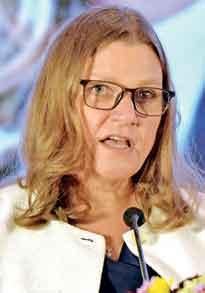 |
| Shannon Cowlin - Pic by Pradeep Pathirana |
Sri Lanka’s repeated exposure to economic, climate and geopolitical shocks has reversed years of development progress and pushed more households into economic hardship, the Asian Development Bank (ADB) said yesterday.
It warned the country’s recovery remains vulnerable to fresh external risks despite recent economic stabilisation.
“These shocks have tested the resilience of the country and its people, pushed many households into poverty, and reversed hard-won development gains, including for families that were previously more financially secure,” newly appointed ADB Country Director for Sri Lanka Shannon Cowlin said while speaking at the CEPA International Conference on Poverty and Development in Times of Crisis yesterday.
“They have also exposed deep social vulnerabilities and long-standing structural weaknesses in the economy.”
Noting that Sri Lanka had faced multiple disruptions over the past three decades, including the tsunami, terrorist attacks, the Covid-19 pandemic, the 2022 economic crisis and most recently Cyclone Ditwah, Cowlin cautioned that the ongoing conflict in the Middle East is creating fresh external risks for the economy.
Sri Lanka is currently navigating its recovery under an IMF-backed reform programme amid concerns over the potential impact of higher global oil prices, inflationary pressures and disruptions to tourism and trade linked to the Middle East conflict.
Cowlin acknowledged that Sri Lanka’s recent economic rebound had been “remarkable”, but stressed that vulnerabilities remained and reforms must continue to support long-term, inclusive growth.
“Crises, while having harsh consequences, especially for the poor and vulnerable, also create moments of choice. They force us to ask: How do we build resilience through our development programs? How do we protect the most vulnerable while rebuilding the economy?” Cowlin said.
She said stronger institutions, scalable social protection systems and better policy coordination would be critical to improving crisis response and safeguarding disadvantaged groups including women, children, older persons and persons with disabilities.
As part of its ongoing support, ADB is processing a US$200 million emergency assistance loan to restore transport connectivity and support livelihoods affected by Cyclone Ditwah, while also increasing its 2026 budget support allocation for Sri Lanka to US$ 480 million from US$ 380 million amid emerging risks linked to the Middle East crisis.
(SAA)