Reply To:
Name - Reply Comment
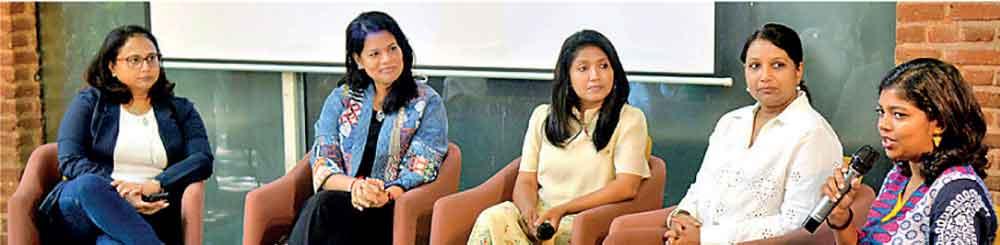
Panel discussion
Pic by Pradeep Pathirana
By Shannine Daniel
More women need to make use of Artificial Intelligence (AI) to address the existing gender gap in AI and STEM-related fields, ADA Regional Head for the South Asia, Sanjini Munaweera said.
Globally, women make up just 28 percent of the global STEM workforce and only 22 percent of AI professionals, the World Economic Forum (WEF) revealed early this year, highlighting that if left unaddressed, this deficit would restrict innovation and economic growth during the reskilling revolution.
The WEF called for fostering collaboration, cultivating mentorship and delivering tailored solutions to country-specific challenges to close the STEM gender gap.
“We need to embrace AI as we need it to be innovative and stay relevant,” Munaweera said at a recent panel discussion that was organised by Women in Tech Sri Lanka.
She encouraged more women in STEM related fields to educate themselves on AI, adding that AI was used by several companies to automate lower level tasks, including software engineering or software development. This left room for people to be more involved in higher level tasks that involved strategic thinking, she said.
As reported by the Daily Mirror earlier, the government was aiming to build a US$ 15 billion digital economy by 2030, for which AI would contribute 10-12 percent or roughly US$ 1.5 billion. The Ministry of Digital Economy would be spearheading this project, along with other public sector stakeholders.
“There are a lot of opportunities, that will be available, and the private sector needs to get involved, since the government cannot achieve this goal on its own. Everyone in STEM industries should contribute, regardless of gender,” Munaweera stressed.
Last year, the government allocated Rs one billion (US$ 3.3 million) to develop AI, with an emphasis on green energy and renewabletechnologies.
Moreover, the Education Ministry committed to incorporating Information Technology (IT) and AI into school curricula from last year onwards.
However, despite the government’s investments, the panel discussion highlighted that there was a large gap between the number of female undergraduates who receive an education in STEM fields, and those who ultimately get employed in these fields.
“Networking opportunities allow women to speak up and talk about why they get educated in STEM fields but do not want to pursue a career in these fields,” said Fortude’s Chief People Officer Oshana Dias. She also noted that Sri Lanka’s tech industry needed to provide more such opportunities outside of Colombo.
According to a study conducted by the University of Moratuwa in 2023, nearly 50 percent of the undergraduates who enrolled in STEM degree programmes were female students.
The global Women in Tech movement, headquartered in Paris, France, is a global community dedicated to fostering empowerment, diversity, and innovation within the technology sector, through networking events, mentorship programmes and skill-building initiatives.