Reply To:
Name - Reply Comment
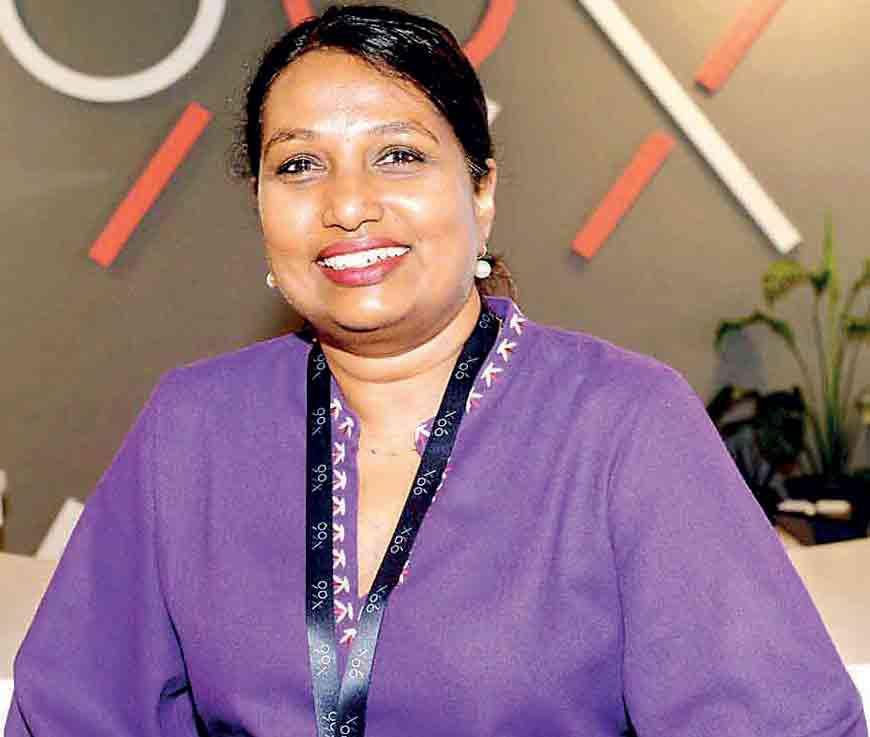
Shehani Seneviratne
PIC BY PRADEEP PATHIRANA
Sri Lanka Association for Software and Services Companies (SLASSCOM) Chairperson and 99X Technologies COO Shehani Seneviratne in an interview shares her vision for Sri Lanka’s tech industry, highlighting the importance of artificial intelligence (AI) adoption, continuous upskilling and strategic global expansion. She discusses how the country can position itself as a competitive technology hub, need for inclusive talent development and role of leadership in fostering a people-first, high-performance culture across the sector.
Following are the excerpts from the interview.
Q You take the helm of SLASSCOM at a time when Sri Lanka’s tech industry is navigating both rapid technological change and a challenging economic climate. What are your immediate priorities and how will you measure success?
The global tech landscape is evolving at an unprecedented pace. So, our priority is to ensure that Sri Lanka’s IT industry is well-prepared to face this changing environment. A major focus is on our talent pool, making sure that our workforce is not only future-ready but also AI-ready to meet the emerging demands.
 A few years ago, the industry’s key challenge was the supply of qualified talent. Today, thanks to numerous initiatives, we have a strong pool of graduates from across the country. The next step is to reskill and upskill them, so they can meet both the current industry needs and challenges of tomorrow.
The other priority is global business development. With talent in place, we need to attract high-value investments, encouraging more companies to establish centres here, while also supporting the existing companies and start-ups to scale globally. Start-ups, in particular, require guidance and support to reach international markets.
Beyond our traditional markets, we are also exploring the emerging and high-growth regions, looking for opportunities where Sri Lankan tech talent can make an impact.
Essentially, the goal is to align our skilled workforce with expanding business opportunities. By doing so, we aim to achieve SLASSCOM’s ambitious target: US $ 5 billion in industry value by 2030. It’s about creating a virtuous cycle, building talent, attracting investment and scaling businesses globally, so that the industry thrives sustainably in a rapidly changing world.
Q In terms of strategic shifts, policy, education and industry collaboration, what is essential for Sri Lanka to elevate its status as a serious global technology hub?
Consistent policy is critical. Frequent policy changes by the successive governments hurt the IT industry and other sectors. Sri Lanka needs a clear national vision supported by all governments, with strong leadership to execute policies and ensure roadmaps are implemented.
It’s not easy, coordination across stakeholders, departments, universities and international partners is required. Consistency and leadership will help leverage Sri Lanka’s high-quality talent, cultural fit with global markets and resilience. Despite the past calamities, our teams have been resilient and delivered high-quality products and services.
To become a global technology hub and attract investors, we also need a seamless environment for companies to setup and operate—something achievable in a day in other countries. Stable policy and a supportive ecosystem are key.
Q How is dialogue between the government and industrial stakeholders?
There is a good level of engagement. We see several committees—the Industry Advisory Committee, AI Committee, Startup Committee, where we are actively providing input and taking part in the implementation.
Q What kind of talent do you want at 99x?
We want well-rounded people who go the extra mile and are fully committed to delighting customers. This isn’t just for 99x; it’s what the industry needs. The employees can no longer be task executors. They need to be proactive, acting as tech consultants to clients.
With the global landscape becoming more competitive and some European customers focusing on insourcing talent, being proactive and going the extra mile is essential.
Q You mentioned upskilling. Is there a mismatch between what the programmes are offering and what the industry needs?
Yes, there is a gap, particularly when it comes to soft skills. Many graduates need to improve in areas like communication, working with international clients, confidence and proactivity. Upskilling in these professional areas is essential.
Upskilling on AI is also essential. People need to get comfortable using AI tools and technologies, if not, they risk falling behind. This requires creating awareness and providing hands-on training with AI platforms and tools so they can use them confidently. It’s not just about skills; it’s a mindset change.
When the developers embrace AI, they move beyond the mundane tasks and go up the value chain, focusing on strategic thinking, domain knowledge and areas that require human judgment and emotional intelligence. Ultimately, adopting AI is about reshaping how humans contribute, leveraging technology to become more productive, efficient and capable of higher-value work.
Q Can you expand on the upcoming AI initiatives?
99x has built a platform called Agentri AI, which is an agentic AI framework to orchestrate multiple AI agents toward complex business goals. Through customer projects across industries such as financial services, legal, insurance and transportation, 99x has been applying Agentri AI to deliver measurable outcomes.
Q How has 99x strengthened its positioning in the international software product engineering market, particularly in adapting to the post-pandemic delivery models and AI-driven demand?
We primarily work with the Scandinavian market and aim to be true technology partners for our customers, who are often very tech-savvy ISVs (independent software vendors). To add value, we need to stay ahead of the curve and ensure our engagement is genuinely beneficial to their business.
Around mid-last year, we fully embraced AI, encouraging everyone to use AI tools in development and coding.
We’ve also built our own AI platform Agentri. Both existing and new customers have found it highly beneficial and we’ve seen a significant boost in productivity as a result of integrating AI into our workflows.
Q With AI and emerging technologies reshaping the talent landscape, how should Sri Lankan tech companies prepare their people for global competitiveness and what role does continuous learning play in that transformation?
It’s largely about reskilling and upskilling the workforce. We have the SLASSCOM Academy and last year, 25 percent of our programmes were focused on AI, this number will only grow. We run awareness programmes to ensure companies and employees understand the importance of getting on this journey now.
Beyond awareness, we offer hands-on training, workshops and practical programmes to prepare talent. In November, we’re also hosting the annual AI Asia Summit with industry partners to facilitate knowledge sharing and bring the latest developments to the workforce. Continuous learning is essential; this is a rapidly evolving industry and you can’t afford to miss the bus.
Q QWhat is the importance of AI adoption for the developers?
If the developers don’t start using AI tools, they risk falling behind or even losing their jobs. AI is bringing both new opportunities and challenges to developers. They can achieve higher productivity by automating repetitive tasks. This gives them the ability to focus more on strategic problem-solving, architecture and design, more complex work and ship releases faster. Basically, the job market is shifting but not disappearing—new roles are being defined.
Q How should graduates entering the industry approach continuous learning?
Universities are now emphasising AI in their curricula but learning can’t stop after a degree. Today it’s AI; tomorrow, it could be something else. Graduates need a continuous learning mindset—engaging in self-learning, online courses, workshops and industry interactions—to stay effective and ahead of their peers.
Q As only the second woman to lead SLASSCOM, how would you assess the industry’s progress on gender diversity and what structural changes are still needed to ensure real inclusivity?
Currently, women make up about 34 percent of the tech industry. Over the past few years, several initiatives have aimed to increase this number. It’s crucial not only to encourage more women to enter STEM careers but also to support them to stay in the industry. At university level, the numbers are often 50-50 and sometimes women even outnumber men in the STEM programmes. Yet, many don’t enter the workforce and some drop out due to personal reasons. Our role is to create an environment and platform that allows them to continue and thrive.
One positive outcome from COVID was the rise of hybrid and part-time work models, which are particularly favourable to women, allowing them to balance work with other responsibilities. However, female leadership in tech remains low, dropping to around 10 percent at senior levels.
This year, my focus is on building more female tech leaders through niche programmes, mentorship and training, helping to cultivate the next generation of women leading IT companies.
Q Has there been any research on why women drop out, despite these initiatives?
Yes, there have been studies, including reports on female entrepreneurs and start-ups, which provide some insights. One key reason is perception—some women feel IT careers are too challenging or stressful and may opt for roles in QA, project management or other disciplines rather than engineering. I don’t agree with this mindset because we have many successful women in engineering and leadership roles, including at 99x.
Often, it’s about balancing personal priorities and work demands. Women need encouragement and a can-do attitude to pursue these careers confidently. Companies are also recognising the benefits of a gender-diverse workforce, such as better risk management and emotional intelligence within teams.
The goal is to provide equal opportunities, not positive discrimination and to actively promote women into leadership positions where they can thrive.
Q Diversity in tech often focuses on gender but where do you see untapped opportunities for inclusion, such as regional, socioeconomic or neurodiverse representation and how can these drive innovation?
Let’s start with regional diversity. In Sri Lanka, more than 50 percent of the IT workforce comes from outside the Western province and our initiatives are designed to reach the entire country, not just the capital region. We see graduates coming out of all 30 universities across the country, so the talent pool is widely distributed. With hybrid work models now in place, people can work from their hometowns, which makes it easier for them to participate and advance in the industry without relocating.
On gender diversity, SLASSCOM runs a Women Technopreneurs Forum to identify female entrepreneurs across regions and help them scale their businesses. When it comes to neurodiverse inclusion, some member companies are developing software that allows neurodiverse individuals to contribute effectively, for example in quality assurance roles.
Overall, the tech industry is becoming more inclusive, providing equal opportunities regardless of geography, gender or neurodiversity. By embracing this broader inclusion, companies not only create a fairer workforce but also drive innovation through diverse perspectives and approaches.
Q Coming down to your leadership, what principles guide your leadership at both SLASSCOM and 99X and how do you balance growth ambitions with fostering a people-first, high-performance culture?
When I first engaged with SLASSCOM about 15 years ago as a volunteer, I never imagined stepping into a leadership position. It was purely about passion, volunteering, working with people from other companies, learning from each other and giving back. That spirit of contribution continues to guide me: dedicating my time and energy for the betterment of the industry in any way I can.
At SLASSCOM, my aim is to move the needle each year toward our five-year plan: US $ 5 billion in industry value and 1,000 export-oriented start-ups by 2030. Some initiatives are ongoing from previous years, while others are new this year but the goal is always the same, progressively getting closer to that overall target.
At 99x, we have always embraced a people-first culture. In times of adversity or calamities, our focus has been on protecting the 99x family while continuing to deliver value to the customers.
It’s about teamwork, ensuring our people feel supported and simultaneously working to satisfy customers at the highest level. Balancing growth with care for people is central to both organisations.
Q What has been your personal experience in this journey?
The biggest challenge has always been balancing priorities, my children, family, work and industry responsibilities. 99x has been extremely supportive, starting with our founder Mano Sekaram, who is passionate about giving back to the industry. That culture of support has continued across the company.
From a family perspective, when my children were small, I had to make significant personal sacrifices and put my family first, including changing jobs at times. Now that they’re more independent, I can focus more on work.
I’ve learned that career planning requires timing; different phases of life demand focus on different areas.