Reply To:
Name - Reply Comment
Sri Lanka’s broader economic activities across manufacturing and services showed resilience during March, defying most of the impact from the ongoing Middle East conflict, which has sent the prices of fuel and other products soaring.
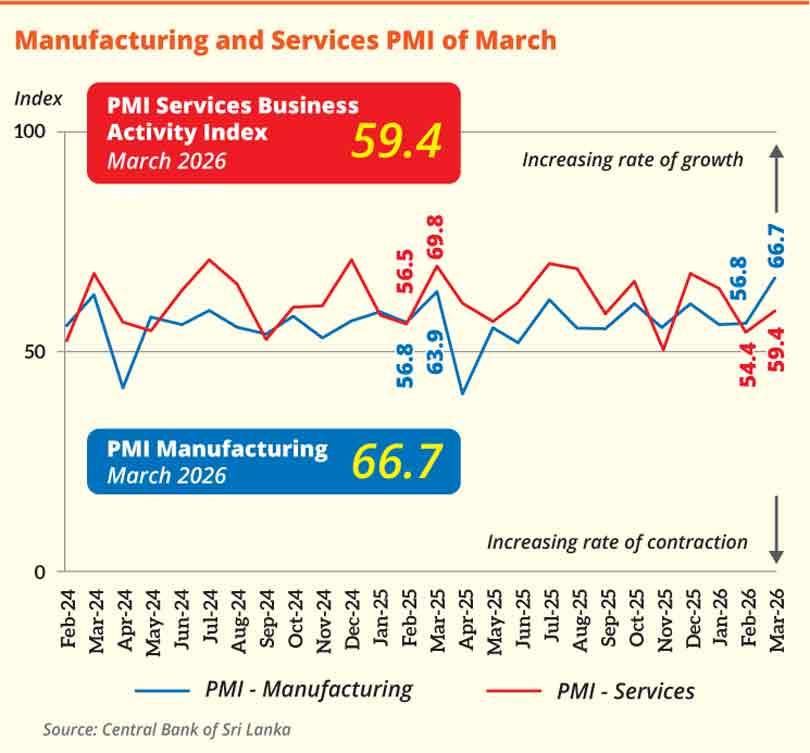
The Purchasing Managers’ Index (PMI), the closely watched leading economic indicator for manufacturing and services, showed index values of 66.7 and 59.4, respectively, in March. This compares to 56.8 and 54.4 in February, reflecting solid expansions in both sectors from a month ago.
Under the PMI, a reading above 50.0 indicates an expansion, while a reading below the neutral 50.0 threshold reflects a contraction.
The relative strength in the two indices came on the back of festive season demand ahead of the Sinhala and Tamil New Year celebrations in April.
In fact, the seasonal pop helped keep both activities firmly in positive territory. Businesses ramped up operations ahead of the New Year holidays, outweighing disruptions stemming from global geopolitical tensions.
However, many respondents in the manufacturing sector reported a tight production environment. This was mainly attributable to raw material and fuel shortages, rising costs, and logistical constraints.
The new orders and production sub-indices expanded in March, particularly within the food and beverage and wearing apparel manufacturing sectors.
Furthermore, the stock of purchases sub-index expanded in line with increasing production demand.
“Some firms reported precautionary stocking to safeguard their production pipelines against potential disruptions due to the ongoing Middle East conflict,” the Central Bank stated in its PMI release.
Meanwhile, the employment sub-index expanded, albeit at a slower pace in March, while suppliers’ delivery times continued to lengthen, particularly due to demand pressures and shipping-related disruptions.
On the services side, financial services remained the leading driver, made possible by increased lending activities.
In addition, wholesale and retail trade showed an expansion in activity due to festive demand, while professional and personal services also recorded notable growth.
New business expansion continued, driven mainly by the financial services sector, with significant growth in insurance and pension funding activities.
Employment in the sector continued to expand as firms hired additional staff to meet rising consumer demand ahead of the festive season.
Expectations for both manufacturing and services over the next three months stood above the neutral level, but respondents expressed caution regarding downside risks and uncertainties related to the Middle East conflict should it prolong.