Reply To:
Name - Reply Comment
BY Nishel Fernando
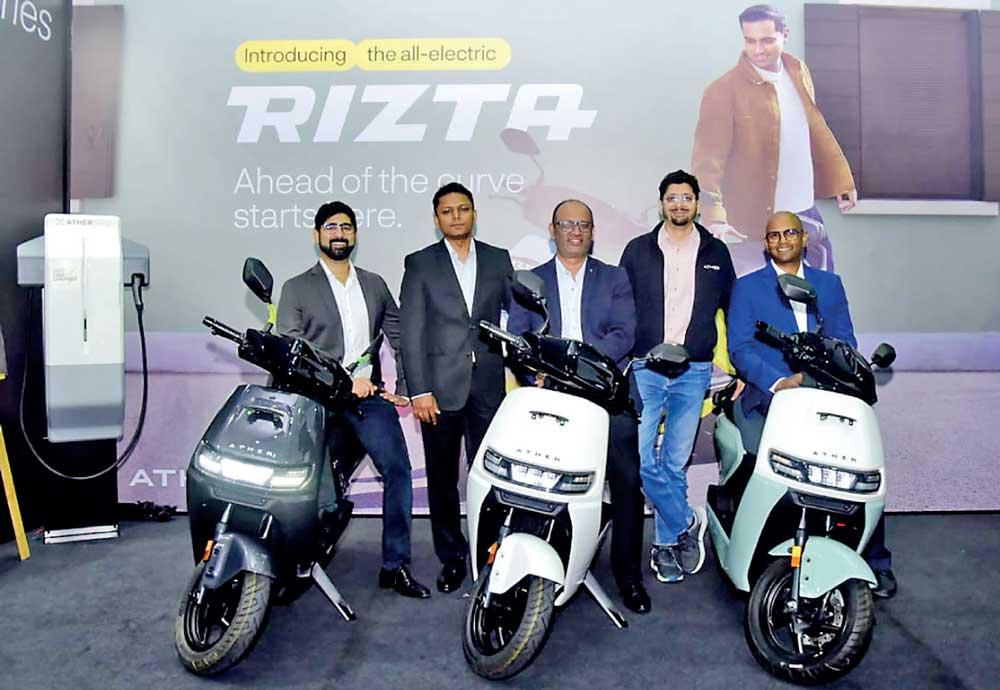
On a rainy evening in Colombo recently, amidst the hum of a busy capital adjusting to wet weather, a conversation about the future of mobility took centre stage. While the public unveiling of the brand’s latest offering took place amidst the automotive buzz of Colombo Motor Show 2025, the strategic roadmap was laid out at a media roundtable hosted by Ather Energy, India’s leading electric vehicle (EV) manufacturer and its local partner Evolution Auto.
The dialogue transcended mere sales figures, framing the entry of advanced EVs as a fundamental architectural shift in Sri Lanka’s mobility landscape—a pivot from fossil-fuel dependence toward a sustainable, tech-driven ecosystem.
As the island nation recovers from a tumultuous economic period that saw vehicle imports halted and fuel queues snake around city blocks, a quiet transformation is taking root. The two-wheeler market, the lifeline of Sri Lankan transport, is electrifying. However, for years, this shift was defined by low-speed, lead-acid battery-powered imports that offered little in terms of reliability or performance. Enter Ather Energy, a company founded by IIT Madras engineers, which is betting that the Sri Lankan consumer is ready to trade compromise for quality.
With a rapidly expanding charging grid, a new family-focused product line and a formidable research and development (R&D) engine, Ather is not just testing the waters; they are laying the foundation for a permanent ecosystem.
Engineering backbone: ‘Ather Stack’
To understand Ather’s strategy in Sri Lanka, one must first look at its origins in Bangalore. Founded in 2013 by Tarun Mehta and Swapnil Jain, the company spent its first five years in stealth mode—a rarity in the fast-moving start-up world.
“These were engineers who built a high-performance, connected, technologically advanced EV from scratch,” explained Ather Energy Head of Marketing Saurabh Sharma during the discussion.
Unlike many competitors who assemble vehicles using off-the-shelf components from third-party vendors, Ather took the hard road of vertical integration. It built its own chassis, designed its own battery management systems (BMS) and wrote its own software. This proprietary platform, known as ‘Ather Stack’, is a comprehensive ecosystem integrating the vehicle’s hardware, software and cloud intelligence. It encompasses everything from the dashboard’s Android-based operating system to the complex algorithms of the BMS. This tight integration enables unique capabilities like ‘Magic Twist’ for regenerative braking and ‘AutoHold’ for slopes—features that rely on seamless communication between the motor, battery and software that off-the-shelf components cannot replicate.
The results of this R&D-heavy approach—where nearly half the company’s workforce is dedicated to engineering and 10 to 12 percent of revenue is plowed back into innovation—are visible in the longevity of its products. Sharma highlighted a statistic that challenges the biggest scepticism around EVs: battery degradation.
“We are perhaps the only brand globally with over seven years of real-world consumer data on batteries,” Sharma noted.
“Across all terrains—cold, hot, rainy, humid—and all rider types, our data shows that even after seven years of usage, the average battery health remains at 80 percent.”
This data-backed confidence allows Ather to offer market-leading warranties, a critical factor in winning over value-conscious Sri Lankan buyers who fear expensive battery replacements.
Sri Lankan context: Quality over compromise
The entry of Ather into Sri Lanka—marking its second international expansion following Nepal—comes at a pivotal moment. The local automotive industry has weathered a storm and as the market stabilises, pent-up demand is colliding with a new reality.
“The automobile industry in Sri Lanka saw a tough time over the last couple of years,” admitted Sharma.
“But now we are seeing the ‘green shoots’ of recovery. However, the current EV landscape here is dominated by low-cost, low-speed vehicles using older technologies like lead-acid or graphene batteries. These vehicles struggle with basic gradability—they can’t climb a flyover or a parking ramp with two people. That is a limiting experience.”
Ather’s market research revealed a distinct characteristic of the Sri Lankan consumer: a preference for premium quality. Drawing parallels to the mobile phone and SUV markets, Sharma observed that Sri Lankans often own high-end devices and vehicles, prioritising durability and experience over the lowest possible price tag.
“We realised that fundamentally, Sri Lankan consumers are looking for an upgrade,” he said.
“They don’t want a downgrade from their petrol scooters. They want the same acceleration, the same top speed but with the benefits of electric.”
This insight drives their dual-product strategy. The company initially launched Ather 450, a performance-oriented scooter that captured the “thrill-seeking” segment. With a 0-40 km/h acceleration of 3.3 seconds and a top speed of 90 km/h, it outperformed most 125cc petrol scooters. However, priced above Rs.800,000, it remained a niche product for the top one percent of the market.
To crack the mass market, Ather recently introduced ‘Rizta’, a family scooter designed for comfort and convenience. Priced under Rs.700,000, Rizta targets the “heart” of the market—the segment priced typically between Rs.600,000 and Rs.800,000. It translates the brand’s high-tech lineage into a family-first utility vehicle, featuring a seven-inch touchscreen dashboard with Google Maps and the safety-critical ‘SkidControl’. Crucially for the mass market, it offers a segment-leading 34-liter under-seat storage and a spacious pillion seat, supported by a practical 123 km certified range.
Infrastructure: Solving range anxiety puzzle
Perhaps the most significant barrier to EV adoption is the fear of running out of charge. Ather’s approach to infrastructure is pragmatic and data-driven.
“You have to understand that 90 percent of charging happens at home,” Sharma explained.
“It’s a shift in mindset. In the petrol world, you go to a pump to refill. In the EV world, you wake up with a full tank every morning because you charge at home like your phone.”
Therefore, Ather’s public charging network is designed not for full charges but for “top-ups”. The company is deploying its fast-charging grid—the Ather Grid—at locations where people naturally pause, such as coffee shops, malls and shopping complexes.
“The idea is that while you grab a coffee for 10 or 15 minutes, your scooter gets a top-up of 15 to 20 kilometres,” said Sharma.
“That is enough to get you home or to your next destination.”
Zahran Ziyaudeen, Chief Operating Officer of Evolution Auto, Ather’s local partner, detailed the scale of the operation.
“We currently have 40 Experience Centres acting as dealer touchpoints across the island and we plan to increase this to 50,” he noted.
Parallel to the retail expansion is the growth of the charging grid. While currently anchored by 10 fast-charging points, the network is set to expand to 50 points across the island. The expansion will maintain a strong focus on the Western province—the country’s most populated region—while strategically covering key routes extending to Kalutara, Panadura and beyond.
The strategy follows a specific formula derived from their Indian operations: a ratio of one public charger for every 200 to 250 vehicles sold.
“Our ‘true north’ metric is to establish a grid density where every customer is within a four-kilometre radius—roughly a 10-minute ride—of a fast charger,” Sharma explained.
This density effectively kills range anxiety, turning the public charger from a necessity into a safety net.
Rigorous testing: Made for tropics
A key differentiator for Ather is its refusal to simply “dump” products into a new market. Before a single unit was sold in Sri Lanka, the company shipped test vehicles to the island for extensive validation.
“We did almost 6,000 kilometres of testing on Sri Lankan roads,” Ziyaudeen revealed.
“We tested in every condition—rain, heat, traffic—to ensure the product holds up.”
This local testing complements the torture tests conducted at Ather’s massive testing facility in Bangalore. The company puts its scooters through abuse tests, vibration tests and water wading tests to ensure the electronics—often the Achilles’ heel of EVs in tropical climates—remain sealed and functional. This is why features like the IP67-rated battery and water-resistant dashboard are not just marketing fluff but essential requirements for the monsoon-prone island.
Road ahead: 2030 and beyond
The partnership between Ather and Evolution Auto is setting ambitious targets. With an 18 percent market share already secured in the electric segment, the duo aims to sell between 1,000 and 1,500 units in the current fiscal year, ramping up to 5,000 units by March of next year.
“We expect a consolidation in the market,” Sharma predicted.
“The low-quality players will fade as consumers realise the value of battery longevity and after-sales service. We are investing heavily in service training and spare parts availability because we know that selling the scooter is just the start of a 10-year relationship with the customer.”
Looking further ahead, Sharma is bullish on the total transformation of the sector.
“By 2030, we expect the majority of the two-wheeler fleet in Sri Lanka to be electric. Once you experience features like reverse mode, onboard navigation and the silent torque of an electric motor, it is very difficult to go back to a petrol engine.”
As the rain cleared in Colombo, the signal emerging from the roundtable was distinct. The era of experimental, disposable electric scooters is ending. With deep R&D pockets, a strategic charging grid and products tailored for the local commute, Ather Energy is positioning itself not just as an option but as the inevitable future of Sri Lankan mobility.