Reply To:
Name - Reply Comment
Despite the recent policy interest rate hikes by the Central Bank having the potential to offset some of the external risks and higher domestic credit growth, higher rates will lead to higher domestic debt servicing cost,
which is already high, and will also dampen economic growth, according to Moody’s Investors Service. The rating agency pointed out that the scenario could be further exacerbated if the rupee was further depreciated as it would drive up the external debt financing cost, which makes up about 40 percent of the total government debt
“Interest expenditures accounted for 32.3 percent of government revenues in 2015, one of the highest among B-rated sovereigns. A rise in bond yields or depreciation of the rupee will worsen this ratio,” Moody’s said. The interest rate on one-year treasury bills was 8 percent in January 2016, up from less than 6 percent in December 2014.
“Sri Lanka ramped up its external debt burden to about 57 percent of gross domestic product (GDP) in 2015 from 49 percent in 2010, when credit conditions were more favourable and is now left with high repayments,” Moody’s pointed out.
The rupee has depreciated by 7.4 percent since the Central Bank reduced interventions and allowed greater exchange rate flexibility in September 2015. However, the 50-basis-point hike in February 19, 2016 could provide some relief to the currency due to lower imports and expected slowdown in foreign exists from the government securities.
But the pressure may mount on the currency as the seasonal imports are set to begin. Meanwhile, Moody’s observes a rise in short-term external borrowings by Sri Lanka during the recent years due to diminishing capital flows to emerging markets amid tightened global financing conditions. Sri Lanka’s short-term external debt has risen to over US $ 8 billion by end-3Q15 from just under US $ 7 billion a year ago. At the same time, the country’s external reserves have depleted to less than US $ 5.5 billion by end-January 2016 from US $ 6.5 billion a month ago.
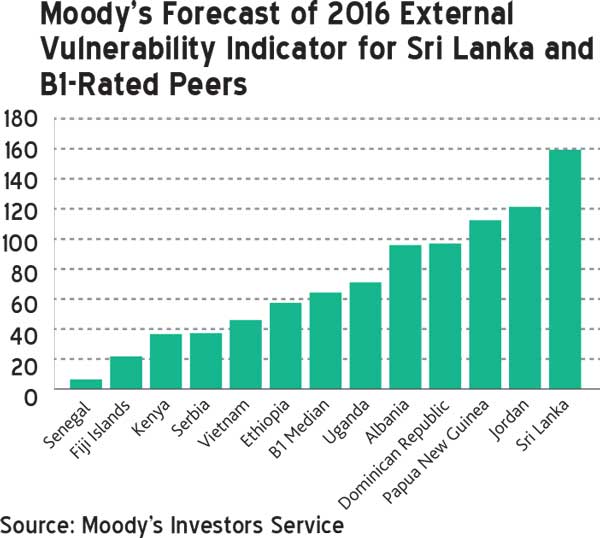
“Together with a rise in short-term debt, Sri Lanka’s external vulnerability indicator (which we calculate as [short-term external debt + currently maturing longterm external debt + total non-resident deposits over one year]/official foreign exchange reserves), has risen and is higher than B1-rated peers,” the global rating agency said.
However, Moody’s said the country’s immediate financing pressures could ease as a result of the financing support from the Asian Development Bank (ADB) and the forthcoming arrangement with the International Monetary Fund (IMF). Further, such financing will likely to be at more favourable terms than to market borrowing, which will alleviate the debt servicing cost pressures to some extent. Reflecting the recent comments by some of the local economists,
Moody’s is also of the view that an arrangement with the IMF will put the country’s fiscal house in order. “Although this will lower Sri Lanka’s high fiscal deficits and debt, it will likely require a widening of the small tax base and revisiting the government’s expenditure commitments,”
Moody’s said. As the rating agency further pointed out, such an agreement with the IMF would likely restore investor confidence in Sri Lanka’s policy framework and ultimately support more stable external inflows.