Reply To:
Name - Reply Comment
By Nishel Fernando
A coalition of Sri Lanka’s key transport and safety authorities yesterday issued a unified and urgent call for the implementation of mandatory comprehensive vehicle inspections, moving beyond the current emissions-only testing.
The push comes in response to a staggering daily loss of seven to eight lives and a further 10 individuals facing permanent disabilities, due to road accidents, inflicting a grievous social and economic toll on the nation.
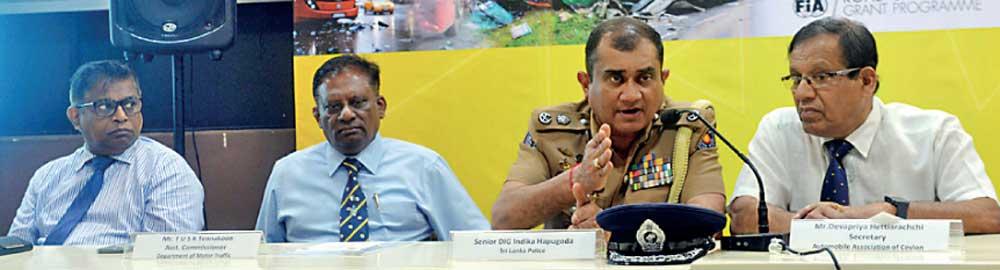
At a press conference organised by the Automobile Association of Ceylon (AA Ceylon) in Colombo this week, to launch a UN-funded road safety awareness programme themed ‘Vehicle Testing Can Save Lives’, the leaders from the Sri Lanka Police, Motor Traffic Department and National Hospital of Sri Lanka (NHSL) presented a grim picture of the country’s road safety crisis.
According to AA Ceylon, a mere 20 percent of vehicles in the country are currently subjected to a thorough vehicle test.
Deputy Inspector General of Police for Traffic and Road Safety DIG Indika Hapugoda revealed alarming statistics, stating, “In 2024, we lost 2,521 people in 2,411 fatal accidents. In the first six months of this year alone, 1,199 lives have been lost. This is a critical situation. We are losing close to 30,000 lives on our roads every decade, a figure that rivals the casualties of the 30-year war.”
He stressed that while driver negligence is a major factor, the mechanical condition of the vehicles plays a significant and preventable role.
“Unroadworthy vehicles cause accidents. If the tyres are worn, if the brakes are faulty, if the signal lights, headlights or wipers don’t work, accidents happen,” Hapugoda stated.
He announced a strict crackdown from July 1 on illegal and dangerous vehicle modifications such as extra metal fittings and excessively loud horns, which exacerbate the injuries.
“The ‘fitness certificate’ is often issued without any real inspection. This needs to be systematically addressed,” he added, pointing to a recent bus crash that claimed 23 lives, where a subsequent investigation revealed significant technical faults with the vehicle.
The economic repercussions of this crisis were starkly outlined by NHSL Assistant Director Indika Jagoda. Citing a World Bank report, he explained the immense, yet often overlooked, financial drain on the country.
“If we can reduce road accidents by 50 percent, we can increase our gross domestic product by 07 percent to 22 percent. It is a massive expense for our country’s economy,” Jagoda asserted.
He described the situation as a “silent epidemic”, far deadlier than the well-publicised diseases.
Jagoda also highlighted the severe strain on the healthcare system.
“At any given time, 25 to 30 of the 42 ICU beds at the NHSL’s Accident Service are occupied by road accident victims. This is money being spent on a preventable problem.”
He pointed to the failure to use the existing safety features such as seat belts for all passengers and proper child restraints, as a key area for improvement. He noted a critical gap in the system.
“After an accident repair, we don’t know if the airbags or other sensors are working. We need a way to certify that they are functioning correctly.”
Motor Traffic Department Assistant Commissioner T.U.S. Tennakoon drew a parallel between human health and vehicle maintenance.
“Why do we go for periodic medical check-ups? To live a long and healthy life. It is the exact same for a vehicle,” he said.
Tennakoon explained the critical importance of features like tyre tread, which is essential for grip and effective braking, especially in wet conditions.
“Today in our country, the only mandatory periodic check is the emissions test,” Tennakoon noted. “However, a vehicle must be inspected for both active safety, features that prevent an accident and passive safety, which minimises harm after a crash. We have proposed that there should be a mechanism to inspect all vehicles in the country. This will protect the vehicle, public property, other road users and the occupants.”
PIC BY PRADEEP PATHIRANA