Reply To:
Name - Reply Comment
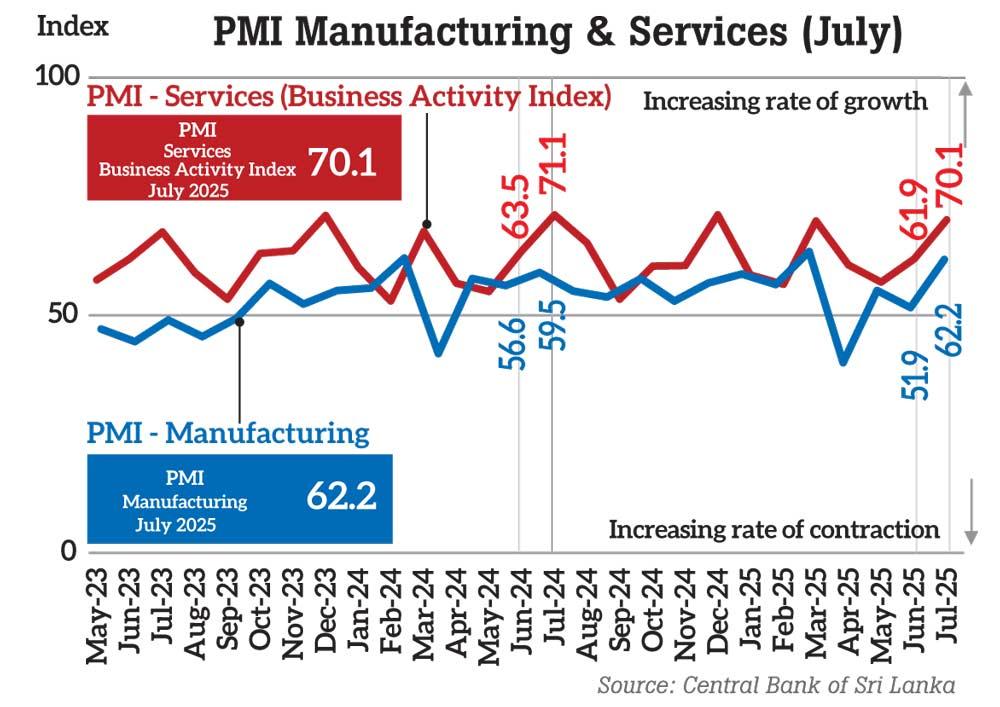
Sri Lanka’s manufacturing and services sectors expanded vigorously in July, defying uncertainties on the global trade front. The strong performance suggests the economy remains robust and is growing faster than previously expected.
The Purchasing Managers’ Index (PMI) for manufacturing recorded a value of 62.2 in July, a sharp increase from 51.9 in June. This reflects a sustained and rapid expansion in broader manufacturing activities.
Meanwhile, the services sector PMI rose to 70.1 in July, up from 61.9 in June, signalling significantly faster growth. (A PMI value above 50.0 indicates expansion, while a value below 50.0 reflects a contraction).
In both sectors, all sub-indices were positive. Notably, the manufacturing sector’s employment sub-index moved into expansion territory after contracting the previous month, reflecting renewed hiring to cater to growing demand.
Furthermore, the new orders and production sub-indices grew at a faster pace, supported by heightened activity in the food and beverage and textiles and apparel sectors.
This growth occurred despite fears within the textile industry that US tariffs on Sri Lankan imports would render the country uncompetitive. However, the data indicates that demand was not dented, with production continuing at a robust pace.
July’s services activity was propelled by significant growth in wholesale and retail trade. The financial services sector also continued to expand, driven by accelerated bank lending supported by lower interest rates.
These strong monthly PMI figures provide a useful leading indicator of the economy’s potential performance for the full year. Just last week, Central Bank Governor Dr. Nandalal Weerasinghe stated that Sri Lanka could achieve GDP growth of 4 percent to 5 percent for 2025, well above the International Monetary Fund’s (IMF) baseline projection of 3 percent.
Respondents from both sectors expressed optimism for the next three months, buoyed by favourable macroeconomic conditions. However, manufacturers remained cautious due to ongoing global trade uncertainties.